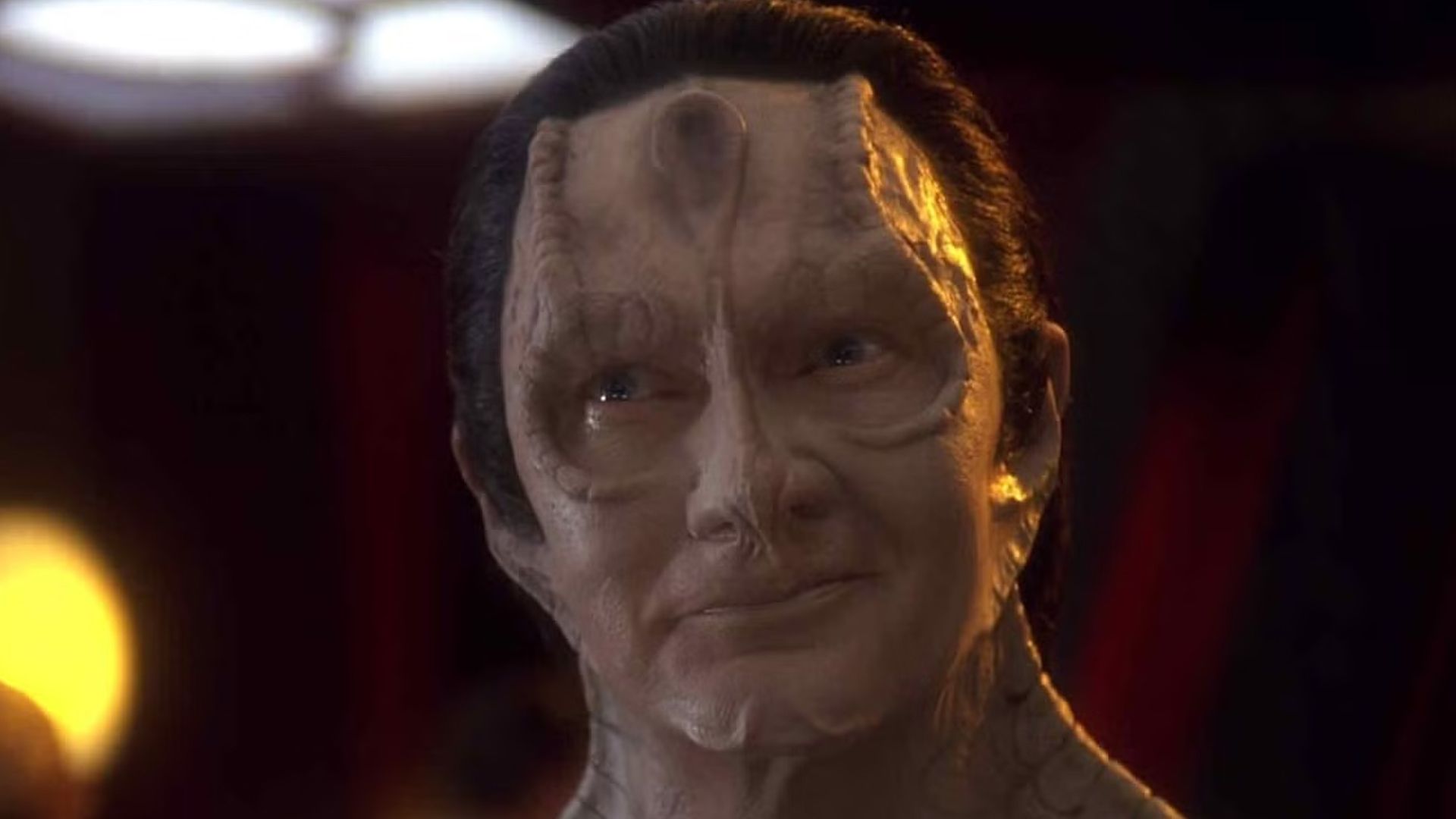
Star Trek: Deep Space Nine's "In the Pale Moonlight" (Season 6, Episode 19) is one of those Star Trek episodes that leaves a lasting impression on both die-hard fans and casual viewers alike. In an objective ranking of every Star Trek television series, ranked from best to worst, Deep Space Nine consistently lands near the top of the charts.
As for popularity, several reasons explain why this show is more universally acclaimed than others. First, the crew of Deep Space Nine and, later, the USS Defiant feature some of the franchise's most complex characters. Second, the '90s program moves away from episodic plots and introduces a more serialized form of storytelling. Lastly, the show is more mature than its predecessors, and this episode exemplifies that.
"In the Pale Moonlight" Ignores Star Trek's Core Themes
"In the Pale Moonlight" revolves around the Starfleet commander of Deep Space Nine, Captain Benjamin Sisko (Avery Brooks), who struggles to maintain the upper hand in Star Trek's Dominion War. After a series of losses against the Dominion and its ally, the Cardassian Union, Sisko tries to recruit the Romulans to join the Federation with help from Elim Garak (Andrew Robinson).
Garak, a former Cardassian spy, convinces Sisko to trick the Romulans into declaring war on the Dominion through morally unethical means. By the end of the episode, the Romulans do side with the Federation, but not without an intangible price. Star Trek is known for embodying and exploring some of the most rigorous ideals in major franchise history.
This is reflected in shows like Starfleet Academy and the organization as a whole (though the space station is property of the Bajoran Republic). Starfleet's motto, "Ex astris, scientia,"translates to "From the stars, knowledge," and exemplifies the importance placed on research and exploration.
Starfleet graduates are expected to discover as much as they can in the name of science, but also in the name of diplomacy. When one makes contact with other planets and species, there are clear expectations of friendliness, hospitality, and genuine helpfulness. When conflicts arise, members of Starfleet and the greater Federation are meant to face challenges logically, not emotionally.
"In the Pale Moonlight" remains a groundbreaking Star Trek episode because of how egregiously Sisko goes against the number one rule of Starfleet, something that Captain Jean-Luc Picard (Patrick Stewart) summarizes perfectly in Star Trek: The Next Generation: "The first duty of every Starfleet officer is to the truth, whether it's scientific truth, or historical truth, or personal truth."
Despite the difficulties and sometimes negative consequences of honesty, scientific exploration and discovery cannot be sustained with lies, half-truths, or bad-faith actions. Despite his initial apprehension, Sisko plainly remarks that he can live with the immoral decisions he made to encourage the Romulans to join the conflict, looking straight into the camera to drive the point home.
As "In the Pale Moonlight" progresses, it becomes clear to Star Trek fans that anyone can succumb to corruption and greed, even if they claim to serve the greater good. To this day, Sisko remains a popular character, with many praising the captain's courage, bravery, pragmatism, and resourcefulness.
Sisko's positive attributes wouldn't exist without complexities, such as trauma resulting from his wife's death. In this episode of Deep Space Nine, Sisko's initial apprehension about recruiting the Romulans quickly shifts as the Dominion grows stronger. In the end, when circumstances align just right, everyone is prone to falling for temptation, even a high-ranking officer.
The Dominion War Introduces a Dark Side to Star Trek
"In the Pale Moonlight" is a tense Star Trek episode and a clear example of how dark Deep Space Nineis compared to the rest of the franchise. The Dominion War takes place largely in the last few seasons, although it brews for most of the show.
In the end, it becomes an all-out survival of the fittest between those in the Alpha Quadrant (the Federation, the Romulans, the Klingon Empire, the Bajoran Republic, etc.) and those in the Gamma Quadrant (the Dominion, the Cardassian Union, and the Breen Confederacy). In a nutshell, the conflict stems from the Dominion's quest for control as it attempts to infiltrate and conquer the Alpha Quadrant.
As the Dominion War emerges in the early seasons of Deep Space Nine, Sisko and his crew remain level-headed and collected through initial contact and negotiations. As relations sour and the Dominion continues to try to exert control over the Alpha Quadrant, however, individual and collective morals present on the space station begin to fly out the window, a development that is a shock for Star Trek fans.
Sisko's acceptance of bribery, lying, and eventually murder in "In the Pale Moonlight" is one example. Another glaring example is Section 31's creation and release of a virus intended to harm the Changelings and bring down the Dominion. Deep Space Nine slowly establishes and expands on the consequences of war and conflict, especially on such a large scale,throughout the series.
On a rewatch of the first few seasons, the gradual buildup becomes much more apparent. In "In the Pale Moonlight," Sisko becomes a character who singlehandedly represents the psychological impacts of war: paranoia, distrust, and the willingness to sacrifice other people, morals, or ideals to gain an advantage.
With the episode exploring Sisko's decisions as a flashback, since the character notes a personal log entry that he deletes at the last second, the Star Trek episode is a shining example of how war impacts the psyche. In general, the Dominion War marks the first time that the franchise pivots away from more optimistic, lighthearted material, instead focusing on conflict and drama on an unforeseen level.
Before DS9, most episodes had their fair share of problems to solve, especially around time travel. Although many characters squabble, they always manage to come together and restore a (temporary) peace to the Federation through friendly teamwork. By building up a war involving so many players, over multiple seasons, Deep Space Nine solidifies itself as a series to be taken seriously.
Deep Space Nine's Influence on Modern Star Trek Still Stands
While Deep Space Nine aired in the '90s, critics and Star Trek fans reacted in various ways. Some praised its deviation from the series that came before it, while others thought the show was too different; some even complained that it didn't include a voiceover, a standard up until then.
As time has passed and the franchise has expanded, the series is now viewed much more positively. Currently, the series holds an 8.1/10 rating on IMDb and a 91% on Rotten Tomatoes. More than three decades later, the show's impact grows even more evident. It wasn't until Deep Space Nine and the Dominion War that serialized storylines entered the Star Trek franchise seriously and intentionally.
Before then, most episodes had their own plots that resolved by the end, though a couple of early two-part episodes did exist. The series made after the crew of Deep Space Nine said their final farewell in the late '90s have seen their fair share of long storylines, largelydue to the Dominion War's success.
Star Trek: Picard, for example, features a different all-encompassing conflict for each of its three seasons. Between Sisko, Captain Kirk, and Captain Picard alone, the Star Trek franchise features plenty of well-developed characters; the three commanders are just a few examples of characters who fit neatlyinto the rapidly expanding box.
Deep Space Nine features some of the most interesting and complex characterssci-fi has ever seen, including Sisko, Garak, and Dukat (Marc Alaimo). Modern Star Trekcharacters who resonate as brightly and intriguingly as the ones who came before them include Captain Christopher Pike (Anson Mount) from Star Trek: Strange New Worlds, and Brad Boimer (Jack Quaid) from Star Trek: Lower Decks.
Theseshows have referenced Deep Space Nine several times, showing its direct influence. Several characters crossover into an episode of Lower Decks, for instance ("Hear All, Trust Nothing", Season 3, Episode 6). Quark and Trill, in particular, are mentioned in several other series.
Star Trek: Voyager, as another prime example, also features the Maquis, a group first introduced in DS9. While "In the Pale Moonlight" is a classic episode, the television series it's a part of is a sight to behold overall.