Recent technology outages have renewed anxiety about how fragile digital systems can be. CNN’s guide to apocalyptic books, films, music, food, fashion and travel offers ways to sit with that unease — and, perhaps, enjoy it.
The recent run of failures included a Microsoft outage, a nationwide ground stop — only the second since 9/11 — and outages at United Airlines, several banks, Microsoft again and the NSA. As CNN colleague David Goldman put it, “The internet is held together with shoestring and bubblegum.” The sequence has led some people to wonder whether this is the end of the world as we know it.
Apocalypse stories can feel comforting as well as frightening. From flood narratives in religious traditions to films such as “Independence Day” and “Terminator 2: Judgment Day,” tales of civilizational collapse have long imagined a world remade. The article’s starting point is David Bowie’s “As The World Falls Down,” his 1986 ballad from “Labyrinth.”
Among the classic works are the original “Planet of the Apes,” set in a far-future world where human society has collapsed, and H.G. Wells’ “The War of the Worlds,” a serialized novel about an alien invasion. When Orson Welles broadcast the story on radio, some listeners believed the invasion was real and panicked.
Cormac McCarthy’s 2006 novel “The Road,” which won the Pulitzer for fiction, follows a father and son surviving an extinction-level event; it was adapted into a 2009 film starring Viggo Mortensen and Charlize Theron. Octavia Butler’s 1993 novel “The Parable of the Sower” imagines a post-apocalyptic United States in 2024 and explores climate change and social inequality.
Don DeLillo’s 2020 novel “The Silence” considers what might happen if electronic systems failed. His earlier works include industrial accidents in “White Noise” and nuclear proliferation in “Underworld.” Ling Ma’s “Severance,” published two years before the Covid-19 pandemic triggered a global shutdown, depicts modern society collapsing after a mysterious airborne disease spreads.
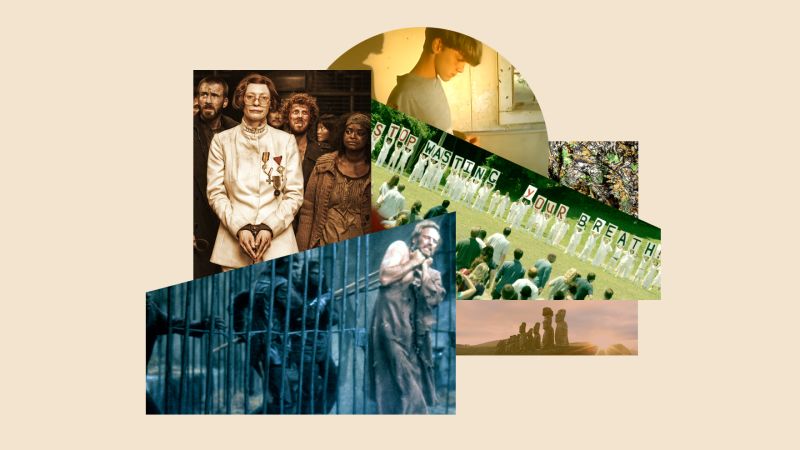
Climate disaster features in other visions of societal breakdown. Bong Joon Ho’s 2013 English-language debut, “Snowpiercer,” traps survivors — including Chris Evans — on a claustrophobic, seemingly endless train and examines social inequalities worsened by climate collapse. This year’s “Digger” portrays earthly destruction linked to greedy capitalists and climate disaster, while Latvia’s Oscar-winning animated film “Flow” offers a dialogue-free post-apocalyptic story.
For television, the article recommends “The Leftovers,” which premiered in 2014 and ran for three seasons, starring Carrie Coon and Justin Theroux. Based on Tom Perotta’s 2011 novel, it asks what might happen if 2% of the world’s population vanished. Rather than depicting a blood-and-doom apocalypse, the series explores a radically altered society where new religions and traditions emerge after parents, friends and lovers disappear. “Station 11” and “The Last of Us” are also cited as popular apocalypse series. All three shows stream on HBO Max, which is owned by CNN’s parent company.
National Geographic’s “Doomsday Preppers,” a reality series that ran from 2012 to 2014, profiles survivalists preparing for disaster. For a soundtrack, the suggestions include Bowie, the ‘90s songs “Fade Into You” by Mazzy Star and “Pitseleh” by Elliott Smith from “Yellowjackets,” as well as Weyes Blood’s “And in the Darkness, Hearts Aglow” and R.E.M’s “It’s the End of the World as We Know It (And I Feel Fine).” The article also suggests that the distorted music of Grimes, Sophie and Slayyyter could suit a future after familiar systems collapse.
As for food, “Snowpiercer”’s survivors eat rectangular protein bars made from cockroaches. The article points instead to Twinkies and “David” protein bars, while noting predictions that insect protein, including grasshopper flour, will become more popular in coming decades.
Fashion has also taken inspiration from imagined futures. In 2010, Alexander McQueen said a collection was inspired by his vision of the end of the world and a return to the sea. “Humankind is made up of creatures that evolved from the sea, and we may be heading back to an underwater future as the ice cap dissolves,” the British designer said in a press release. The collection included reptilian patterns on micro dresses and fabrics resembling aquatic mammals’ skin. More recently, the spread of RealTree camo patterns this year has been framed as an omen of apocalyptic anxiety.
For a remote refuge, the article points to the luxe bunkers billionaires have built or pursued. Mark Zuckerberg’s is allegedly beneath his ranch on Kauai, the Hawaiian island; Peter Thiel tried but failed to build one in New Zealand. It also considers Easter Island, or Rapa Nui, the remote Chilean territory where Martin McDonagh’s newest film, “Wild Horse Nine,” is set. The movie is not an apocalypse story, though it deals with beginnings and endings, and portrays the pleasures and struggles of being far from the rest of the world.
Experts cited in the article say the current cascade of technology failures reflects old, failing systems, not a coordinated breakdown. If the grid does fail, the article concludes, there will at least be plenty of apocalyptic stories to turn to.