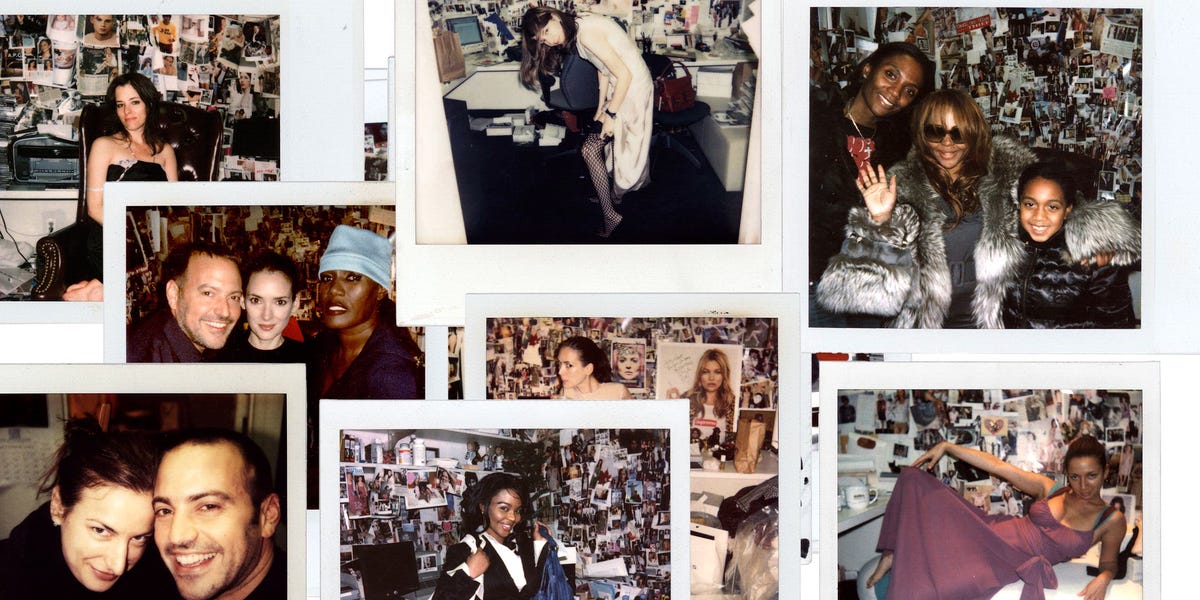
A new book, 163 Mercer, revisits the Marc Jacobs store’s SoHo basement, where retail executive Robert Rich photographed fashion figures and friends during the early 2000s. Published by IDEA and named for the store’s address, it brings together Polaroids and stories from a period before digital cameras and social media reshaped the scene.
Rich welcomed visitors including Kate Moss, Selma Blair, Sofia Coppola, Maya Rudolph, Natasha Lyonne, Parker Posey and Winona Ryder to his basement office in the brand’s downtown flagship. He documented fittings and conversations with a Polaroid camera.
The project grew out of Rich’s first book, Winona, made with Francesca Sorrenti and published in 2023 after he saw Winona Ryder’s likeness on merchandise in IDEA’s Instagram feed. “I reached out and asked if they wanted to do a Winona Polaroid book, and they immediately replied, 'Yes!'” he recalled over Zoom. The book sold out on its first day, with a second printing the following year.
For 163 Mercer, Rich partnered with Zoe Cassavetes, a director, screenwriter and actress who had been sales director at the nearby Mercer Hotel in the ’90s. She met Rich after Marc Jacobs and Marc Jacobs International president Robert Duffy sent her to the store to choose a thank-you gift for her professional hospitality at the hotel, where Jacobs often stayed.
The two, who still speak by phone every day, considered several ways to use Rich’s photographs, including wallpaper based on his office collage and a podcast devoted to one of the women per episode. Cassavetes’s film background, including her 2007 directorial debut, Broken English, helped shape the decision to make a book. IDEA agreed to the project.
They arranged the images at Cassavetes’s Los Angeles apartment, spreading them across her oversized office table. “It's a lot like writing a script, which is why I say I ‘directed’ the book; putting together the layout was like making a movie,” she said. Rich sometimes asked her to add an edited image. “We have similar tastes, and we were open to each other's opinions. He has a cool eye,” she added.
Cassavetes and Rich became friends while working down the street from each other. “My title at the Mercer was director of sales, but I was really a VIP manager. I had a basement office, too,” she recalled. Before New York’s indoor smoking ban in 2003, they took cigarette breaks inside. “The logistics helped our friendship, hanging out in each other's offices smoking and having tea.”
The book includes Polaroids of regular visitors as well as people who came only once or twice. The women shared memories for the project, but the images are not all captioned. “We didn't caption every Polaroid; they weren't like social media posts,” Rich said.
Rich began assembling an office mood board with tear sheets and magazine covers featuring women in Marc Jacobs, then added fitting-room Polaroids, newspaper clippings and other memorabilia. He compared it with his childhood bedroom, which was covered in Charlie's Angels photos. Cassavetes said the wall’s appeal came from its private, esoteric quality: “The wall wasn't for a million people to admire. We had privacy. We had fun because we had more freedom.”
Rich already knew Moss, while Cassavetes knew Sofia Coppola and Ryder. Rich met the other visitors through work. Ryder came into the store on her own, and Rich told her he loved Girl, Interrupted. “’That's a girl's movie,’ she said, and I said, ‘I'm a girl's movie guy,’” he recalled. After Ryder’s 2001 shoplifting case, she starred in the brand’s spring 2003 campaign, appeared on its “Protect the Skin You're In” T-shirts and wore Marc Jacobs to court.
“Selma didn't know the others,” Rich said. “We hit it off when she tried on the Courrèges–inspired collection. I took Polaroids, sent some to Marc, and kept others. She kept coming in. I introduced her to Kate, Missy, and Frankie Rayder, all of them.”
Cassavetes described the social atmosphere as different from today’s brand-celebrity relationships. “It was unpretentious; no one was there to get paid. We were hanging out and having fun. That was the Marc Jacobs spirit: more artsy, less corporate. It was a perfect zeitgeist moment,” she said.
Rich also recalled dressing Hilary Swank before her Oscar win for Boys Don't Cry. “She would come to the store, and I would dress her up for all the pre-Oscar award shows and events. I put her in a tiered ruffle sundress with a beachy vibe for the Independent Spirit Award in 2000,” he said.
The office hosted spontaneous get-togethers, including one with Moss, Ryder and Patric Reeves. “I stocked my fridge with Sofia champagne cans. They were small but potent,” Rich said. A photograph of the gathering appears in the book. Polaroids became less popular after the brand declared bankruptcy and digital cameras and camera phones arrived, but Rich continued using his stockpile until 2015.
“Sometimes I wouldn't even recognize Winona because she had a new role, hair color, or style,” Rich said. “But I met all the boyfriends, watched them get married, pregnant, have babies, and divorce.”
Rich said Marc Jacobs’s clothes made it easy to attract the women he called “It girls.” “Marc's clothes were unbelievable; you didn't have to beg them,” he said, adding that the store’s friendly atmosphere also helped. He was a fan of Jacobs, he said, and that enthusiasm spread to staff he hired, including bartenders who “knew how to talk to people.” Employees received a clothing allowance and four outfits a season rather than uniforms.
Cassavetes recalled that Rich made sure the women did not wear the same outfit. Rich said Jacobs welcomed different ways of wearing his designs: “Marc liked everybody's take on his clothes. Winona would change the buttons or redo straps; he loved it.”
Costume designer June Ambrose wrote in an email that she remembered finding hidden treasures in the basement. “Robert has an incredible eye and instinctively knew what I needed; I could trust him. He understood the woman, the attitude, and the personality behind the clothes,” she wrote. “He made me fall in love with Marc Jacobs.” Rich also gave editor and stylist friends early access to sample sales.
Rich’s career with Marc Jacobs began after Joe Zee took him to his first runway show for the brand. “I was blown away and marched backstage and asked Marc for a job,” he said. He became store manager in 1999 and later rose to vice president of public relations for retail stores.
Before 163 Mercer became the Marc Jacobs store in 1997, the address housed the Tony Shafrazi Gallery, which propelled the careers of Francis Bacon, David LaChapelle and Keith Haring. Rich had worked for Haring. “There was nothing in SoHo; Marc could have picked any space. There was good energy there. Tony would stop in and regret having given the space up,” Rich said, adding that Jacobs helped establish SoHo’s current designer shopping enclave.
“The store was so laid back and a fun, creative safe space. It was also the center of the downtown fashion world at that time,” Cassavetes said.
Rich suggested a possible third book would look beyond SoHo. “We wouldn't just be in the office. Maybe it would be pictures from everywhere.”