Adaptive Fractional Super-Twisting Controller Enhances Automotive Anti-Lock Braking Performance
By Google News Motors ·
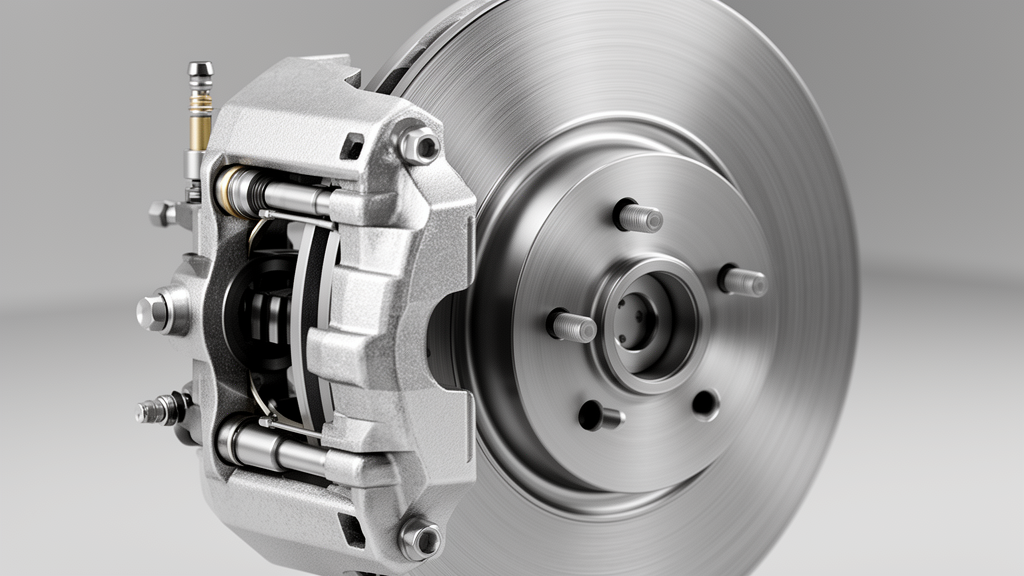
A research team comprising Emery Baroki Munphano, Alain Kammogne Soup Tewa, and Blampain Eloi Jean Jacques has introduced an advanced control strategy for automotive anti-lock braking systems, combining fractional-order calculus with a super-twisting sliding mode algorithm.
Detailed in a study published in the journal Discover Vehicles, the investigation focuses on resolving the persistent trade-off between rapid wheel slip regulation and harmful control chattering during severe braking maneuvers.
By establishing an adaptive fractional-order architecture, the authors demonstrate through extensive numerical simulations that their proposed controller significantly shortens stopping distances, maintains closed-loop stability, and effectively damps high-frequency oscillations across diverse road surfaces ranging from dry asphalt to packed snow and smooth ice.Anti-lock braking systems represent a vital active
safety technology designed to prevent complete wheel lock-up during hard deceleration, thereby preserving vehicle steerability and directional stability.
The core functional objective of an anti-lock braking system is to maintain the wheel slip ratio, defined as the normalized relative difference between the vehicle's forward linear velocity and the rotational speed of the wheel, within a narrow optimal band typically situated between 10% and 20%. Operating within this targeted range maximizes the longitudinal friction coefficient generated at the tire-road interface.
However, maintaining this slip ratio presents substantial control engineering challenges because the underlying tire-road friction dynamics are highly nonlinear, time-varying, and subject to dramatic external disturbances and sudden transitions between different surface adhesion levels.Conventional control approaches historically deployed in automotive braking, including classical proportional-integral-derivative
architectures and bang-bang regulators, frequently exhibit performance degradation or instability when confronted with abrupt variations in road grip and vehicle loading.
While standard sliding mode control has emerged as a robust alternative capable of handling matched parametric uncertainties, it inherently suffers from chattering. This phenomenon involves high-frequency switching oscillations that excite unmodeled mechanical dynamics, cause severe premature wear on braking actuators, and reduce passenger ride comfort.
Although higher-order sliding mode algorithms such as the super-twisting method act on the sliding variable's time derivatives to smooth out control signals, conventional formulations rely on integer-order vehicle models that struggle to capture non-local memory effects and complex viscoelastic behaviors inherent to tire deformation.To overcome these limitations, the authors integrated fractional-order calculus into
both the vehicle dynamic formulation and the sliding mode control law, adopting the Caputo fractional derivative definition.
The mathematical formulation utilizes non-integer differentiation orders bounded strictly between zero and one.
The choice of the Caputo definition is specifically motivated by fundamental physical considerations: unlike the Riemann-Liouville alternative, the Caputo operator requires initial conditions expressed through standard integer-order derivatives, such as initial vehicle longitudinal speed and wheel angular velocity, which are directly measurable by conventional onboard automotive sensors. Furthermore…
Originally published by Google News Motors