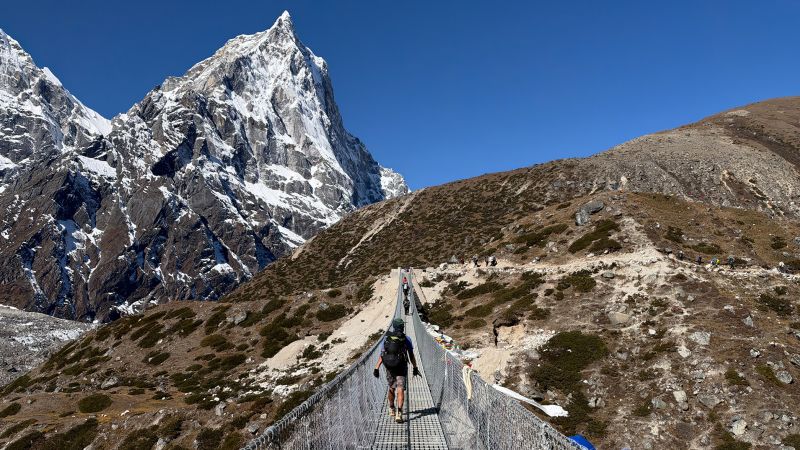
Nepal’s tourism industry avoided the sharp downturn officials feared after August’s deadly flood, with October figures showing a small rise in foreign visitors compared with the same month last year. Arrivals from the United States surged 31%, offsetting a fall in visitors from India.
The flood, triggered by the partial collapse of a glacier on Langtang Lirung near Nepal’s northern border, killed more than 1,500 people. Another 5,000 were presumed dead but officially remained missing in Nepal and across the border in China’s Tibet region.
Officials worried the disaster would deter travelers from visiting a country where tourism supports many communities and brings in foreign currency needed for trade. “We thought: Oh my god! This September and October we will not have a good season,” said Mani Lamichhanne, senior director at Nepal’s tourism board.
The board urged Western visitors not to cancel their trips. The message circulated on social media from mountain guides and Nepalis abroad was that visiting and spending money was the best way to help Nepal.
Lamichhanne said Nepal was on track to record its highest number of tourists in 2026. At Kathmandu airport in early October, guides and trekking-company staff waited for arrivals, though one guide described the season as quieter than expected. In Thamel, a busy downtown neighborhood, sellers of imitation hiking gear appeared less concerned.
In Langtang village, roughly 11 miles from where the glacier gave way, the settlement was spared because it lies on the other side of the mountain. The village sits beneath 7,234-meter (23,733-foot) Langtang Lirung, and depends partly on foreign hikers using the Langtang Valley Trail. The route was closed for two months after the flood.
Pasang Tamang, owner of the Sunrise Guest House, said residents had worried that supplies would be cut off and their income lost. His guest house can accommodate up to 30 people, but was still far below capacity. “Last year it was house full, but now maybe five, 10, maximum 15 (a night),” he said. Most visitors were Nepalis rather than foreigners.
Tamang said he was surprised people were returning, but called their visits “a little rescue” for his finances. The village, at 3,430 meters (11,253 feet), has faced disaster before: a glacial avalanche triggered by Nepal’s 7.8-magnitude earthquake in 2015 buried Langtang, killing hundreds and forcing survivors to rebuild nearby.
Residents have close ties to communities swept away by the torrent of water, ice and silt that tore down the Bhote Koshi and Trishuli rivers. “We knew them very well, but what to do?” Tamang said. “It’s life here.” Some of his friends who survived are still searching for missing relatives. “They’re just hoping they might find their bodies.”
The picture was different in the Everest region. Flights continued to bring hikers to Lukla, a gateway town, and Café Himalaya in Dingboche was as busy as in other years, its owner Tsering Palzaur Sherpa said. Official figures showed no real change in visitor numbers at Sagarmatha National Park this season.
Palzaur said locals had expected more tourists, thinking foreign visitors might be diverted there because the Annapurna Circuit, Manaslu Circuit and Langtang Valley trails to the west were closed for months. But the Khumbu Valley also faces glacial hazards. “Every single day we live in fear that something bad might happen,” he said.
The lake at Imja Glacier, near Island Peak and six miles from Dingboche, threatens the town and other Khumbu communities. “It’ll only take maybe five minutes for the whole village to get washed away,” Palzaur said. He and others in town plan to run to higher ground when warning sirens sound.
Archana Shrestha, director-general of Nepal’s meteorological department, which maintains the sirens, said they were being repaired one by one after concerns were raised earlier this year that some were not working properly. A drainage canal built at Imja a decade ago lowered the lake by 3.4 meters (11.1 feet), but officials told CNN the area cannot be considered entirely safe because disasters involve many factors.
Four other glacial lakes, including three in the Everest region, have been identified as posing the highest risk. A $50 million project with the United Nations is set aside to monitor and lower water levels at Thulagi, Hongu 2, Lower Barun and Lumding Tsho.
Shrestha said warming temperatures were rapidly changing Nepal’s fragile mountains as glacial lakes filled. “The small lakes are bursting now too… and these ice falls are a new kind of thing,” she said. “It’s all happening so fast.”
Nepal has 21 lakes that could pose a threat, but cannot afford to monitor and drain them all. The country is seeking scientific ideas to better understand changes in its mountains. Local media reported in October that the government was planning law changes to allow some settlements in disaster-prone areas to be relocated.
Lamichhanne said many high-Himalaya visitors are adventure seekers prepared to accept some risk. “So they are likely prepared to face some kind of risk.”