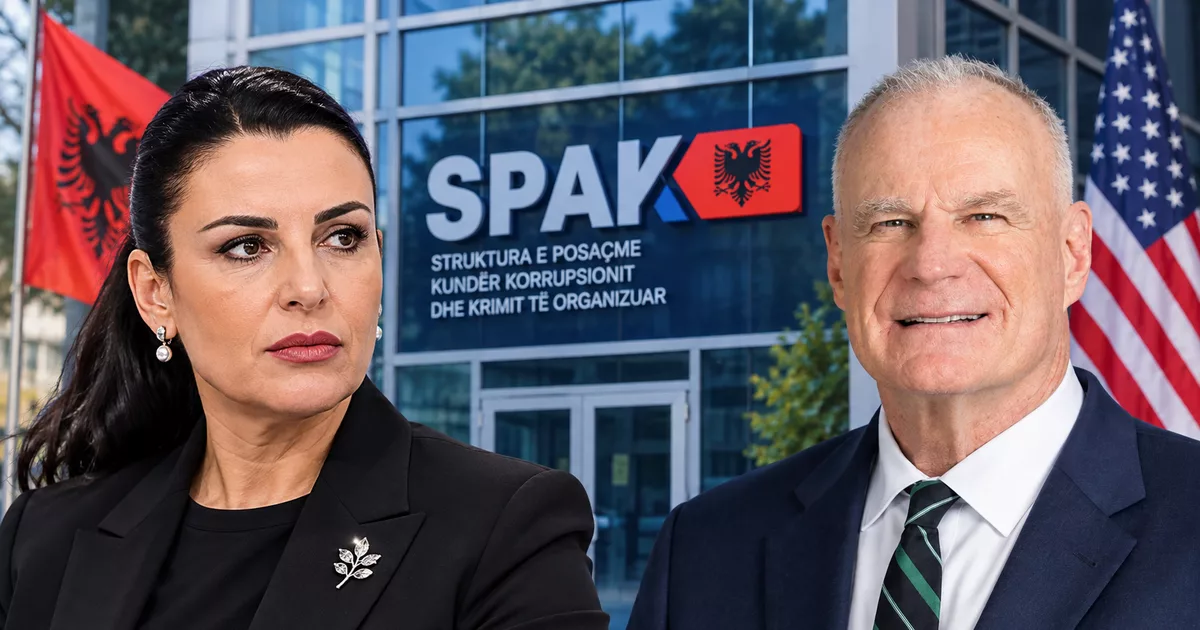
Albania’s Special Court Against Corruption and Organized Crime has set Friday, Dec. 11, for the first preliminary hearing in the case against former Deputy Prime Minister Belinda Balluku. On the day the date became public, U.S.
Ambassador Eric Wendt visited the Special Prosecution Office, known as SPAK, and met its chief, Klodian Braho, and Joni Keta, head of the National Bureau of Investigation, which works with SPAK on major corruption and organized crime cases.
Balluku was deputy prime minister and minister of infrastructure and energy in Prime Minister Edi Rama’s government. Prosecutors allege she used her position to steer public contracts to selected companies. She has denied wrongdoing.
SPAK says it found violations in 10 tenders worth more than 400 million euros. They include the Llogara Tunnel on the southern coast, seven lots of Tirana’s Outer Ring Road and a road project between Porto Romano and Durrës, Albania’s second-largest city and main port.
Balluku is charged with violating the equality of participants in public tenders in nine instances, corruption, concealing assets and money laundering. Prosecutors also allege that two builders gave her coastal villas in Palasë and Dhërmi, on the southern Albanian Riviera, worth about 1.8 million euros in exchange for tenders.
The properties were put in the name of former footballer Igli Tare, who is also charged with money laundering.
SPAK estimates that the Llogara Tunnel tender alone caused about 78 million euros in damage to the state budget. The indictment names 28 defendants: Balluku, 25 other public officials, businessmen and two companies.
SPAK initially charged Balluku over the Llogara Tunnel tender. The court suspended her from office and barred her from leaving the country. In March 2026, Parliament rejected SPAK’s request to lift her immunity, preventing her arrest.
The Dec. 11 hearing will not decide guilt or innocence. A judge will determine whether the case meets the legal requirements to go to trial. All defendants are presumed innocent. According to the latest survey, nine in 10 people in Albania say corruption is widespread.
Wendt’s visit drew attention because SPAK was established in 2019 as part of a justice overhaul backed by the United States and the European Union, intended to give prosecutors independence to pursue powerful officials. The ambassador has visited SPAK before. After an October visit, the U.S.
Embassy said talks covered transnational crime, drug trafficking and illegal migration, which it described as priorities for the Trump administration.
There is no public evidence that Wendt’s latest meeting concerned Balluku, and neither the embassy nor SPAK has said it did. The visit should not be read as U.S. involvement in the case or as a signal of how the court will rule.