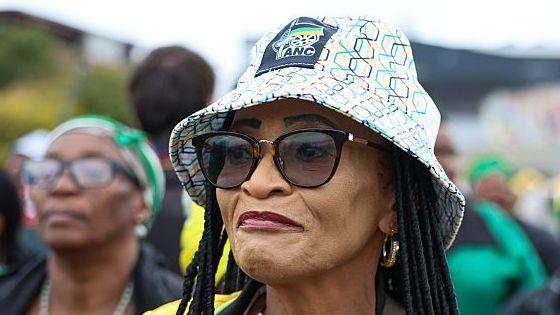
South Africa’s African National Congress is seeking power-sharing deals with smaller parties to form local governments after losing support in this month’s elections. Parties have until 27 November to negotiate and form councils.
The ANC, which has dominated South African politics for more than 30 years, won 31% of the vote nationally, down from 46% in the previous local election. It secured a majority in only one of the country’s nine provinces, Limpopo, compared with six previously, and received the most votes in two of the country’s eight cities, down from six in 2021.
The Democratic Alliance (DA) won the most votes in Johannesburg, Pretoria and Ekurhuleni, in Gauteng province, and retained its majority in Cape Town. It also received the most votes in Nelson Mandela Bay. The DA was the only party to win an overall majority in a city.
The left-leaning uMkhonto weSizwe (MK) Party, led by former President Jacob Zuma, came third nationally with 10% of the vote. It won 34% in KwaZulu-Natal, which includes Durban, but will need coalition partners to govern there.
The ANC and DA have shared national power since 2024 as part of the Government of National Unity (GNU), formed after the ANC lost its parliamentary majority for the first time since apartheid ended. The parties have continued to disagree on key issues, and both have threatened to end their power-sharing arrangement.
The ANC appears reluctant to work with the DA in local governments. SABC has reported that most of the ANC’s top leaders see an agreement with the DA as a last resort. Instead, the ANC has been approaching smaller parties. Reports point to possible cooperation with ActionSA in Gauteng, where it received 17% and could be a kingmaker.
The DA has also sought agreements with smaller parties and the ANC, but appears likely to sit in opposition in Gauteng. ActionSA is unlikely to work with the DA because the parties cannot agree on mayoral candidates in Johannesburg and Pretoria.
It is too early to know whether the local election results will affect the national coalition. Neither the ANC nor the DA has spoken publicly about the future of their national arrangement amid ongoing coalition talks. The ANC’s reluctance to partner with the DA in major cities points to continued tensions between the parties.
A party insider told the Daily Maverick on Sunday that a nationwide agreement to work with the DA at municipal level "was overwhelmingly rejected" at a meeting of ANC members. Political analyst Andre Duvenhage told the BBC there was a possibility that "a lot of asymmetrical coalitions" could emerge, with parties working together in one area and opposing each other elsewhere.
Political analyst Sandile Swana said that any party wanting to leave the GNU over a failure to secure local deals would be "[shooting] yourself in the foot".
The ANC’s loss of support has been linked mainly to high levels of corruption and declining confidence in its ability to provide basic services, including electricity, water and rubbish collection. Some attribute the DA’s increased backing to its record of management in municipalities it controls, while others accuse it of neglecting poorer areas and townships.
Half of South Africa’s cities have been governed through power-sharing agreements since 2016. These arrangements have often been viewed as unstable and chaotic, and the collapse and formation of coalitions has affected basic services. Governance in Gauteng’s three cities has faced scrutiny in recent years, partly because of unstable governments.
Experts say it will take longer than a five-year term to address the problems facing many municipalities, particularly Johannesburg. "I think if we are really turning the ship around, we are talking about a 10-year period," Duvenhage said. Swana said it would take a decade to "cleanse and purify" local councils and "reinstate them as "proper municipalities".