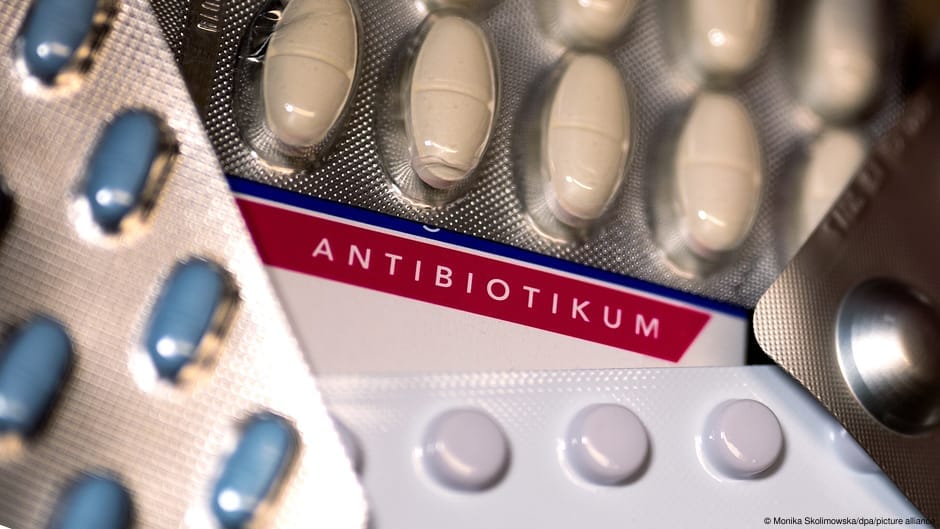
The World Health Organization says antimicrobial resistance (AMR) could directly cause an estimated 39 million deaths over the next 25 years. Jean Pierre Nyemazi, acting director of the WHO's department of antimicrobial resistance, called the threat immense during a recent virtual press conference.
WHO member states have set a goal of reducing AMR-related mortality by 10% by 2030, Nyemazi said. But, he added, “When we see the trend, the investments, the action, we don't think we are on the right track.”
Without effective antibiotics, even minor infections could again become life-threatening, said Can Imirzalioglu, director of the Institute of Medical Microbiology at Justus Liebig University Giessen. “If antibiotics were no longer effective, modern medicine as we know it today would no longer be possible at all.”
Imirzalioglu also works on “One Health,” a concept adopted in 2004 by experts in human medicine, veterinary medicine and nature conservation. It recognizes the close links between the health of people, animals and the environment. Antibiotics and resistant germs are found not only in hospitals, but also in animal shelters, animal products, wastewater, fertilizers and plants, he said.
In hospitals and doctors' offices, antibiotics should be used as selectively and purposefully as possible. Research is focused in particular on improving and speeding up diagnostic methods. Imirzalioglu said antibiotics were frequently prescribed in Germany for respiratory and urinary tract infections, although they work only against bacteria, not viruses.
Each dose of antibiotics can affect the gut microbiome, which consists of billions of microorganisms, primarily bacteria, and is important for digestion, metabolism and the immune system. “If we damage the [bacteria], resistant pathogens can spread and take their place,” Imirzalioglu said. Resistant pathogens can spread in the gut without causing symptoms, leaving people as “carriers of resistant pathogens, which they, in turn, release back into their environment.”
A study by Katharina Schaufler, a veterinarian and microbiologist at the Helmholtz Institute for One Health (HIOH), traced one route: resistant pathogens can pass from hospitals through toilets and sinks into wastewater, then reach the Baltic Sea and be ingested by wild birds.
Schaufler said long-term, large-scale antibiotic use in people and excessive use in veterinary medicine have led to resistance to nearly all available antibiotics. An EU-wide ban on antibiotics as growth promoters in animal feed took effect in 2006. Since then, she said, antibiotics may be used only for veterinary treatment.
Schaufler said factory farming makes medical use of antibiotics a permanent necessity, as infections spread quickly among animals kept in confined spaces. Lack of space and boredom can also lead animals to injure one another in an environment where, she said, “there's already a high level of bacterial pressure.”
Antibiotic-resistant pathogens can enter the environment through fertilizers. “It has been proven that, for example, resistant bacteria can still be found on lettuce heads,” Schaufler said. Resistant bacteria have also repeatedly been found on meat.
Schaufler said antibiotics remain a standard additive in animal feed in many countries. Imirzalioglu added that in some countries they can be bought in drugstores without prescriptions. Both said these practices make the global effort against antibiotic resistance more difficult.
Imirzalioglu works on Guardian, a project funded by the German Federal Ministry of Research, Technology and Space. It aims to prevent outbreaks caused by resistant bacteria by monitoring and analyzing wastewater in the German state of Hesse. He is also an advisor to the Antimicrobial Resistance One Health Network at EU level.
Reflecting on policymakers, Imirzalioglu said: “The experts and working groups have great ideas, and then these are often scaled back or stifled during the initial stages.”
Nyemazi urged individuals to help prevent antibiotic resistance by preventing infections through hygiene, regular vaccinations and doctor's appointments, and by taking medications in accordance with prescriptions. The article was originally published in German.