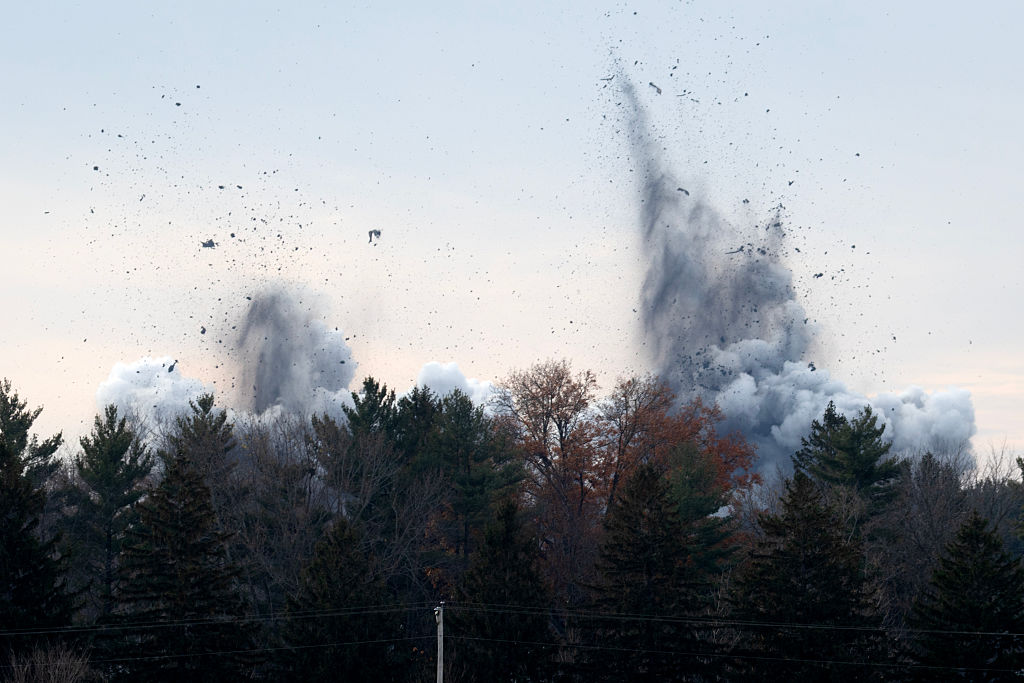
The Army detonated 68 barrels containing 9,700 pounds (4.4 tons) of degraded lead azide at about 9 am CT Wednesday at the Iowa Army Ammunition Plant in Middletown, Iowa. The blast sent gray-white clouds over southeastern Iowa and was intended to prevent a spontaneous, uncontrolled explosion of the crystallized, highly unstable compound.
Residents within 5 miles of the facility, in a town of fewer than 400 people, were advised to evacuate. Those farther away were told to shelter in place, tightly close windows and doors, turn off fans and set indoor air systems to recirculate.
Local Iowa outlet KWQC recorded the plume from the two earth-covered containers, which were detonated simultaneously. A KWQZ journalist at a reportedly safe distance said during a live broadcast that he could see and then feel the shockwave roll through the crop field where he was standing. He wore a mask for the rest of the broadcast.
In the hours before the detonation, the Army released maps modeling the plume’s drift and distribution. They indicated that airborne lead would travel about 100 miles southwest of the facility, while dust deposition would cover about 200 square miles in that direction. Researchers and government workers have collected air and soil samples to provide baseline readings for lead levels after the detonation and its fallout.
Lead is a neurotoxin that does not break down in the environment and poses significant health risks, particularly to young children and pregnant people. To prepare for the blast, the Army surrounded the earth-covered containers with sand-and-lime fill, set up water cannons and misters to keep dust down, and covered the top of the container with fire-suppressant foam. The Army documented the preparations in a video posted to social media Wednesday morning.
The explosion followed days of confusion, outrage, questions and delays. The Army said it had known about the hazardous state of the lead azide since March, but Iowans were largely unaware of the situation and planned detonation until last week. The Army initially planned to detonate the barrels on Friday, November 20. Public alarm and an emergency court filing from environmental groups led to delays: first until Monday, then Tuesday, and finally Wednesday.
A federal appeals court initially issued a stay on the Army’s permit for the detonation. On Monday, Trump said he had ordered the military to halt the operation until the court lifted the stay and Governor-elect Rob Sand, a Democrat, signed off. The court ruled this week that the Army could proceed, given no better option.