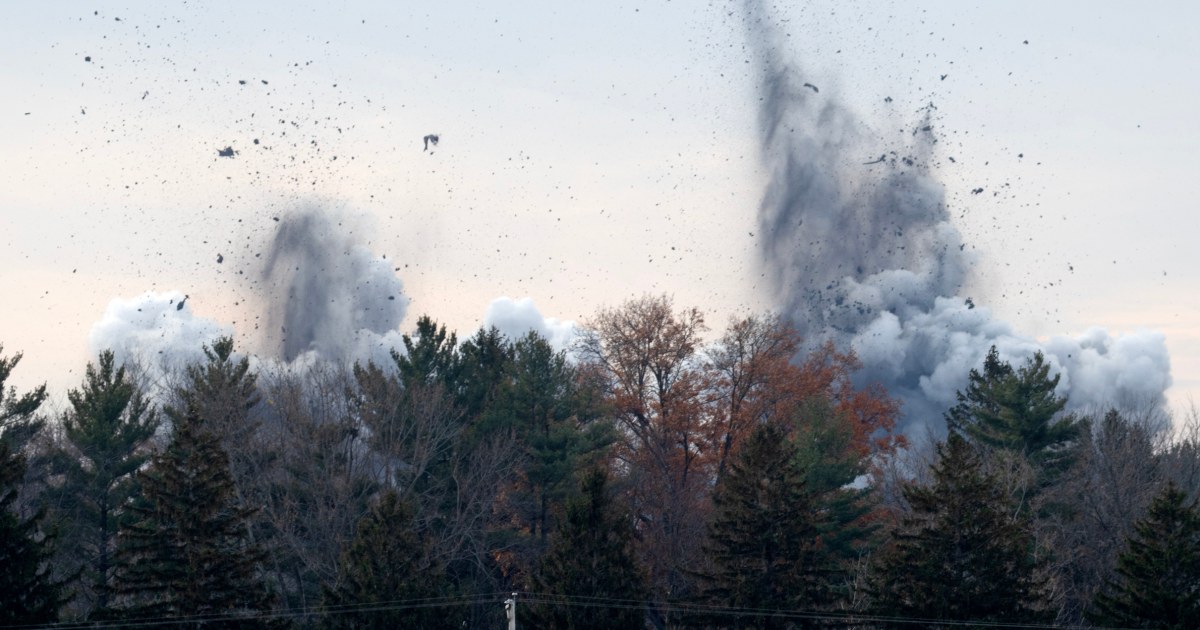
The Army detonated 68 drums of unstable lead azide at the Iowa Army Ammunition Plant in Middletown on Wednesday. The blast was expected to send lead dust many miles, with Army projections indicating the plume could travel about 100 miles southwest and into northeastern Missouri.
The drums held about 9,700 pounds of deteriorating, toxic material. The Army said the lead azide had become “recrystallized” inside and outside the containers, posed a risk of spontaneous explosion and could not be safely moved.
NBC affiliate KWQC filmed the detonation from Danville, about 4 miles north of the plant. Just after 9 a.m. local time, its camera captured two blasts of gray and white smoke that appeared to dissipate after about 30 seconds. Reporter Cyle Dickens said he felt a “percussion” and a shock wave moving across a farm field toward him.
Linda Ross, who lives about a mile southwest of the site, said she felt “very little shaking and no plume in sight” immediately after the blast. “Two short boom boom sounds. Dog started barking. That’s about it.” Her windows did not shake, she said, but the event was “unnerving.” “We will stay inside today,” Ross said.
Maj. Gen. Eric Shirley, the commanding general of the U.S. Army Sustainment Command who led the U.S. Army controlled detonation, said the operation exceeded his expectations. “I believe absolutely that we reduced as close to zero as is absolutely humanly possible the risk to the health and safety of the people of Middletown,” Shirley said in an Army video message. “As we saw in the immediate aftermath through overhead coverage, all of the lead azide barrels were definitively removed. There was no secondary explosions. ... There was no infrastructure damage in or around our installation.”
Shirley said the visible clouds came from foam sprayed at the site. Robert Cekada, director of the Bureau of Alcohol, Tobacco, Firearms and Explosives, said in the video that military personnel had successfully driven the explosion “into the ground,” minimizing pollution.
The Environmental Protection Agency, which approved the Army’s permit, said air monitors showed “ZERO detection of airborne lead throughout the region.” Previous modeling of lead dust deposition, however, suggested the plume would take several hours to disperse. Independent experts said it would take time to determine how much lead was deposited and what risks it might pose to nearby communities.
Before the blast, the Army called for evacuations in Middletown and within a 5-mile zone southwest of the plant. Soldiers went door to door Tuesday afternoon to tell residents to leave. The Federal Emergency Management Agency is providing short-term hotel lodging to people in the evacuation zone through Friday.
In the days before the detonation, the plan prompted fear and anger among local residents, many of whom said they had not received enough warning. People in the plume’s potential path changed Thanksgiving plans, taped windows, covered gardens, bought cleaning supplies and, in some places, left town.
Jill Holler, whose family farm is about 20 miles west of Middletown, said she spent Sunday night collecting soil samples for future comparisons of lead concentrations. “I was down in the dark getting the soil samples, and it’s just frustrating,” she said.
Lead is a potent neurotoxin, and no amount of exposure is safe. It poses the greatest health threat to children and is associated with learning disabilities, reproductive health problems, mental health issues and an increased risk of hearing loss, among other effects. Lead particles deposited on the surface or in soil can remain there forever unless physically removed.
Army officials said a controlled detonation with mitigation measures was safer than risking an unexpected explosion. Measures included two stories of “HESCO” barriers — modular, collapsible structures filled with sand — around the site, as well as water sprayed during the explosion to catch small particles. Officials also said aqueous foam blocks, gel blocks and two “water walls,” each made of four 16,000-gallon water tanks, would help absorb the blast.
Iowa governor-elect Rob Sand said after the detonation that federal officials had told him everything had gone well, though more testing was needed. “For now, federal officials have reported that lead dispersal should be limited, Iowans are safe, and damage to property is limited,” Sand said on X. “I’m grateful to the experts on the ground who did all they could to make this detonation as safe as possible. The lead-up to the detonation should never have been so chaotic and unclear.”
Emergency permitting documents submitted to the EPA said the Army expected the blast to leave a crater about 38 feet wide and 5 feet deep. The Army said Tuesday that monitoring teams would follow the plume “to collect soil, surface-water, and surface-wipe samples to verify lead levels against baseline models and guide any localized cleanup.”
If residential properties exceed a lead contamination threshold of 200 parts per million, the Army said, “remediation teams will remove affected soil, clean surfaces, and restore the property at complete government expense.” The Army offered few details about how or when testing would take place, or the process and timeline for any government-led remediation.
Andrew Whelton, a professor of civil, environmental and ecological engineering at Purdue University in Indiana, said the Army’s emergency permit documents did not describe testing plans in detail. “Based on the document I reviewed, there is no plan for applying an evidence-based approach to determine if people’s homes, schools, and businesses are safe after the detonation,” he said Tuesday.
Peter Thorne, a pulmonary toxicologist and environmental health specialist with the University of Iowa’s College of Public Health, said scientists planned independent monitoring of the lead dust plume. “We have monitoring equipment out there that’s going to tell us the extent of lead that’s became airborne and moved with the wind,” he said Tuesday. “Our models will be able to tell us how much lead is depositing on soil and on playground equipment and so forth. And from that, we can make some estimates of what what the degree of of danger is associated with this exposure.”
Thorne also questioned how the explosives were allowed to become so dangerous. Officials have said the nation’s stockpile of lead azide, once used to make bomb triggers but phased out about 15 years ago, was moved to the ammunition plant in 2009.
“Why wasn’t this dealt with long ago when they could have chemically degraded and the lead azide would no longer be a hazard?” Thorne said. “It should have been dealt with in the past, and now of it’s become a crisis with very few good options left.”