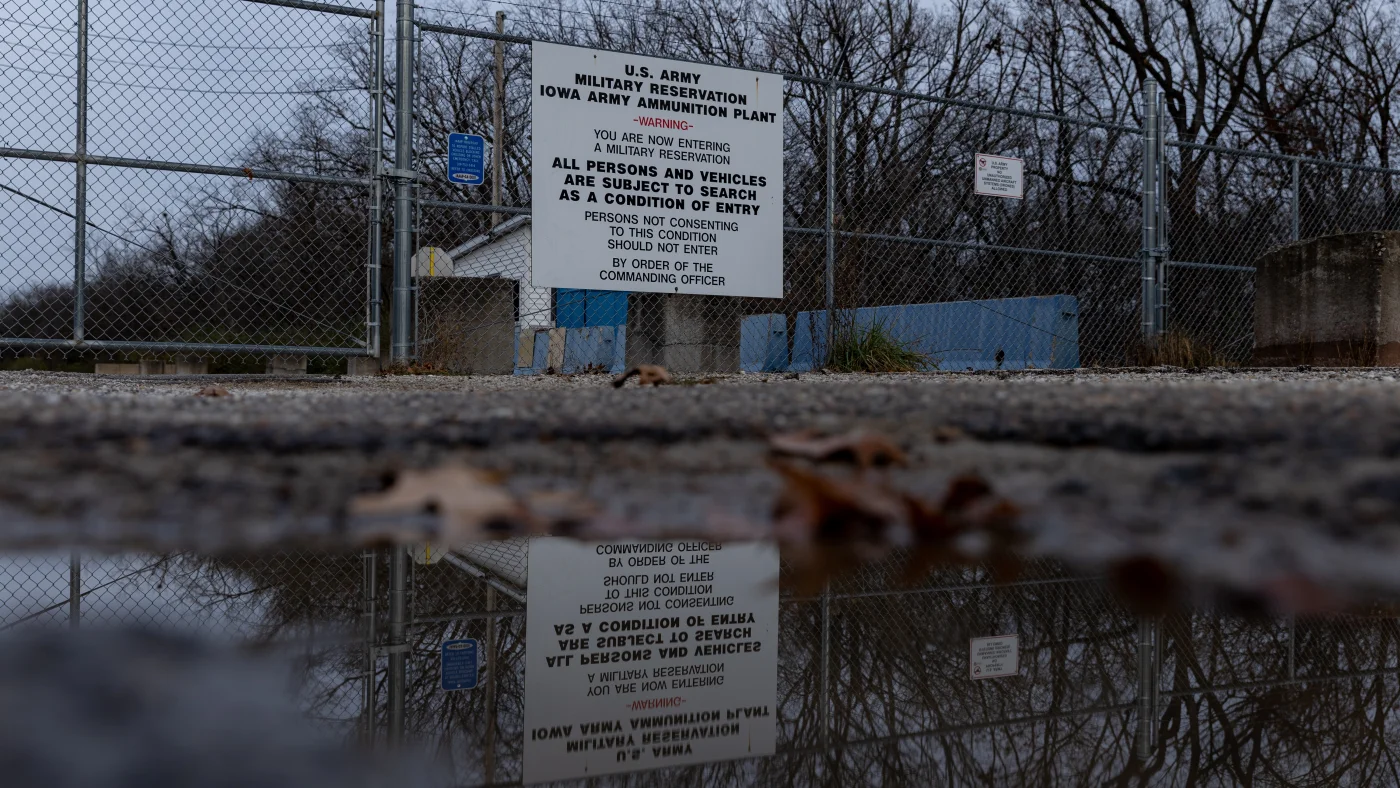
The U.S. Army plans to detonate nearly five tons of lead-based explosives at the Iowa Army Ammunition Plant in Middletown, Iowa, to dispose of lead azide that has become dangerously unstable. The controlled blast is scheduled for 9 a.m. CT/10 a.m. ET, according to Army officials.
The detonation was first scheduled for last Friday and has since been rescheduled three times amid lawsuits by environmental groups seeking to block it. A federal appeals court cleared the way for the blast on Monday. President Donald Trump had told the Army to wait for court approval and sign-off from Iowa Democrat Governor-elect Rob Sand, whom Trump said he would blame if anything went wrong.
The Army says the lead azide, used to ignite munitions, had been stored for decades at the plant. Crystals formed inside its containers at some point in recent years, making the material acutely sensitive to movement and temperature changes. At a Tuesday briefing, administration officials said chemical treatment was ruled out because the munitions had degraded to the point that moving them or opening their containers risked accidental detonation.
Trump administration officials say the detonation is the only safe way to dispose of thousands of pounds of ordnance moved to a bunker in Iowa 17 years ago. Authorities determined in March that the substance had become too unstable to move, prompting the Army and other agencies to race to destroy it before an uncontrolled explosion.
The military initially sought a non-explosive method to neutralize the material, then worked on berms and other countermeasures while monitoring weather and the growing risk of an uncontrolled blast. Tom Croci, an Environmental Protection Agency official, said agencies focused on setting “the right parameters with the Army to make sure that a supervised controlled detonation was happening in the most optimal environment and at the most optimal timing.” “So that was some of the back and forth to make sure that we had that right,” he added.
FEMA has urged people within 20 miles southwest of the plant to stay indoors with windows closed to limit exposure to airborne lead dust, as well as noise and vibration. Some residents have voluntarily evacuated. The agency said it was contacting homes in the area considered most at risk to offer evacuation help. NPR reporters called the FEMA hotline and were eventually told a callback about evacuation assistance would take several hours.
The Centers for Disease Control and Prevention says children and pregnant people face the greatest danger, because there is no safe level of lead exposure, whether airborne or settled as dust on surfaces. Army maps released Tuesday showed areas in southeast Iowa and northern Missouri that may be affected. The Army said it would issue another map after the detonation with a final estimate of the affected area.
The Iowa National Guard deployed 100 soldiers to support local efforts and federal agencies’ community outreach to 150 households, according to a statement from Iowa Governor Kim Reynolds. Plans for the blast have rattled Iowans, who were told about it only last week.
Andrew Whelton, a Purdue University professor who has worked on environmental disaster planning, including for the U.S. Army, told NPR the timing “should have been planned better.” He said: “Because that didn't happen, because the messaging was just so poor, you had anxiety, you had stress, you had businesses planning to shut down.” Whelton added: “Some farmers have said 'we cannot bring all of our cattle. We do not have the facilities for that,”
On Tuesday, the acting Army Secretary and leaders of FEMA and the ATF pushed back on the idea that the blast was a surprise, pointing to town-hall meetings while acknowledging that its timing had shifted. Whelton said he was concerned about follow-through on toxic sampling, cleanup and remediation. He also said the government does not have a great track record on the long-term effects of toxic exposure, citing the chemical spill in East Palestine and the cleanup or the Los Angeles wild fires.
Two Iowa environmental groups sued to stop the blast. The Iowa Army Ammunition Plant is in Augusta, Iowa, near Middletown. NPR News originally published this report. By Quil Lawrence. NPR does not offer or accept money for coverage or interviews. Anyone who makes such an offer or request is not an NPR employee and does not represent NPR.