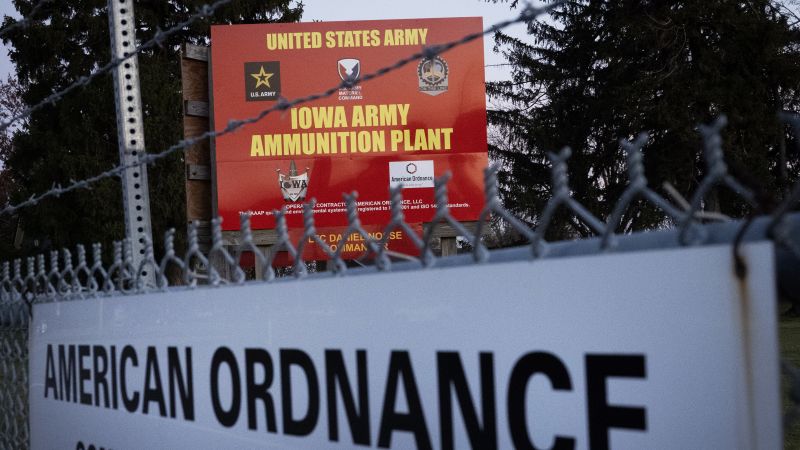
The US Army plans to detonate five tons of lead azide on Monday at the Iowa Army Ammunition Plant in Middletown, as residents raise concerns about potential lead exposure. The operation, coordinated with the US Environmental Protection Agency, will destroy 68 drums of the material, which is used to detonate munitions.
The detonation was originally scheduled for Friday but was postponed until Monday following objections from residents and elected officials. Senator-elect Josh Turek called for a delay, saying Thursday: “I have heard from many Iowans who are worried about their health and safety due to the potential risk of lead exposure as a result of the detonation.”
Lucy Giehl, who lives just 4 miles north of the plant, said the three-day postponement had not eased her concerns. “What are they going to do during those three days to help people be better prepared?” Giehl openly wondered to The Associated Press. “There’s just so many details that I feel like haven’t been addressed with the public.”
Lead azide is a volatile lead compound that can “explode from shock, heat, flame or friction when dry,” according to a federal hazardous materials database. Residents in Middletown’s City Park neighborhood have been asked to leave before the rapid, two-part detonation. The Army has not announced when the blasts will take place.
“Extensive modeling efforts predict that the potential level of lead particles in the air may be elevated,” the Army said. “The detonation will result in an air plume with some lead-containing particles which will disperse in the air and deposit on the ground.” It is unclear how much lead could be released. Lead is toxic to the brain, and no amount of exposure is considered safe.
Patrick O’Shaughnessy, a University of Iowa professor and environmental health expert, said lead is heavier than air, limiting how far it can travel. Any sizable particles would likely land within 20 miles of the detonation – “and then it’s only going to be the much, much smaller ones that will maintain themselves lofted with the wind and move down, downwind … towards Iowa City,” he told CNN.
Wind conditions could affect how far lead particles travel. CNN Meteorologist Chris Dolce said Monday’s forecast called for winds of about 5 to 10 mph, blowing from north to south. O’Shaughnessy said he and colleagues plan to test and monitor the air and ground to assess possible fallout.
The Army also warned that noise and ground vibrations from the detonation could cause “localized window damage.” Daren Paul Morris, who walks his dog near the plant every day, told CNN affiliate KCRG he plans to evacuate but is concerned about what he might find when he returns. “Hopefully I don’t have any broken windows. I just had the roof replaced,” Morris said.
“I don’t know if I would mow the grass for the first time until it rained good. You know you don’t want to kick up all that dust,” he added. “They haven’t really told us how toxic … well, lead is obviously toxic.”
The Army discovered the degrading lead azide “housed in bunkers at the installation” in March and immediately began communicating with stakeholders and residents “about the danger it posed,” Acting US Army Secretary Adam Telle said. In the following months, officials worked to develop “a scientifically validated, fully coordinated safety plan before engaging the public.”
After coordinating with the EPA, experts and the community, officials determined a controlled detonation “posed the lowest risk to the public in the immediate and surrounding area,” Telle said. The Army said the material’s degraded condition has left it “extremely unstable and sensitive to even slight friction or movement,” making relocation potentially more dangerous.
“Packing and transporting it poses an unacceptable risk of accidental detonation to personnel handling and transporting as well as to the public,” an Army flyer distributed to the community last month said. Telle said delaying the detonation could create further hazards, and that Monday is the “latest possible moment prior to a forecasted temperature drop, which would risk further destabilization of the material.”