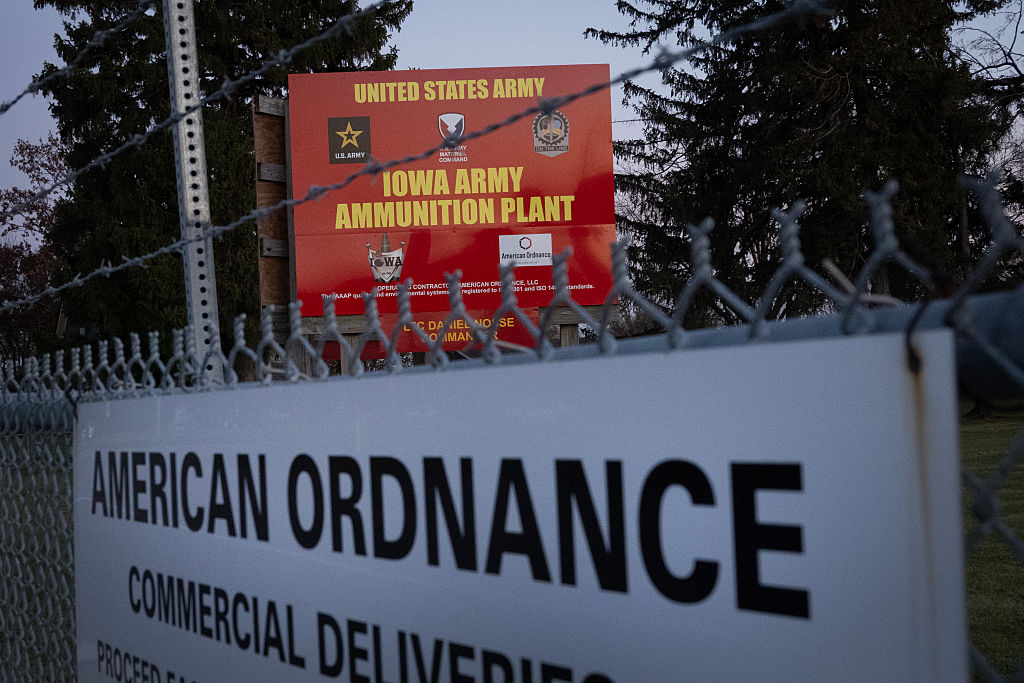
The US Army has postponed plans to detonate 68 deteriorating barrels of lead azide at the Iowa Army Ammunition Plant in Middletown, Iowa, saying it will wait until Monday, November 23, to give officials more time to communicate with residents. The planned explosion could release lead dust and airborne lead, with Army modeling suggesting a plume might travel nearly 100 miles north.
The Army had planned two controlled detonations around noon Friday, destroying the barrels inside earth-covered concrete containment structures. Acting Secretary of the Army Adam Telle announced the delay in a social media post at 7:31 pm ET Thursday, saying: “Public communication is essential to public trust. Therefore, the Army will continue to actively engage with state and local officials throughout the region to distribute accurate, up-to-date information.”
Telle said the detonation could not be delayed beyond Monday because the lead azide is deteriorating and extremely explosive and sensitive. He said the delay would put the detonation at “the latest possible moment prior to a forecasted temperature drop, which would risk further destabilization of the material.”
The Army identified the deteriorated stockpile in March. The 68 barrels contain around 9,700 pounds (4.4 tons) of lead azide suspended in water and ethanol. Over time, the compound has degraded and crystallized; in crystal form, it is extremely sensitive to physical shock, friction or heat. The Army described its condition as “catastrophically hazardous.”
An environmental assessment released Wednesday said moving the barrels was ruled out because loading, transporting or burying them could cause an “unacceptable safety risk and a high probability of accidental, uncontrolled detonation.” The Army also rejected chemical neutralization, which it said would require personnel to handle the barrels over 7 to 22 days, increasing the risk of an accidental fatal detonation.
The Army selected a controlled “Blow-in-Place” plan and intended to carry it out in fall, citing reduced temperature cycling and the need to limit effects on facility operations and local agriculture. Under an emergency permit from the Environmental Protection Agency, explosive charges and an accelerant would be placed on or near each containment structure.
Planned mitigation measures include lime- and sand-fill barriers around the structures, water cannons and misters to control lead dust, and choosing weather conditions that avoid high winds or a thermal inversion. Army modeling released Wednesday, based on the conditions forecast for Friday’s planned detonation, estimated lead dust deposits of 5 to 100 micrograms per square foot as far as 25 miles north, nearly to Wapello, Iowa. Airborne lead at 0.18 micrograms per cubic meter could reach nearly 100 miles north toward Cedar Rapids, Iowa. The EPA’s air standard for lead is 0.15 micrograms per cubic meter.
The Army advised people in the immediate area to consider leaving or staying indoors with windows closed during the detonation, and recommended washing cars parked outside. Local fire departments reportedly planned to hose down children’s playgrounds, and schools planned closures.
The Army had planned public outreach, including an open house on October 15. But while Middletown residents may have known about the planned detonations, Iowans in the projected path of the plume were surprised by the news this week. The Army said it planned to remove affected soil and dust through “rapid excavation” and treat it with a “stabilization agent,” but those efforts would not address the airborne plume. Lead does not break down in the environment, and young children and pregnant people are particularly vulnerable to its neurotoxic effects.
State leaders and residents raised questions Wednesday and Thursday about how the lead azide deteriorated and whether safer alternatives had been fully considered. Iowa governor-elect Rob Sand wrote on social media that an “unacceptable lack of communication and clarity has made Iowans understandably concerned and angry about this situation.”
Illinois Governor JB Pritzker said on social media: “Alongside our neighbors in Iowa, we are also demanding answers about how this could affect our people’s health and safety.” Political leaders in Illinois also sent a letter to Telle and EPA Administrator Lee Zeldin expressing “grave concerns” about the plan.
Before the delay was announced, environmental groups filed a lawsuit Thursday seeking a court-ordered pause. They alleged the EPA approved the plan “without full consideration of less dangerous alternatives that would avoid widespread dispersal and deposition of toxic lead; and inadequate public notice of the plan to open-detonate hazardous waste due to the extraordinarily rushed timeline set by the Army.”
On Friday morning, the Army, Department of Health and Human Services and EPA issued a joint statement saying agencies were working together to conduct the detonation as safely as possible, had been planning since March and would use mitigation measures to limit public risk and disruption.
In June, Zeldin listed the EPA’s work with Iowa’s lead azide stockpile among the agency’s top “100 environmental victories that showcase EPA’s unwavering dedication to protecting American families.” The work was number 60, described as providing “critical emergency support to Iowa Army Ammunition Plant, deploying technical experts for 68 deteriorating drums of explosive lead azide.”