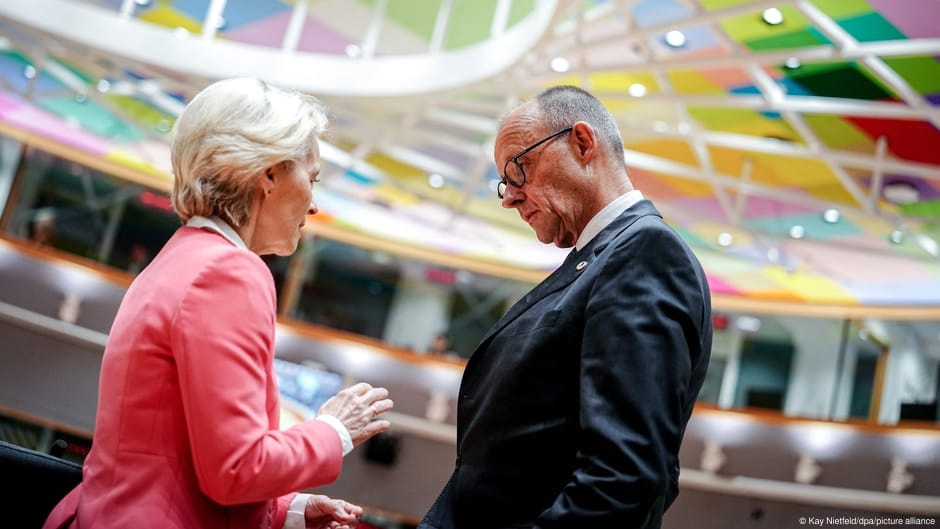
You can follow developments from the EU summit taking place on Thursday, November 26, below:
European Council President Antonio Costa said that 24 out of 27 members of the EU supported a proposal for a €45 billion loan for Ukraine.
That loan is split into two sections, with €20 billion to help finance for civil services and the other €25 billion going to arms and ammunition.
Euro News reported earlier in the day that Bulgaria reversed course and was ready to join the loan, so long as it was only paying into the part that wasn't covering Ukraine's military needs.
European Commission President Ursula von der Leyen said there was considerable work to be done before a deal could be in place.
EU leaders cut short a second day of talks that was due to take place tomorrow and pushed discussions to another summit in December.
The disagreements over a shared EU budget for the years between 2028 and 2034 stem from different priorities among EU members.
Some countries prefer greater funding for defense and enhancing competitiveness, while others seek to keep in place funding for agriculture, among other issues.
EU leaders ultimately weren't able to reach an agreement at the end of Thursday.
French President Emmanuel Macron said far-right presidential candidate Marine Le Pen should be more humble after she criticized efforts to reach a deal on the EU budget before the end of the year.
EU leaders were gathered in Brussels throughout the day to see if they could hammer out an agreement over a shared budget from 2028 to 2034.
But they remain far apart on many issues, including some members opposing the use of funds for military aid to Ukraine.
During the day, Le Pen, who is projected to beat her centrist rivals in the April 2027 elections, accused Macron and the European Commission of trying to rush through a budget deal before next year.
"The apparent aim is to deter us from defending France's interests in EU budget negotiations if the French people entrust us with the responsibility of governing," she said in a post on X.
Macron hit back, saying later: "Mrs. Le Pen is campaigning. It takes a peculiar kind of arrogance to think she’s already in charge of France's destiny. Last I checked, she wasn’t elected."
Macron said he was careful to take into account the presidential election and that if there was no deal by December 31, negotiations would have to resume in the second half of 2027, when his successor would be in office.
"You have to be more humble when you're campaigning, even if you already see yourself in the job," Macron said.
EU leaders hadn't made as much progress in their discussions about the EU's next long-term budget, Dutch Prime Minister Rob Jetten said.
Jetten said it was up to EU Council President Antonio Costa to come up with an improvised proposal for the next budget, which he said would be debated in "more intense" negotiations in December.
EU leaders are still hoping to have another round of talks around midnight before calling it a day.
Like Germany, the Netherlands is a net contributor to the European Union.
German Chancellor Friedrich Merz said EU leaders will try to reach an agreement on the next multi-annual budget for the EU by the end of this year.
Merz said a day of talks among EU leaders in Brussels had brought "new movement" toward a reduction of the proposed size of the next budget, as demanded by Germany and other countries that are net contributors to the bloc's finances.
The leaders will try to hammer out a deal during a two-day summit starting December 17, Merz said.
Germany has been leading calls to attach a durable funding scheme for Ukraine to the EU's next budget.
Merz has made clear that his country would approve the next budget if all countries backed a loan for Ukraine.
Last year, the EU reached an agreement on a €90 billion loan to Ukraine through a compromise loan after a much-discussed frozen-asset plan failed.
The Czech Republic, Hungary and Slovakia opted out of backing the loan.
Contrary to earlier expectations, European Union leaders weren't quite done for the day, even if it was well past 2200 local time.
German Chancellor Friedrich Merz said that rather than meet again as scheduled on Friday, leaders would hold a final round of discussions around midnight and end the summit.
Thank you for reading along with our coverage of the Euro Summit on Thursday.
We will be back tomorrow to bring you the latest from the second day.
Until then, you can watch DW's analysis of the event:
Hungarian Prime Minister Peter Magyar has said the chances of reaching an agreement on Thursday are "virtually zero."
Leaders of the European Union are gathered today in Brussels to agree on the bloc's budget proposal for 2028 to 2034.
In an X post, Magyar said he outlined "Hungary’s priorities and the red lines" to the other member states.
"Having heard the completely opposing positions around the table, I would put the chances of reaching an agreement today at virtually zero," he wrote.
He also said "an agreement around Christmas looks unlikely" as well.
Spanish Prime Minister Pedro Sanchez celebrated "a Spain that leads in Europe like never before," after the nomination of Pablo Hernandez de Cos as the next European Central Bank (ECB) chief.
Hernandez de Cos is set to become the new ECB head as the European Union (EU) leaders are gathered in Brussels for the Euro Summit.
Sanchez welcomed the news in a post on X, pointing out that the top EU positions held by Spanish officials Teresa Ribera, the European Commission's First Executive Vice-President, and Nadia Calvino, head of the European Investment Bank.
"In short, Spain leads in Europe like never before," he wrote.
Spanish candidate Pablo Hernandez de Cos will become the next president of the European Central Bank (ECB), after being endorsed by the majority of eurozone countries, news agencies reported.
As the leaders gather for the Euro Summit, the Financial Times first reported that de Cos will be the next ECB chief, citing people familiar with the matter. This was confirmed by Reuters and AFP, citing EU diplomat sources.
The decision came after the Netherlands said it would support the Spaniard as a consensus candidate.
Christine Lagarde has been president since November 2019 but has announced her intention to step down on February 7, 2027.
De Cos was up against Dutch central bank chief Klaas Knot for the presidency, while France's Laurence Boone and Germany's Markus Brunnermeier have been nominated for the ECB's two other top jobs.
Russia has criticized the European Union's proposed seven-year budget, accusing the bloc of seeking to prolong the war in Ukraine.
Kremlin spokesman Dmitry Peskov said the EU's plans to allocate money for Ukraine in its budget would make Kyiv "less inclined toward a peace process and more determined to continue the war."
Peskov said the result would be more military spending, leaving less for governments to spend on school, hospitals and social facilities.
"This is not money for peace," Peskov said.
Support for Ukraine is among the key areas of discussion in the 2028-2034 budget which includes up to €100 billion for Ukraine, however diplomats say this figure falls well short of Kyiv's needs.
Italy's Prime Minister Giorgia Meloni has added her voice to those warning that European leaders have their work cut out for them when it comes to agreeing on a multi-year budget proposal.
"We're light-years away from a solution," Meloni told reporters ahead of the EU summit in Brussels.
"We are not willing to sign off on a budget under which we would have to give more to receive less," she added.
Earlier, German Chancellor Friedrich Merz said the budget was "still too high" and that members states needed to be able to afford the full cost without taking on new debt.
Last week, European Council President Antonio Costa presented a new compromise proposal of €1.78 trillion ($1.95 trillion), around €204 billion lower than the initial proposal by the European Commission.
Every seven years, European leaders gather in Brussels for what is arguably the most consequential negotiation cycle in the European Union. As German Chancellor Friedrich Merz put it upon arrival, it is about "the future of the European Union."
This is not a typical EU summit. The leaders of the 27 member states are confronting a question that will shape all angles of EU politics for years to come: How much money should the EU have, who should pay for it, and what should it be spent on?
It is the essence of EU summit diplomacy: a painstaking exercise in give-and-take, bargaining and compromise.
The European Commission laid down the opening bid over the summer. The proposal was ambitious. Brussels wants an EU budget that reflects a rapidly-changing world: more spending on defence, innovation, research, digital technologies and competitiveness. At the same time, that inevitably means pressure on some of the traditional pillars of EU spending, particularly agricultural subsidies and parts of the bloc's regional development programmes.
Since then, every member has arrived with a shopping list of demands.
Governments have pushed back against cuts, demanded new priorities, sought exemptions and fought for national interests. There have though also been others who are pushing FOR a reduction in spending, including Merz.
The original proposal from Commission President Ursula von der Leyen has already undergone numerous adjustments as negotiators attempted to accommodate competing demands.
The result is an extraordinarily complex puzzle.
At the centre of it all stands European Council President Antonio Costa. He will be shuttling between bilateral meetings with leaders, gather small groups behind closed doors and attempt to construct a package that gives everybody something they can take home and present as a victory.
For Costa, the stakes are high. Delivering an agreement would be a major test of his authority and reputation as the EU's chief broker. Especially as he was not made top negotiator for the EU in the peace talks on Russia's war in Ukraine. Diplomats expressed confidence in his fairness and negotiating skills before the summit, viewing him as someone capable of building trust among leaders who have differing priorities.
Yet nobody in Brussels expects an easy breakthrough. Many officials acknowledge that the pressure on member states may not yet be intense enough to force the final concessions required for a deal. Leaders are still defending red lines rather than crossing them.
So, this summit will highly likely end without a grand agreement. Leaders will probably decide to take stock of the latest negotiating proposals and return home to assess them in detail. There will be a new — and perhaps final — round on the next summit in December, a few days before Christmas.
As leaders grapple with long-term budgets, across Europe, young people are rising up. They're demanding better jobs, more funding for education and lower rents. The problems they are protesting are complex and often specific to their home country.
But there’s also a common message: Young people feel pessimistic about their economic future. A look at the data shows they could be right.
Bulgaria's Prime Minister Rumen Radev said his country would support a proposed €45 billion ($49 billion) EU loan to Ukraine, but only the funds earmarked for non-military aid.
"Bulgaria is going to take part in the loan of €20 billion (for) non-military support for Ukraine," Radev told reporters as he arrived at the EU summit in Brussels.
"We have a huge historic diaspora of Bulgarians living in Ukraine, our wish is to concentrate our support in that area. We are going to contribute, but no money from Bulgaria for weapons," Radev said.
Last week European Commission President Ursula von der Leyen said the €45 billion would be split into two parts: up to €25 billion for military aid and up to €20 billion for other help as a means of getting member states to contribute where there were objections to funding weapons for Ukraine.
German Chancellor Friedrich Merz said that the budget proposal for 2028 to 2034 was "still too too high" and did not provide the basis for an agreement, during comments made as he arrived at the summit.
"After all, the member states must be able to afford to pay for all of this," Merz said in Brussels.
The German leader also said the war in Ukraine needed to be ended as soon as possible and that the country needed help during a "very difficult winter."
Merz said that funding for Kyiv is "a task that we must also accomplish together,” and added: "The European Union consists of 27 member states, not 23 or 24."
Slovakia, the Czech Republic, and Hungary have been exempt from contributing to aid for Ukraine. The countries negotiated, as part of the current €90 billion loan for Ukraine, that they would not have financial obligations in guaranteeing the loan.
Czech Prime Minister Andrej Babis did not agree with the German chancellor.
"Funding for Ukraine should be negotiated separately," said Babis, adding that his country needs the money for other expenditures. "I believe we will fight for this money," providing an early indication of how talks might proceed over the next two days.