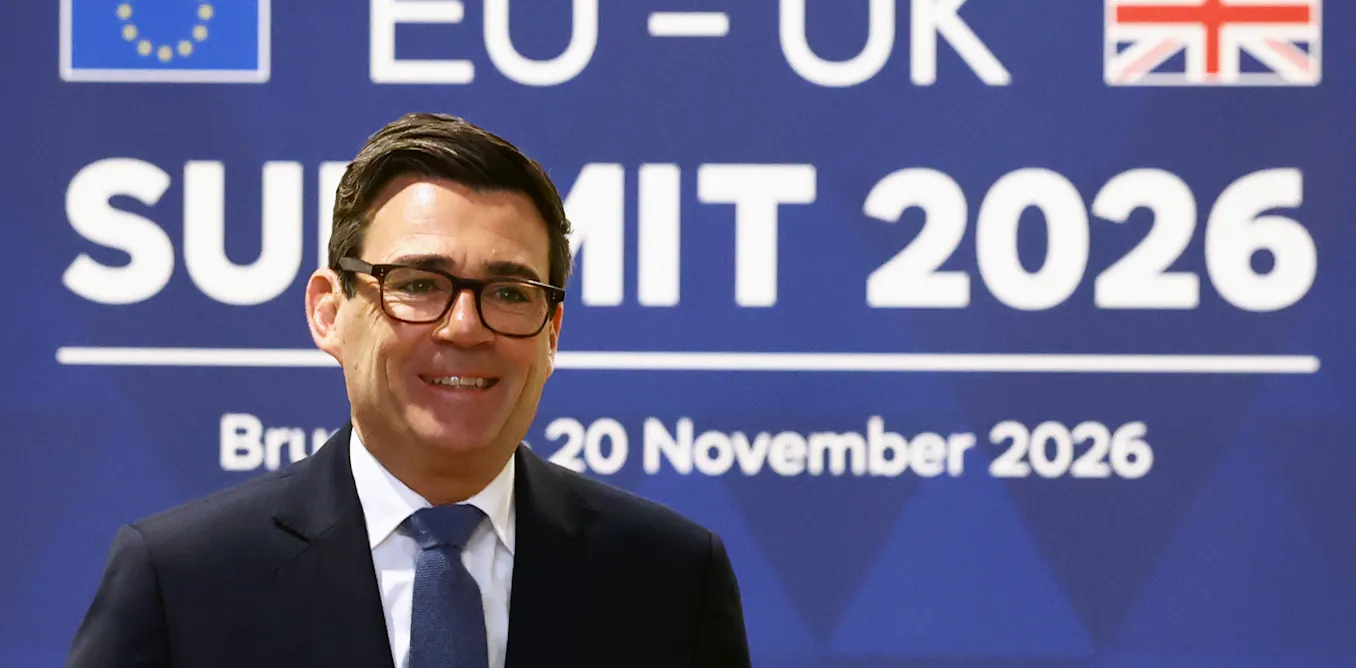
Andy Burnham’s first EU-UK summit in Brussels produced agreements on youth mobility, food exports and carbon emissions. But the meeting also marked the start of further political negotiations, as the prime minister pursues a “national conversation” about the future of UK-EU relations.
Burnham met European Council president Antonio Costa and European Commission president Ursula von der Leyen. Burnham and Costa belong to sister social democratic parties and are both former mayors: Burnham of Greater Manchester and Costa of Lisbon. Their political backgrounds could make future meetings smoother than those in the years after the 2016 Brexit referendum.
Before the summit, the prime minister had repeatedly said the Conservatives failed to secure a good deal with the EU. As part of former prime minister Keir Starmer’s “reset” of relations with Europe, then-business secretary Peter Kyle and European Commission vice-president Teresa Ribera signed an agreement committing the UK and EU to closer trade cooperation.
Ribera, like Costa and Burnham, belongs to a European social democratic party: Spain’s Socialist Workers Party, or PSOE. Senior Labour figures have long admired the electoral success of social democrats in Spain and Portugal.
The article argues that one under-discussed explanation for the UK’s negotiating difficulties lies in the internal politics of Europe’s centre-right. Before the 2009 European Parliament elections, then-Conservative leader David Cameron left the European People’s Party, a bloc of centre-right, pro-European parties.
Cameron later established a new eurosceptic, right-of-centre faction with parties from Poland and the Czech Republic. The article says he underestimated how much the move upset influential EU figures, including German chancellor Angela Merkel. It argues that Merkel and others had not forgotten what the article describes as Cameron’s betrayal when the UK sought a better deal before the 2016 referendum, and were therefore less inclined to compromise.
The debate around Burnham’s Brussels visit is increasingly focused on the politics surrounding Brexit, rather than its rights and wrongs. Youth mobility, migration, food exports and emissions remain important issues, the article says, but the UK is not expected to rejoin the EU in the near future.
During the Makerfield byelection, Burnham said his first priority was to address the consequences of Brexit, rather than necessarily its outcome. He is now emphasizing that Brexit has not worked for British voters without saying it was completely wrong, according to the article.
The article suggests Burnham may see a binary push to reverse Brexit as a source of political risk, while believing he has enough political capital to discuss its downsides. The potential costs include losing Labour’s fragile “red wall” seats in northern England and the Midlands to Reform UK.
The article says Burnham appears more focused for now on attracting voters from the Liberal Democrats and Greens than on winning back people who have already moved to Reform. Conservative leader Kemi Badenoch appears sensitive to disapproval of the Conservatives’ handling of Brexit among both Remain and Leave voters.
Burnham was mayor of Greater Manchester during the height of the Brexit turmoil and can approach the issue without being associated with the Westminster upheaval of that period, the article says. It contrasts him with his predecessor Starmer, who was often seen as paralysed by caution, and says Burnham speaks about difficult issues lightly and fluently. His parliamentary seat overwhelmingly voted Leave in 2016.
Burnham’s position on whether he ultimately wants the UK to rejoin the EU remains unclear, with the article noting that he has sent mixed signals. It says his firm aim is to reduce the issue’s toxicity and hold a “national conversation”, requiring him to consider both relations between Westminster and Brussels and the views of constituencies such as Makerfield.