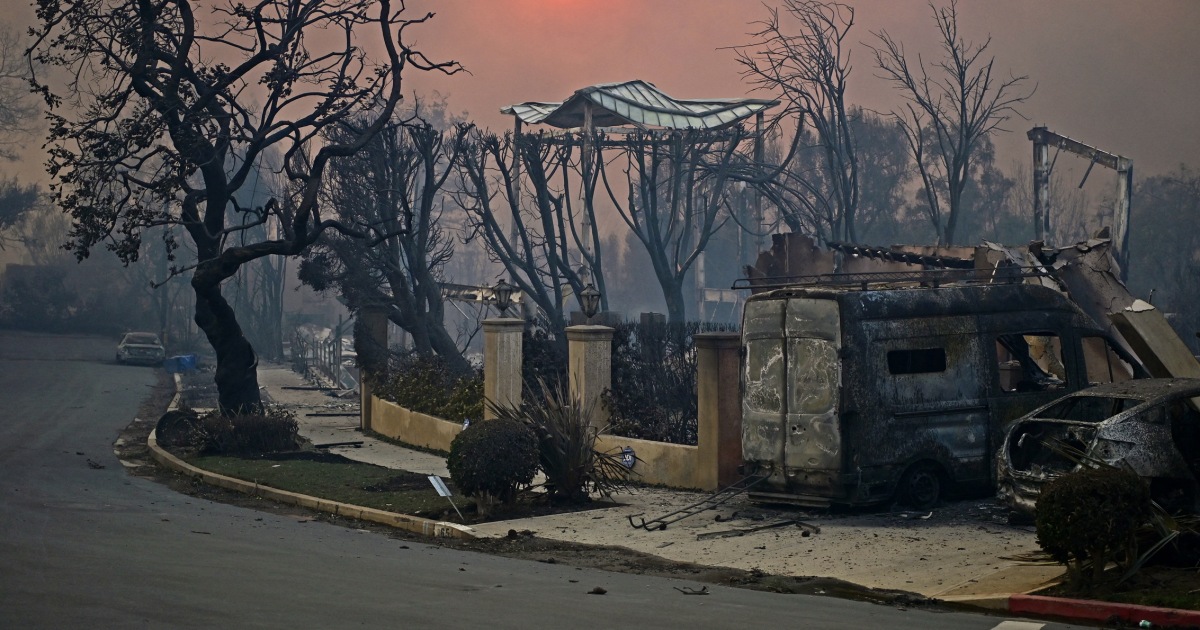
LOS ANGELES — Almost five months after a first trial ended in a mistrial, a jury found a man guilty of starting the devastating 2025 Palisades Fire in Los Angeles that displaced thousands of people and became the most destructive wildfire in Los Angeles city history.
Jonathan Rinderknecht, 30, was convicted Friday on both federal counts against him: destruction of property by means of fire, and arson affecting property used in interstate commerce.
Sentencing was set for March 17. Rinderknecht faces a minimum of 5 years and a maximum of 40 years in prison, prosecutors said.
The Jan. 7, 2025, Palisades Fire was fueled by winds gusting up to 100 mph that fed on the very dry conditions.
It killed 12 people, destroyed over 6,000 homes and other structures, and caused $25 billion in damage, First Assistant U.S. Attorney Bill Essayli said.
“The question at the time was who was responsible. And now we have the answer to that question,” Essayli said after the verdict.
It was the second federal trial for Rinderknecht, who prosecutors alleged set a brush fire early New Year’s Day 2025 that was quickly contained by firefighters, but which continued to smolder and — seven days later — erupted into the Palisades Fire.
“The strongest evidence was the defendant’s own testimony,” one of the jurors, who gave his name as Cameron and who said he initially voted to acquit, told reporters outside the courthouse after the verdict.
The juror said Rinderknecht said that he was on the hill the night of the first fire, that he didn’t smell a fire or see fireworks and that it was a clear and calm night.
“No one else was on the hill that day or night, and happened to be smoking,” the juror said. “Everything kind of started to point to one conclusion — especially if there was no one else on that hill,” he said.
Rinderknecht’s first trial in Los Angeles federal court ended in June with a mistrial after jurors deadlocked 10-2 in favor of an acquittal.
His retrial began with jury selection on Nov. 2, and the panel comprised of six men and six women began deliberating his fate on Wednesday.
Prosecutors alleged that Rinderknecht, a former Los Angeles resident who was an Uber driver at the time, started the prelude to the Palisades Fire, a much smaller blaze known as the Lachman Fire.
Named after a nearby street, this blaze was detected by environmental sensing platforms at 12:12 a.m. on Jan. 1, 2025, and was extinguished by firefighters after burning roughly five to eight acres of dense brush.
But even though firefighters doused the flames, the “holdover fire” continued to smolder underground and was reignited a week later by the Santa Ana winds and grew into the monstrous Palisades Fire, prosecutors said.
At the first trial, prosecutors painted Rinderknecht as a man mad at the world, citing passenger accounts of him ranting at them on New Year’s Eve.
Rinderknecht “was angry all the time,” and “believed he was enslaved by the wealthy,” Assistant U.S. Attorney Danbee Kim told the court.
At the second trial, prosecutors seeking to convict Rinderknecht built a case against him using surveillance camera footage of his car driving in the Pacific Palisades neighborhood before the fire, GPS location information, and a green BIC barbecue lighter.
“It’s not the traditional smoker’s lighter that I’m used to seeing,” LAPD Detective Matt Castellichio testified for the prosecution.
Assistant U.S. Attorney Mark Williams said in closing arguments Wednesday that DNA from the lighter matched Rinderknecht’s DNA.
The defense attorney, Haney, said Rinderknecht admitted earlier to investigators he had the lighter with him. He said investigators found it in the glove compartment of his rental car, not at the scene of the Lachman Fire.
Rinderknecht, after dropping off a passenger in the Palisades, decided to walk up what’s known as Hidden Buddha Hill hoping to see some fireworks in the distance and ring in the new year, Haney said.
After the environmental sensing platforms detected the Lachman Fire, Rinderknecht called 911 several times but his cellphone was out of service range.
Those calls, Williams told the jury, were to create an alibi and Rinderknecht had asked ChatGPT whether a person was at fault if a wildfire was caused by their cigarette.
Rinderknecht also recorded images of the fire, Williams said.
“The only verdict you can reach is guilty,” Williams said in his closing argument Wednesday.
Haney said Rinderknecht should be acquitted because nobody saw him start the fire, no camera recorded the blaze being ignited, and that evidence at the site of the Lachman Fire had been compromised because the scene was open to the public for several days before it was closed by police.
Ed Nordskog, a retired Los Angeles Sheriff’s Department arson and bomb investigator, testified earlier for the defense that “it appears hundreds of people visited the scene before it was locked down.”
“In my experience, we call it a case killer,” Nordskog testified.
The Palisades Fire burned 23,448 acres, resulted in 12 deaths, and destroyed 6,837 homes, businesses and other structures, according to the Los Angeles Fire Department.
Starting in the Santa Monica Mountains, it burned through the Pacific Palisades neighborhood and then spread rapidly through the Los Angeles County communities of Topanga and Malibu.
It was more than three weeks before firefighters were able to corral the fire and the blaze wasn’t completely contained until Jan. 31, 2025.
Los Angeles City Council member Traci Park, who represents the Palisades, said “there is no amount of courtroom justice that will ever undo the harm that was caused.”
“What happened was just so deeply personal and traumatic,” she told NBC Los Angeles outside court Friday.
The Los Angeles Fire Department on Friday thanked the jurors.
“Our first thought remains with the families of those we lost and for everyone in our community whose lives were changed by this fire,” it said in a statement. “No verdict, however important, could ever undo that loss.”
In the second trial, the juror who gave his name as Cameron said they initially took a vote, and he was the only one to vote not guilty. Ten others voted to convict and one was undecided, he said.
“We sat there, and we just bounced our reasons why until we eventually met in the middle,” he said, adding, “We just continued and continued until eventually everyone did decide.”
The juror said that the panel weighed the evidence carefully and knew that whatever they decided would have serious ramifications on Rinderknecht’s life.
The juror wouldn’t say whether he believed Rinderknecht intended to burn down the Palisades.
“His intent was to start a fire,” the juror said. “What that fire did after ... only he will know and God will know.”
“The result of his fire is what ultimately led to January 7th,” the juror said.
Follow popular topics
ElectionsArtificial intelligencePop CultureScienceHealthSee your feed›Add NBC News to GoogleMadeline MorrisonMadeline Morrison is an associate producer for NBC News.
Phil HelselPhil Helsel is a reporter for NBC News.
Corky Siemaszko contributed.