Claude Fable 5.2 and Mythos 5.2 cement Anthropic's AI lead just before its IPO
By Google News AI ·

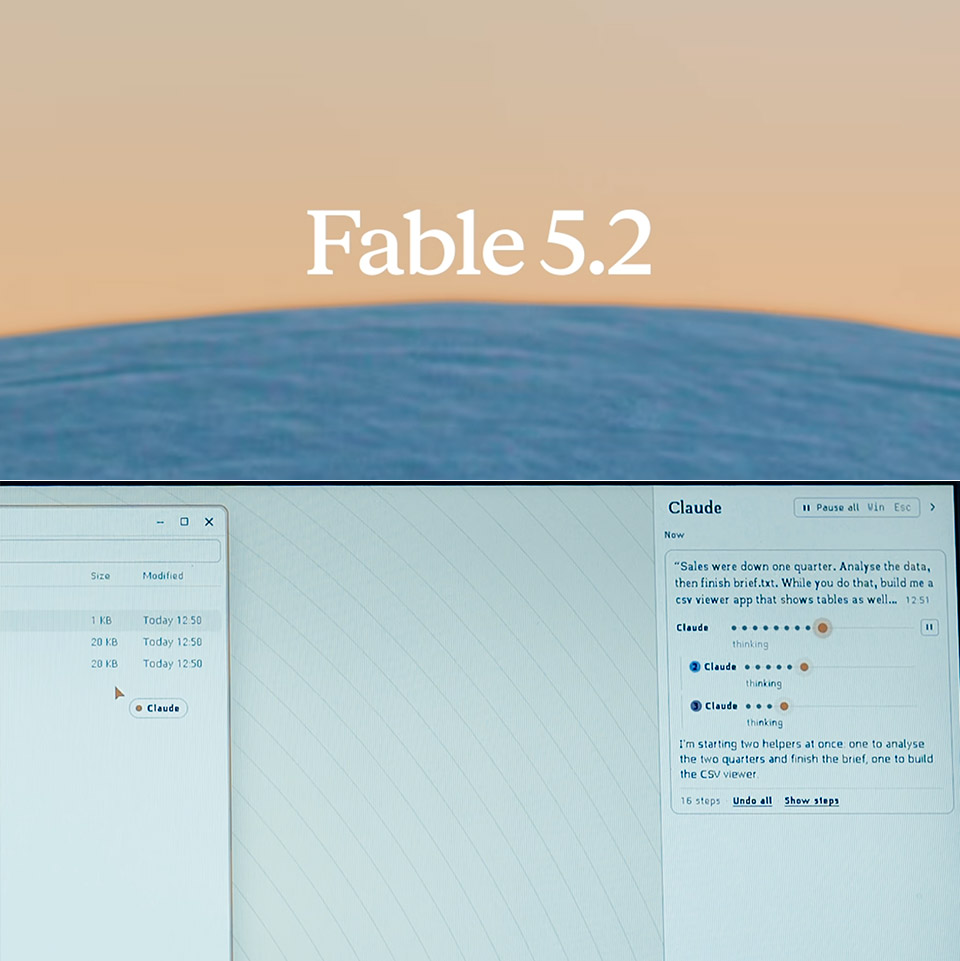
Anthropic's Claude Fable 5.2 and Mythos 5.2 reclaim the AI performance lead shortly before the company's IPO, in some cases by a wide margin. Opus 5.5 remains Anthropic's recommended model for everyday use.
Claude Fable 5.2 and Claude Mythos 5.2 share the same model foundation but, just like their predecessors, differ in access. Fable includes safeguards that block risky tasks in cybersecurity and biology and is available to all users. Mythos removes certain of these restrictions and is open only to organizations that apply through Anthropic's Verification Programs for Cybersecurity or Life Sciences.
Pricing is $8 per million input tokens and $40 per million output tokens. On paper, at least, that's a cut from the predecessors, which cost $10 and $50. What users actually pay depends on token consumption, which varies with tasks, settings, and software environments. Anthropic positions the new models for the most demanding technical work and continues to recommend Claude Opus 5.5 for everyday use.
The models produce output up to 30 percent faster than Fable 5.1 and Mythos 5.1, Anthropic says. An optional fast mode for select organizations speeds up token output by up to a factor of 2.5 but costs twice as much and is available only on certain platforms, including Claude Code, the Claude Platform, Google Cloud, and Microsoft Foundry.
Artificial Analysis’s benchmarks put Fable 5.2 clearly ahead of its rivals. On the current Index v5 at the highest compute tier, it takes first place with 65 points, five ahead of Gemini 4 Carbon (60, High tier), which Google still hasn't released, six ahead of Claude Opus 5.5 (59, Max tier), and a striking 15 ahead of Claude Fable 5.1, which came out only in early September.
Fable 5.2 scores best in five of nine individual tests, according to Artificial Analysis.
It hits 80 percent on HLE-Diamond, a test with expert-level academic questions, 73 percent on Terminal-Bench-Science, which tests whether an AI agent can independently run scientific workflows in a terminal, and 49 percent on FrontierCode 2.0, which evaluates whether an agent can deliver useful code changes in real open-source projects.
Fable 5.2 is weaker in agentic knowledge work and terminal-based coding. It reaches 1,785 Elo on AA-Briefcase, a benchmark for multi-step knowledge work tasks, just behind Claude Sonnet 5.5 (1,813) and within the confidence interval of Opus 5.5 (1,800). On Terminal-Bench 4.0, which measures multi-step terminal tasks in areas like software development and security, it scores 60 percent, tied with Opus 5.5.
Kimi K3.1 Pro (67 percent), Gemini 4 Carbon (65 percent), and Sonnet 5.5 (64 percent) rank higher here.
Peak quality comes at a price, though. Per-task costs at the highest tier average $26.50, about 2.6 times as much as Opus 5.5 ($10) and roughly double Fable 5.1 ($12.99).
Fable 5.2 still scores 62 points on the Intelligence Index at the lower High and Xhigh tiers, ahead of every other model at any tier according to Artificial Analysis, while consuming far fewer tokens: 98,000 output tokens per task compared to 173,000 for Opus 5.5 at the Max tier.
The new models also set records in cybersecurity, which is seeing intense debate right now. Mythos 5.2 finds more vulnerabilities than earlier models and is better at reproducing and fixing them, Anthropic says. Fable, the publicly available variant, blocks most security-related tasks as a result, including penetration tests and exploit code generation. Opus 4.8…
Originally published by Google News AI