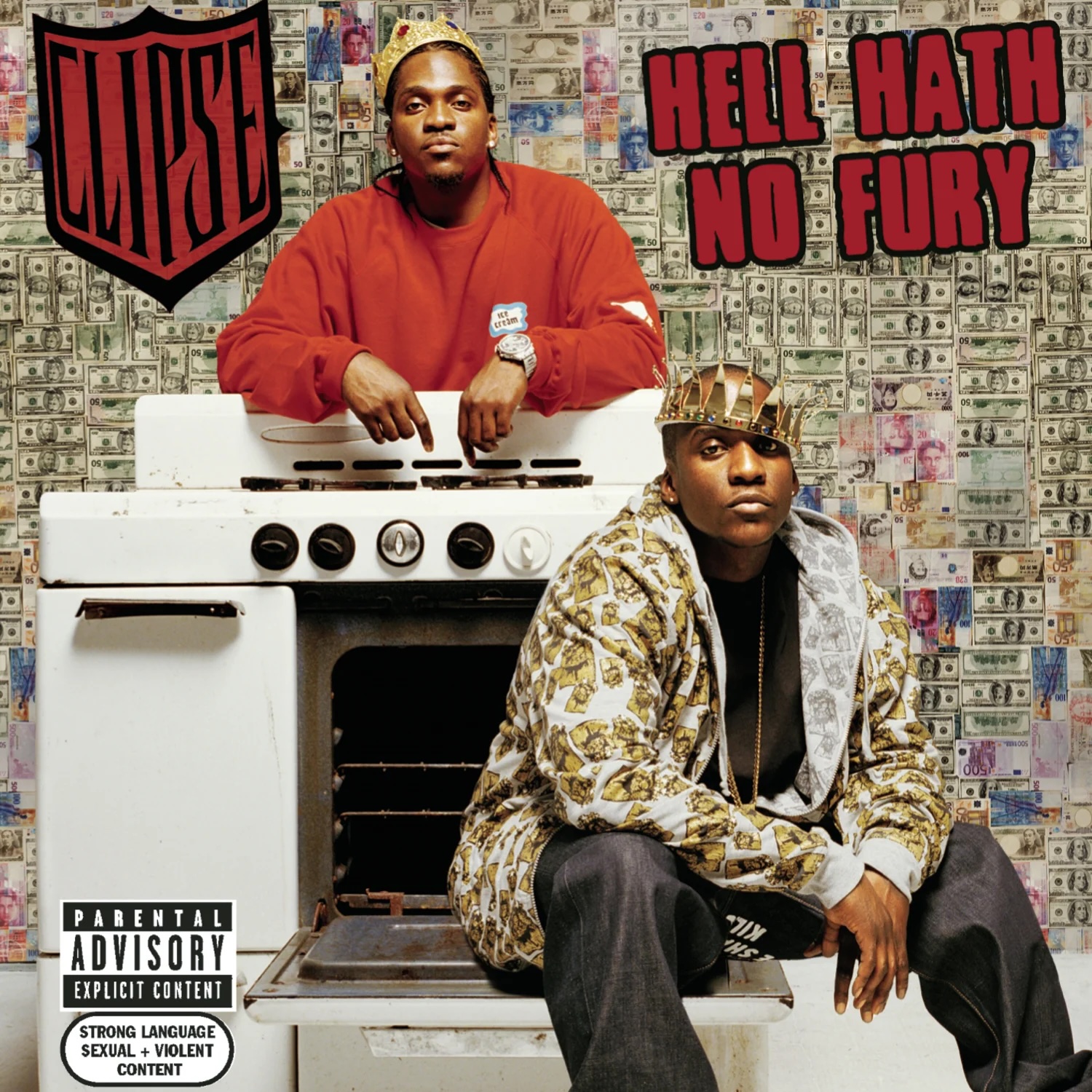
After more than four years of label disputes, Clipse released Hell Hath No Fury in 2006. The delayed follow-up to their gold-selling 2002 album Lord Willin' arrived with Malice and Pusha T furious at the industry—and ready to make a record with little interest in radio play.
The Virginia Beach brothers had broken through with help from the Neptunes, who produced Lord Willin' and helped bring its stark stories of the drug trade to radio. But after a corporate restructuring shifted Clipse from Arista to Jive, the group was shelved by a label that had not signed them. They sued to leave their contract, and their momentum stalled.
In retrospect, the delay helped fuel one of rap’s most uncompromising albums. Rather than chase another hit like “Grindin’,” Clipse made a hostile, tightly focused record that pushed their sound to its limits. Hell Hath No Fury turns 20 on Saturday.
Clipse had faced a stalled debut before. The Neptunes helped broker a deal with Elektra in 1999, but the planned album Exclusive Audio Footage never came out. Lord Willin' gave them another chance, and its mix of the Neptunes’ oblique funk and Clipse’s blunt trafficking narratives reached radio alongside Nelly and Ludacris. The group also made “What Happened To That Boy” with Birdman, an experience that apparently led to a rift with Cash Money that would reverberate for decades.
After the move from Arista to Jive, even their ties to the peak-era Neptunes could not keep them off the shelf. Clipse sued to exit their contract, a fight that likely kept them out of music for longer, and vented their frustration on the We Got It 4 Cheap mixtapes. On them, they mocked label executives and vowed to maintain other income streams: “Fuck Zomba, I sell nose candy, Willy Wonka.”
The mixtapes—especially 2005’s Vol. 2—also brought Clipse a new audience among critics and hipsters. When the lawsuits were settled and deals were signed, the prospect of a second album became real. Hell Hath No Fury was repeatedly delayed before reaching stores on the Tuesday after Thanksgiving, prompting critics to revise their year-end lists.
The group had no intention of making a record designed to generate income for labels they felt had abandoned them. They opted for a malevolent, inward-looking album, with no hit singles or superstar crossovers. Its only collaborators were close friends on the same wavelength and Slim Thug, another Neptunes beneficiary, who appeared on one hook as his own spotlight moment was about to end.
Unlike Lord Willin', which included party songs, songs aimed at women and appearances from Fabolous and Jermaine Dupri, Hell Hath No Fury largely shut out commercial considerations. It sounded unlike major-label or independent rap of 2006—or any other year—more like Clipse and a small circle of collaborators closing ranks.
On the We Got It 4 Cheap tapes, Clipse had taken current hit beats and made them their own, a tactic also used by Lil Wayne as he became rap’s biggest star. But Clipse were not trying to emulate Wayne. Lead single “Mr. Me Too” addressed their disdain for him. The conflict ran deeper than Wayne wearing Bathing Ape after Clipse; the fashion dispute stood in for broader grievances about rap stars discussing the cocaine trade.
Pharrell’s verse on “Mr. Me Too” can sound like a grim parody of cash-money millionaire excess: “Just last week, I was out in Aspen/ Me and Puff hoppin' off a plane, both us laughin'.” Malice and Pusha T, meanwhile, focus on their peers’ behavior while they were absent: “I was just assumin' you'd keep the coke movin'/ But I got one question: Fuck y'all been doin'?”
The production is as confrontational as the lyrics. According to Clipse interviews from years later, the Neptunes tracks were made by Pharrell working independently of his onetime partner Chad Hugo. Drones, hums and low rumbles meet handclaps, sharp snare bursts and shakers, while the brothers deliver lines such as “Have that money right or end up in the truck taped up” and “Peel money rolls till our thumbs get the papercuts.”
The second single, “Wamp Wamp,” was no more accommodating. Slim Thug’s hook might have seemed capable of appealing to listeners after Houston screw’s major pop moment, but the skittering steel drums and bagpipes made that unlikely. Its sound is closer to the Hadron Collider than Houston, while Pusha T’s verse turns on elaborate wordplay: “Can't stand the bright from the ice, the chain xenon lamp ya.”
That strange, sharply defined sound runs throughout the album. The Neptunes turn their pop sensibility toward funk abstraction: the sustained, stuttering harp strings on “Ride Around Shining,” the gasping choirs and woodblocks on “Keys Open Doors,” and the swooping, panning effects on “Trill.” The arrangements are outlandish, but Malice and Pusha T find their way through them with ease.
There are small changes in mood, including the regretful ballad “Nightmares,” but the album keeps a consistent focus. Even “Dirty Money,” which addresses women, is making a point rather than flirting. The record stays within the world of the cocaine dealer, making clear that any gifts are bought with ill-gotten money: “Now, tell me: Is the dirty money really that bad?”
Two years after the album’s release, Malice rapped, “I'm not a part of your coke-rap genre.” The line pushed back against critics who focused on the record’s drug-trade lyrics, including “Open the Frigidaire, 25 to life in there/ So much white you might think your holy Christ was near” and “Coke money clean through Merrill Lynch, accountant just gasp at the smell of it.” Clipse did not discuss selling cocaine in the same way as contemporaries such as Jeezy and Cam'ron; it formed part of a wider setting.
The underworld of Hell Hath No Fury is about more than cocaine. It gives the brothers room to explore paranoia, distrust, jealousy, confidence and financial instability. The album’s wordplay remains striking, from “Flow chameleon, worth 'bout a million/ Sell Bolivian, feds in oblivion/ Bitch Brazilian, purse reptilian/ Took her from far-off island like Gilligan.” Its meaning has also changed with the intervening years, which brought a long hiatus, Pusha’s solo career, Malice’s religious awakening and the group’s return.
Most tracks follow a similar structure: a Pusha verse, a hook, a Malice verse, another hook, a passage with both rappers, then a final hook and instrumental outro. That pattern brings their differences into focus. Pusha is flashier, angrier and more militant; Malice’s conscience and inner conflict come through more strongly. “Momma I'm So Sorry,” once heard as facetious talk, now sounds like a sincere apology, alongside Malice’s evident unease that his younger brother became involved in an amoral life.
The album won rapturous reviews, including a rare high rating from XXL, but it did not become a commercial blockbuster. At the time, rap sales were closely tied to perceptions of influence and artistic respect, and albums that failed to match Kanye West’s numbers could be mocked on the XXL blogs. Hell Hath No Fury debuted at #14 and never went gold. Some considered it a failure, but it mattered.
On the 2006 Pazz & Jop poll, the album placed at #7, between the Arctic Monkeys and Neko Case. Other rap records in the top 40 included Ghostface Killah’s Fishscale, the Roots’ Game Theory and Lupe Fiasco’s Food & Liquor. The critical response gave Clipse a real audience, though perhaps not the one they expected. They played indie festivals such as Pitchfork, rap shows including a Brooklyn event celebrating the launch of the Zune, and opened for Modest Mouse.
After Hell Hath No Fury, Clipse tried to move back toward the mainstream with 2009’s Till The Casket Drops, which featured Kanye West and Cam'ron and included production from outside the Neptunes. It was less uncompromising and had less impact. Soon after its release, Malice decided he was done, while Pusha became the sharpest shooter on West’s G.O.O.D. Music roster.
Nineteen years after Hell Hath No Fury, Clipse returned with Let God Sort Em Out, a record they explicitly modeled on the earlier album. They worked with Pharrell and shut out contemporary influences. The new release earned recognition from institutions, including the Grammys and the Vatican, that had ignored Hell Hath No Fury. Once again, the group faced label disputes to release the album they wanted.