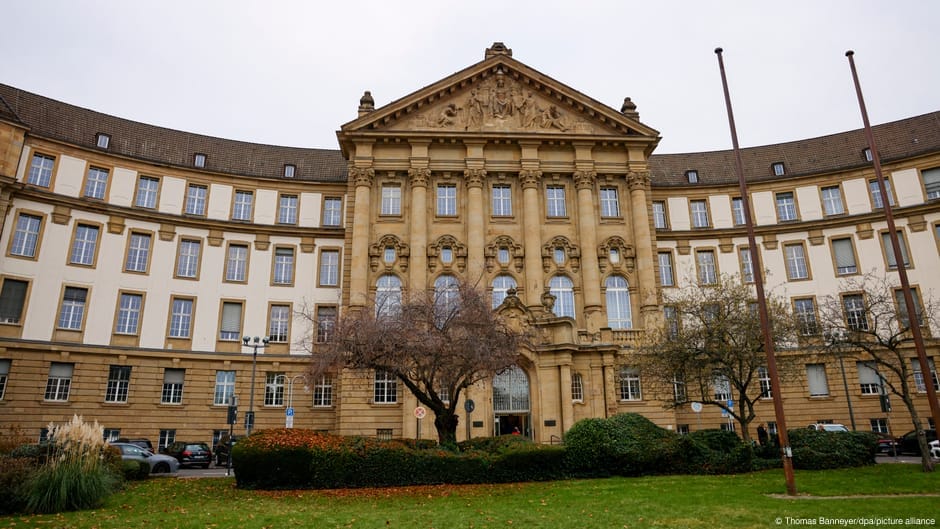
Germany’s higher regional court in Cologne has ordered the archdiocese to pay €550,000 ($601,865) in damages to a woman who was sexually abused by a priest for years. The court described the award as the highest a German court has ever granted to a victim of abuse in the Catholic Church.
The amount will be offset by the €360,000 the Catholic Church’s Independent Commission for Recognition Payments has already paid to the claimant. The Cologne Regional Court had previously rejected her claim. Although it accepted that she had been severely sexually abused by a priest in the 1970s and 1980s, it said the archdiocese could not be held responsible because he had acted “more or less as a private individual.”
The higher regional court overturned that ruling on appeal, saying the priest had approached the claimant “under the cover of his church work” while serving as a deacon. It said he used his standing in the church to be allowed to take in foster children, including the claimant. The priest was sentenced to 12 years in prison in 2022.
German Foreign Minister Johann Wadephul warned against the Ukraine conflict spreading to other regions following Ukrainian attacks on Russian ships in Libya. Speaking at a press conference in Berlin with Romanian counterpart Dan Neculaescu, he said: “Ukraine's right to self-defense is undisputed and we do support Ukraine, but I strongly warn against allowing this conflict to spread geographically.”
Wadephul also condemned reported Russian attacks on two foreign freight ships near Ukraine’s Black Sea port of Odesa, which were said to be carrying grain. He said the attacks affected not only the security of nearby nations but also food security for people in the Global South. “It is clear that we cannot accept drone attacks on trading vessels,” he said. “NATO will therefore step up its engagement in the region.”
President Frank-Walter Steinmeier called for closer economic and political partnerships with African countries as he concluded what was probably his last trip to the continent as head of state. Speaking in Kenya, he noted wide differences in development between countries and within some countries.
“But I believe it is worthwhile investing in Africa and in relations with African countries,” Steinmeier said. He said this was not only about potential investment by German companies attracted by Africa’s mostly young national populations and developing markets. “That is true, but we should not limit our view to that. Many African countries now have political weight and growing self-confidence and want a say in shaping the future of the world,” he said. “Africa, it has become clear, is a continent that requires patience if you want to discover it,” Steinmeier said. “There is no single Africa, but very many.”
Before Kenya, Steinmeier visited Ivory Coast and Ghana. On the final day of his trip, he visited the Crescent Island nature reserve on Lake Naivasha, an area under threat from climate change.
Chocolate manufacturers in Germany produced less in 2025 than in the previous year, according to figures released Thursday by the Federal Statistical Office (Destatis). Germany made around 1 million metric tons (1.1 US tons) of chocolate products containing cocoa, down from 1.1 million tons in 2024.
Germany exported 916,200 tons of chocolate products in 2025 and imported 530,000 tons, a quarter of which came from neighboring Belgium. France received 13.4% of exports, followed by Poland at 9.6% and the UK at 9.3%.
Germany also remained the European Union’s leading producer of gingerbread, or Lebkuchen, accounting for 39.4% of the bloc’s supply, Destatis said, citing EU statistical agency Eurostat. Poland produced 17.3% and the Netherlands 17%.
German authorities said two Iraqi citizens believed to belong to a pro-Iranian terrorist group had been arrested on suspicion of planning several anti-Jewish attacks, including an attack on a synagogue in Cologne. Further details were available in DW’s article, “Germany: 2 arrested, suspected of plotting synagogue attack.”
A survey by the police union GdP found that about 69% of police in Germany support banning private fireworks on New Year’s Eve. More than 70% of the 9,000 members surveyed said the situation for police that evening would improve under a ban.
Among respondents who had been on duty during New Year’s Eve celebrations in the past 10 years, 54% said they had faced a dangerous or threatening situation caused by fireworks. A total of 195 said they had been injured by fireworks that evening.
The poll followed an open letter to Interior Minister Alexander Dobrindt from a group calling itself #böllerciao (Goodbye firecrackers), which had about 1.17 million signatories. The name plays on the anti-Nazi song Bella Ciao. The group includes 86 organizations, among them Environmental Action Germany (DUH) and the GdP, which have called for a ban to protect people, emergency personnel, animals and the environment.
Germany’s coalition parties approved a €1 billion ($1.1 billion) increase in the Interior Ministry’s budget after debate focused in part on planned centers in Rwanda for rejected asylum seekers. Klaus-Peter Willsch of Chancellor Friedrich Merz’s Christian Democrats (CDU) said €5 million was earmarked for the so-called return hubs, to be shared among several European countries.
Willsch said the €20 million often cited in connection with the Rwanda migration centers was intended not only for hubs there but also for potential projects in other third countries. The plans, drawn up by Interior Minister Alexander Dobrindt of the Bavarian Christian Social Union (CSU) with Austria, Denmark, the Netherlands and Greece, drew criticism from coalition partner the Social Democrats (SPD) and opposition parties.
The Green Party and the Left Party rejected the proposal on ethical grounds. Green lawmaker Leon Eckert called it “state-organized human trafficking,” while Dietmar Bartsch of the Left said the deal was being made with an authoritarian regime. The far-right Alternative for Germany (AfD) called the plans too soft; its parliamentarian Marcus Bühl described them as a “smoke screen,” noting that only 20 rejected asylum-seekers from Germany were initially to be sent to Rwanda.
Dobrindt said the opposition was trying to stir up controversy over a concept approved at European level. He also called criticism of Rwanda’s political system inappropriate, citing a school for Afghan girls established there amid the Taliban government’s ban on secondary education for females.
Dobrindt said the additional funding for his ministry would help protect Germany against hybrid attacks from Russia, with more money for IT security and civic protection. The draft 2027 budget, approved by the CDU/CSU bloc and the SPD, provides less for the BAMF migration authority, reducing its funding from €999 million in 2026 to €994 million. Integration aid for migrants and refugees is cut by €328 million to €1.07 billion.
The start of a Berlin trial on Thursday for a German-Ukrainian woman accused of spying for Russia was delayed after she developed health problems and needed treatment from emergency medical workers, a court spokeswoman said. It was not clear whether the trial could proceed as planned.
The 57-year-old is accused of passing information to an officer from Russia’s GRU intelligence agency who was posing as a diplomat at the Russian Embassy in Berlin. Prosecutors allege she used contacts with current and former German Defense Ministry officials to gather information on military aid for Ukraine, drone test sites and the arms industry. She is also accused of giving her alleged handler access to key political events in Berlin.
The woman was arrested in late January. The alleged involvement of the Russian Embassy prompted considerable outrage in Berlin. Russia’s ambassador was summoned, and the handler—identified by news weekly Der Spiegel as the embassy’s deputy military attache—was expelled from Germany.
The Bundestag is holding its concluding debates on the 2027 budget ahead of a final vote scheduled for Friday. Thursday’s discussions were initially set to focus on the Interior Ministry’s budget. The ministry, led by Alexander Dobrindt of the CSU, the sister party of Merz’s CDU, is responsible for the federal police and domestic intelligence agency BfV, among other bodies.
The government proposes allocating about €16.8 billion to the ministry in 2027 ($18.43 billion), roughly €1 billion more than this year. Lawmakers were then due to debate budgets for the Economics and Energy Ministry; the Ministry for Housing, Urban Development and Building; the Ministry of Food and Agriculture; and the Ministry for Education, Family Affairs, Senior Citizens, Women and Youth.
Opening the budget debates on Wednesday, Merz called the tight budget an “accurate reflection” of the “difficult situation as a country — geopolitically, technologically, and demographically” facing Germany. “We will no longer be able to afford everything with tax revenue that we have become all too accustomed to for far too long,” he added.
DW’s article “€561 Billion and Still Not Enough: Germany's 2027 Budget Exposes a Coalition on the Brink” gives further details on the planned 2027 budget.
The second-to-last day of debates on the 2027 budget was under way in parliament. The plan foresees record spending and borrowing, as lawmakers weigh economic and geopolitical challenges and priorities amid an ideological split within the governing coalition.
The agenda also included the opening of the Berlin trial of a woman accused of spying for Russia against the backdrop of Moscow’s full-scale invasion of Ukraine. Germany’s chocolate production fell last year, while the country remained Europe’s leading producer of Lebkuchen.