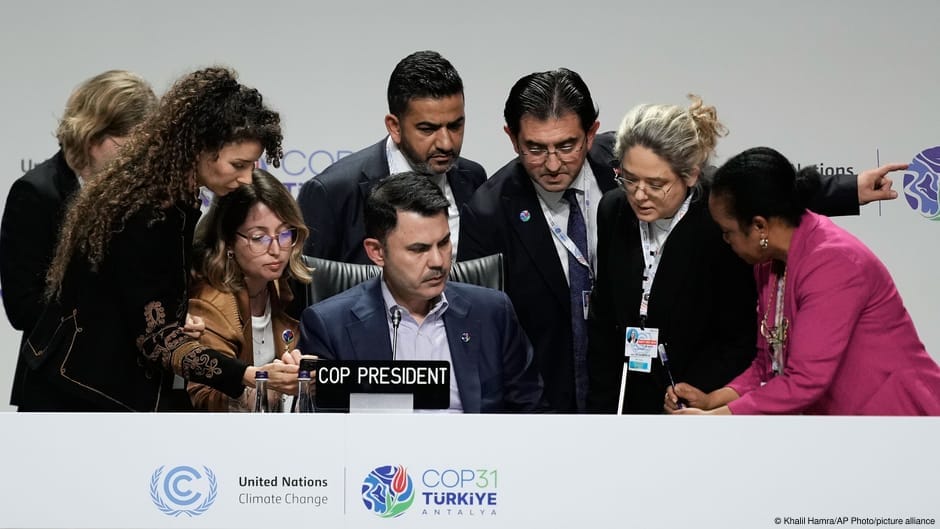
COP31 climate talks in Antalya ended without agreement after the European Union and other countries rejected a proposed deal that omitted fossil fuels and drew criticism over climate finance for vulnerable nations.
The negotiations ran almost two days into overtime after two weeks of talks. The EU said it could not support the COP presidency’s proposed Antalya Pact because it did not respond to the science. “We will not endorse a cover decision that does not even mention fossil fuels, the driver of climate change. And we will not accept negotiating backward in time,” Irish climate minister Darragh O'Brien said on Sunday, speaking for the EU.
O'Brien called adoption of a decision that left out fossil fuels “unconscionable” and warned it risked “deepening the chasm between global commitment and the action required.”
Panama also rejected the proposed deal, calling it a step backwards in addressing the climate crisis. It said any decision must acknowledge “the truth about the collective failure on 1.5 degrees Celsius [2.7 degrees Fahrenheit],” the threshold set out in the 2015 Paris Agreement to avert runaway climate change. “Those who contributed to this crisis ... must shoulder the responsibility to deal with it,” the Panamanian delegation said.
The Marshall Islands, which faces an existential threat from sea level rise, formally objected to the cover decision, saying “we will not compromise our future to benefit fossil fuel interests.” Australia's COP31 negotiating president Chris Bowen said the breakdown was very disappointing.
Russia backed leaving out wording on accelerating a phaseout of fossil fuels, arguing they remain a necessary power source and that each country should determine its own path to cutting emissions. Pakistan and Ghana defended the agreement as a necessary compromise in the spirit of multilateralism. “We need to build bridges not barriers,” Pakistan’s negotiator said.
Financing was another major point of dispute. Developing states blamed the collapse on the EU and other wealthier nations, saying they had failed to increase funding to help countries adapt to climate-linked weather extremes and the damage they cause. The EU is the largest provider of climate finance and has resisted new adaptation finance targets.
Harjeet Singh of the Fill the Fund campaign accused wealthy countries of seeking greater climate ambition while refusing to provide the money to support it. “You can't ask developing countries to transform their economies while they're drowning in disasters and debt,” he said.
The proposed cover decision called for further talks on “an implementation pathway for tripling adaptation finance by 2035,” but set no figure. It noted that developing countries need some $300 billion annually for adaptation until 2035 and expressed concern about “the gap between climate finance flows and needs.”
Outside the formal negotiations, a separate initiative to Transition Away from Fossil Fuels (TAFF) has been gaining momentum. Tuvalu's minister for climate change and the environment, Maina Talia, said it was “moving beyond debating whether fossil fuels are simply mentioned in a text, to creating detailed plans for a global transformation.”
Ireland, Denmark, the Netherlands, France, Germany and Finland have either completed or are working on national roadmaps to wean themselves off fossil fuels. Brandon Wu, director of Policy and Campaigns ActionAid USA, called the plans “meaningless” and “nothing more than restatements of inadequate existing policy” by rich countries failing to step up on climate finance. “COP31 was one of the worst COPs ever, and it's because the EU and other developed countries came with zero spirit of solidarity, cooperation or compromise. They may as well have come to the COP shouting at vulnerable communities: 'we don't care if you die.'”
The rejected cover decision also recognized that electrification can cut emissions, improve energy security and expand access to energy. It proposed raising electricity’s share of final energy demand from around 20% now to 35% by 2035, a proposal heavily promoted by co-host Turkey.
About 75 countries, including solar powerhouse China, adopted the pledge outside the formal negotiations. It is non-binding and does not specify whether the additional electricity must come from clean sources. Critics said that leaves open the possibility that fossil fuels could meet increased electricity demand.
The talks were the first COP held with explicit knowledge that global temperatures will exceed 1.5 degrees Celsius above pre-industrial levels. Countries differed over how to address that “overshoot.” The cover decision called on states to commit to limiting it, noting that each increment of warming above current levels would “result in increasingly adverse, and in some cases irreversible, impacts and risks to human and natural systems.”
The draft also recognized the need for “deep, rapid and sustained” emissions cuts and action to ramp down potent greenhouse gas methane. Another contentious issue was a call to increase carbon capture and storage, which involves capturing CO2 and burying it. The text said the world should aim to reach “gigaton scale” by 2035.
Scientists say some carbon removal technologies will be needed to curb emissions and bring temperatures back down. Critics argue the technologies are unproven at scale, expensive and could give polluters an excuse to continue burning fossil fuels. Vanuatu's climate minister Ralph Regenvanu said carbon capture and storage “had been singled out for special attention that it doesn't deserve.”
COP31 followed a series of recent climate-related disasters, including deadly heat waves in Europe and a glacier collapse in Nepal that killed more than 1,400 people. Geopolitical shocks that sent oil prices rising globally also put energy security and the future of fossil fuels in focus.
Near the end of the conference in Antalya, Ethiopian foreign minister Gedion Timothewos, who will preside over COP32, said his country aimed to “restore hope, rebuild trust and mobilize collective action” at the next summit, scheduled for 2027 in Addis Ababa. “We will work with you all to rebuild confidence in multilateral climate cooperation. This confidence must be earned through delivery. The decisions we take at COPs must advance climate action and implementation.”