The Cop31 UN climate summit in Antalya, Turkey, went into overtime on Friday as nearly 200 countries remained divided over a draft deal that did not mention fossil fuels. The talks had been scheduled to finish on Friday evening.
The Guardian understands negotiators probably will not receive a new draft agreement until Saturday morning. An initial version released earlier in the week called for accelerating the phase-out of coal, oil and gas. A shorter draft issued on Thursday omitted fossil fuels and weakened goals on electrification.
“At this point, no one is happy,” Brazil’s national secretary for climate change, Aloisio Lopes Pereira de Melo, told reporters.
African ministers made a dramatic intervention on Friday, saying African countries were being asked to pay for a crisis they did not cause. Zanetor Agyeman-Rawlings of Ghana, ministerial chair of the African group of negotiators, said: “The continent will not accept an outcome that offers declarations without the resources to deliver them. We didn’t come here to beg. We came here to claim what is rightfully ours for our people who are suffering the brunt of anthropogenic activities of developed countries, that they are now being asked to pay for in ways that they never asked.”
Ministers from Ghana, Zambia, Senegal, Kenya and Sierra Leone accused rich countries of attempting a third exploitation of the continent, after slavery and colonialism, through carbon taxes they said could prevent Africans from using critical minerals to industrialise. African nations also sought discussion of climate finance. Civil society observers accused richer countries, led by the EU, of obstructing progress on finance talks.
The EU’s chief climate negotiator said on Friday that the bloc was already the world’s leading climate finance donor. A senior EU official said: “We, together with the EU member states, are providing €32.3bn [£27bn] from public sources and mobilising €9.3bn in private finance in 2025 to support developing countries. We’re doing by far the most.”
Eight countries called for the phrase “a clear transition away from fossil fuels” to be restored to the agreement. Panama, Belgium, Côte d’Ivoire, Finland, Greece, the Solomon Islands and Sweden also called for polluting countries to contribute to funds helping developing countries adapt to the climate crisis.
Panama’s climate minister, Juan Carlos Navarro, said: “It is not acceptable to have a Cop or a cover document that does not even mention fossil fuels, and we simply will not put up with it. We need to tell the truth and to speak clearly.” Panama sent negotiation president Chris Bowen an open letter setting out demands it said were not negotiable.
“Well, red lines – that’s how negotiations work,” Bowen said. On Friday afternoon, he added: “There is still a spirit of making it work. People have strong views, of course. I’m not stepping away from that. But no one has said to me, let’s give up and go home.”
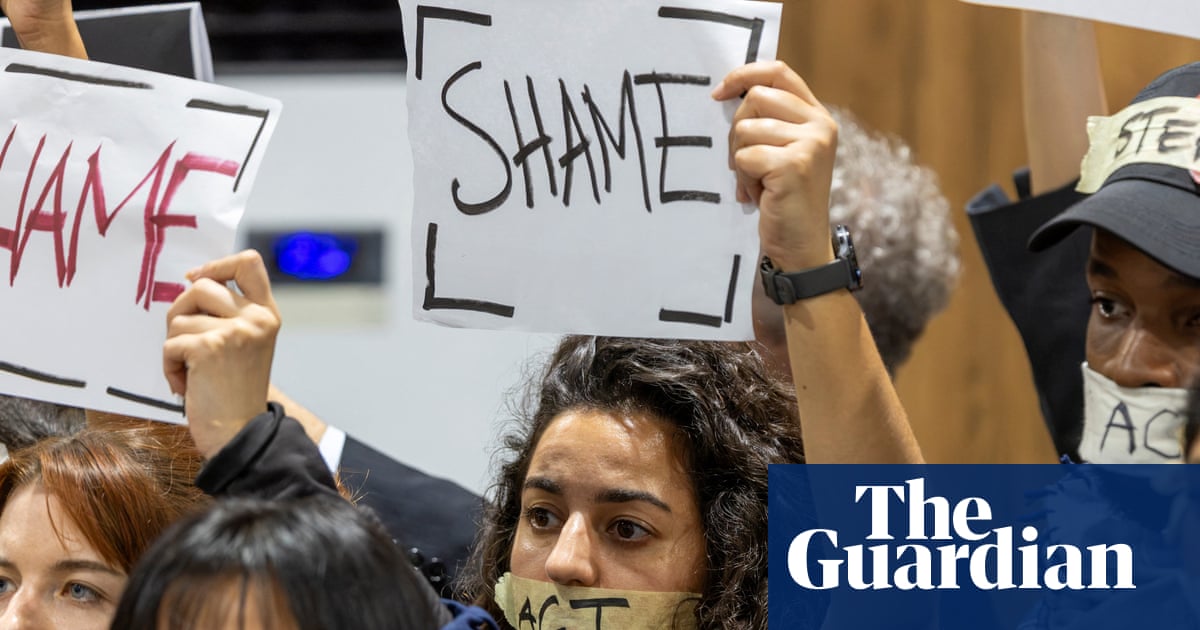
Civil society groups called the summit the “worst Cop ever”, saying none of their priorities had made it into the negotiations. They were particularly frustrated that talks had not advanced a just transition mechanism agreed last year, which they hoped would embed social, racial and economic justice in a low-carbon future.
Several Cop insiders said Saudi Arabia was among countries playing an obstructive role. The country was understood to be pushing for carbon capture utilisation and storage (CCUS) to be strongly referenced in the final agreement as a way to help limit overshooting the 1.5C temperature goal agreed in Paris.
Neil Grant, a senior expert on mitigation at the advisory group Climate Analytics, said CCUS was being included “because the fossil fuel interests want it in there”. He said: “It’s a Trojan horse for fossil fuel interests.”
The last Cop meeting to finish on time was in Italy in 2003. Some talks have continued into the Sunday after their scheduled Friday finish.