The Copa América will return to the United States in 2028, marking the third time in four editions that South America’s premier international tournament has been held in North America. It will be the second consecutive edition staged in the U.S., following the centenary tournament hosted there in 2016.
The decision offers the U.S. men’s national team a chance to face stronger and less familiar opposition as it builds toward the 2030 FIFA World Cup, but it also raises questions about what repeated U.S. hosting means for South American football. ESPN asked Jeff Carlisle and Tim Vickery to consider both sides.
For the USMNT, the tournament brings welcome variety. The team has sometimes struggled to schedule quality opponents, in part because Concacaf is top-heavy. Canada, Mexico and Panama can provide consistent challenges, but the level drops significantly beyond them.
The international calendar compounds the problem. The biennial Gold Cup means two of the three summers in a World Cup cycle are dominated by matches against Concacaf teams. World Cup qualifying and the Concacaf Nations League add to that focus, while qualifying campaigns and other Nations League competitions often limit the availability of teams for friendlies.
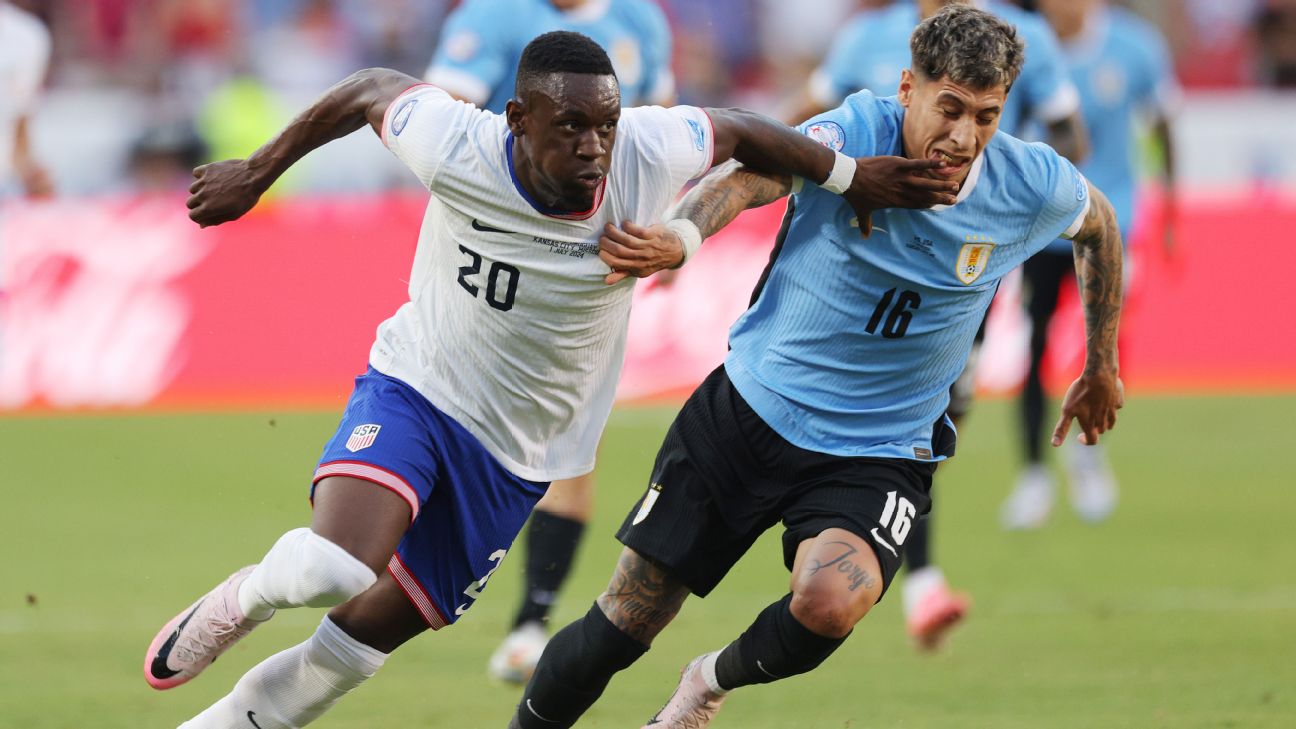
At the Copa América, the U.S. can meet teams it knows less well and potentially face some of the hemisphere’s strongest sides, including Argentina and Brazil. The USMNT’s failure to advance from the group stage in the 2024 tournament, which included a defeat to Panama, shows why testing the team in a tournament setting can be useful.
The 2028 competition will arrive during a period of transition for the U.S. team. The search for a new manager is under way, and a new generation of players has begun its international careers. The tournament could help assess which players and tactics are best suited to the team’s next phase.
The U.S. will also host the Olympic Games in 2028. The Olympics do not match the Copa América’s prestige in soccer, but they attract significant attention in the U.S. U.S. Soccer has emphasized the importance of a strong performance and hired former LAFC manager Steve Cherundolo to coach what will be primarily a U23 team. With Red Bull New York’s Julian Hall and the Philadelphia Union’s Cavan Sullivan making impressive starts with the USMNT, the senior team could draw some players from the Olympic squad.
Carlisle argues that the scheduling tension is a minor concern: experience in tournaments is valuable ahead of a World Cup, wherever it is gained, and the Copa América can provide that for the USMNT.
Vickery points to a different cost for South America. The Copa América, the world’s oldest continental competition, has a long but uneven history. First held in 1916 and initially played annually, it had fallen into disuse by the early 1980s before returning in 1987.
The revived tournament initially took place every two years and travelled around South America. Paraguay hosted for the first time in 1999, Colombia in 2001 and Venezuela in 2007. Peru’s 2004 edition was the first to be played outside Lima. Hosting brought a boost to national morale and helped spur stadium construction, Vickery writes.
After touring all ten CONMEBOL countries following its 1987 return, the Copa began a second circuit in Argentina in 2011. It then went to Chile and Brazil, but the rotation stalled. Ecuador was next in line and is still waiting as the tournament returns to the United States.
The 2016 edition was held outside South America to mark the competition’s centenary. The U.S. was considered equipped to host an expanded tournament. Since 1993, two teams from outside South America had generally been invited to bring the field to 12; Japan and Qatar were among those invited, though teams usually came from Concacaf. In 2016, six Concacaf teams took part, making the tournament larger and more lucrative.
The Copa returned to the U.S. in 2024, presented as part of the country’s preparations to host that year’s World Cup and as an opportunity for South American teams to play in similar conditions.
Vickery says the 2028 decision is justified by money. The U.S. has many large-capacity stadiums, and CONMEBOL has also embraced dynamic ticket pricing. The frequently used argument that “Football needs resources,” he writes, leaves open questions about the fairness of charging committed fans increasingly high prices.
The 2028 tournament means that, over a 12-year period, the Copa América will have been held only in the U.S. and Brazil. Argentina, Paraguay and Uruguay will each host a game at the next World Cup, but Vickery describes that as a token gesture that could leave the competition away from its home continent for some time. He asks whether the arrangement is desirable or sustainable for other South American countries, particularly Colombia, which sees itself as a potential World Cup host, and notes the region’s desire for tournaments and investment.
The next Copa América after 2028 is scheduled for 2032. Vickery says choosing its location could become a political football.