The European Union’s trade agreement with Indonesia opens the prospect of wider market access and investment, but its benefits will depend on how both sides address industrial, environmental and business challenges.
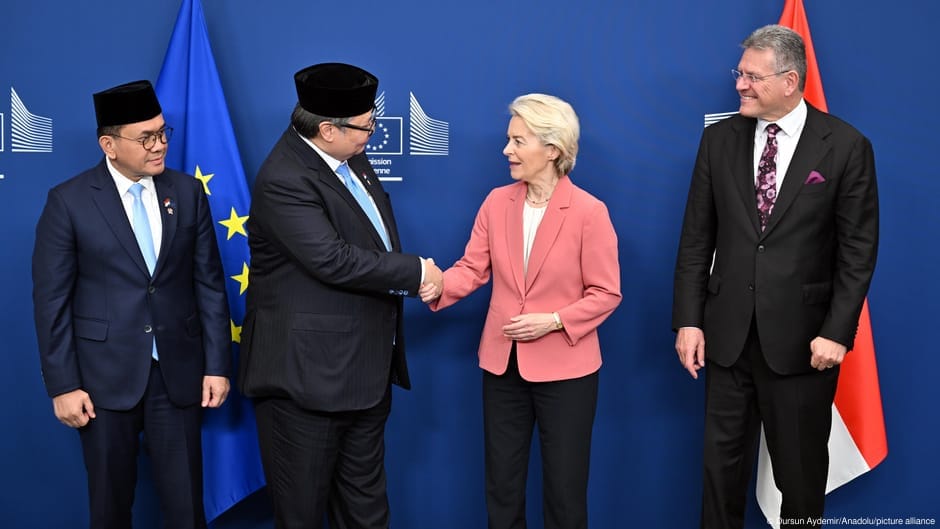
At a signing ceremony in Brussels last week, European Commission President Ursula von der Leyen called the agreement with Jakarta one of the bloc’s “most ambitious deals” in the region, linking markets of 730 million people. The pact follows nearly a decade of negotiations.
For the EU, the deal is part of an effort to diversify trade partnerships, secure critical raw materials and reduce strategic dependencies on China. It will gradually remove tariffs on more than 98% of product categories, covering almost the entire value of bilateral trade over 15 years.
Philip Schleifer, an associate professor of political science at the University of Amsterdam, said access to nickel and other critical raw materials, along with more diverse supply chains, are central to the EU’s strategic partnership with Indonesia.
“The main strategic interests are opening up a large and growing market for European companies, diversifying and deepening its economic partnerships, reducing strategic dependencies on China, and securing access to critical raw materials,” Schleifer told DW.
Indonesia’s minerals are important to Europe’s green and digital transitions. Nickel, for example, is used in batteries and electric vehicles. The agreement also creates opportunities for European investment in sectors including electric vehicles, electronics and pharmaceuticals.
Indonesia, meanwhile, wants to move beyond exporting raw materials by developing domestic processing industries and retaining more value from its natural resources. Eline Blot, a senior policy analyst at the Institute for European Environmental Policy (IEEP), said the two sides will need to reconcile those aims.
“The challenge for the EU is to reconcile its own interest in securing raw material supply with Indonesia's industrial development objectives,” Blot said.
For Indonesia, the agreement could boost exports, attract investment and strengthen its place in global supply chains. A study by the Centre for Strategic and International Studies (CSIS) estimates Indonesian exports could rise by around 60% in the coming years, said economist Yose Rizal Damuri.
“Not only can Indonesia increase exports to Europe, but it can also become more strongly integrated into the global supply chains of European companies,” Yose told DW.
Potential beneficiaries include labor-intensive industries such as textiles, garments, footwear and furniture, as well as other Indonesian commodities and manufactured products. The agreement could also encourage European investment and create employment opportunities.
But access to the European market alone will not guarantee higher exports, Yose said. He identified three priorities: making domestic businesses aware of the agreement, increasing production capacity and improving the business climate.
“Various trade agreements signed by Indonesia have relatively low utilization rates. The value of exports using these facilities remains limited compared with overall export values,” he said, calling for better information and outreach to producers.
Syafruddin Karimi, an economist at Andalas University, said the deal could help Indonesia diversify export markets and reduce dependence on major trading partners such as China, the United States and regional Asian economies. He also warned that Indonesian producers would need to meet European standards.
“Products must be traceable, including whether their production involves environmental damage or labor practices that undermine human dignity,” Karimi said. Smaller businesses, he added, would need more government support to meet requirements on raw materials, production processes and workers’ rights.
More trade and investment could add to environmental pressures, particularly in nickel mining, palm oil production and manufacturing. Blot warned that increased production without stronger safeguards could worsen pollution, ecosystem degradation and industrial emissions.
“Nickel mining and processing can contribute to pollution and ecosystem degradation, while palm oil remains closely associated with deforestation,” she said. The growing importance of Indonesian iron and steel exports also raises concerns about emissions from energy-intensive production.
The EU's Deforestation Regulation (EUDR) presents another challenge, particularly for small-scale Indonesian farmers who may lack the resources, technical capacity and documentation to demonstrate compliance. Blot said the requirements could impose disproportionate costs on smaller producers and potentially favor larger companies.
She cautioned against using smallholders’ livelihoods as a reason to weaken environmental rules, noting that some Indonesian smallholder organisations support the EUDR as a way to improve accountability in the palm oil industry.
“Rather than weakening environmental requirements, the priority should be to ensure that smallholders receive adequate financial and technical support to meet them,” she said.
Schleifer also warned that rising global demand for Indonesian natural resources could bring environmental and social problems previously associated with commodities such as timber, palm oil and coal. Indonesia has considerable bargaining power because of its mineral wealth, but must ensure increased demand supports domestic industrial development rather than simply expanding resource extraction.
The agreement includes a Trade and Sustainable Development chapter covering climate change, biodiversity conservation, sustainable forest management and labor rights. It also provides for cooperation and civil society participation. However, the commitments are not guaranteed to be implemented.
“Experience with other EU trade agreements suggests that there is often a big gap between sustainability commitments on paper and outcomes on the ground,” Schleifer said.
Blot called for a time-bound roadmap with measurable objectives, stronger monitoring and meaningful participation by civil society and local communities.
Karimi said the Indonesian government, at both national and regional levels, must work with businesses to improve production standards, particularly among small and medium-sized enterprises. Yose also stressed the need for a predictable business environment, warning that frequent policy changes and regulatory uncertainty could deter investors.
“Without improvements in the domestic business climate, this will not become a reality. Everything will remain good on paper but will not turn into real momentum for change,” he said.
The agreement offers Indonesia a chance to expand its international trade and attract European investment. Whether it brings broader economic benefits will depend on the country’s ability to build competitive industries, move into higher-value production and protect the environment and workers’ rights.
DW's Muhammad Athif Aiman contributed to this article.