Sign up now: Get ST's newsletters delivered to your inbox
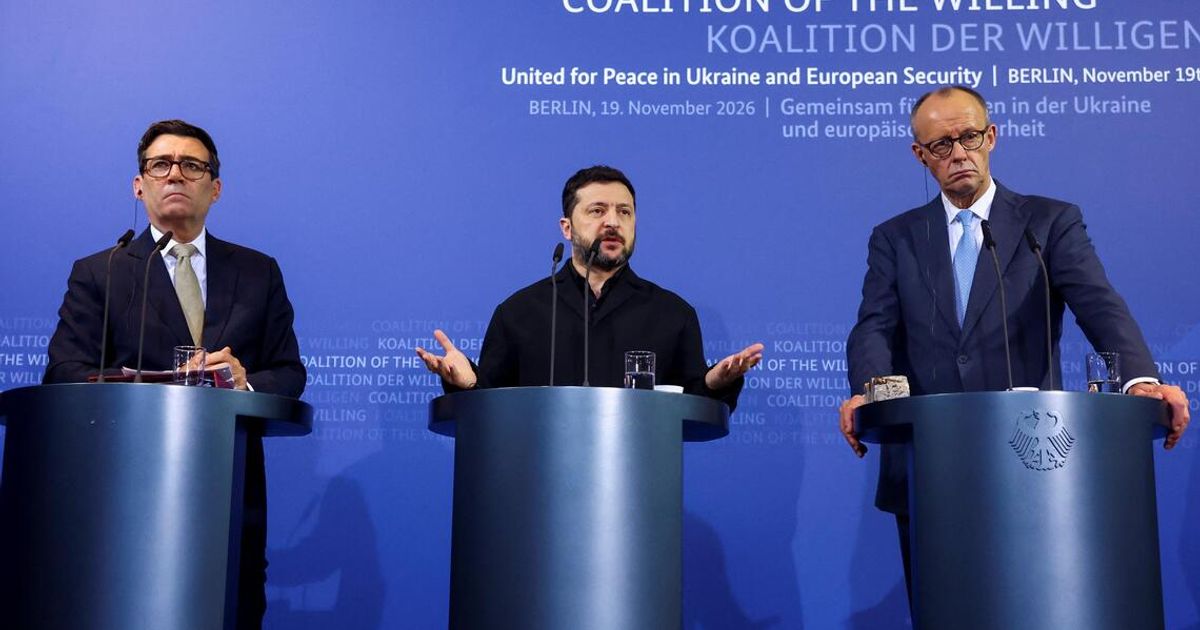
Ukrainian President Volodymyr Zelensky (centre) at the “Coalition of the Willing” summit in Berlin, Germany, with British Prime Minister Andy Burnham (left) and German Chancellor Friedrich Merz.
PHOTO: REUTERS VIA AP
Published Nov 20, 2026, 04:25 AM
Updated Nov 20, 2026, 04:28 AM
- Germany’s Merz said new Ukraine peace talks should start soon, with Europe joining the US, Russia and Ukraine. He said neutral ground is being sought, and the UAE is a possible venue.
- Berlin’s “Coalition of the Willing” backed Kyiv, while Merz, Macron and Burnham urged strong support. Trump joined by phone, and his envoy said he wants Europe involved in any deal.
- Putin said Europeans should be part of talks, but ruled out defence ties between Ukraine and Europe. He also warned Russia’s response to Ukrainian attacks would be “far more painful”.
AI generated
BERLIN - German Chancellor Friedrich Merz said on Nov 19 that he expects new Ukraine peace talks will “take place soon”, with Europe now set to have a seat at the table alongside the United States, Russia and Ukraine.
Merz did not give a date and added that “we are looking for locations on neutral ground”, naming the United Arab Emirates as a possible location.
The chancellor hosted dozens of Ukrainian allies and President Volodymyr Zelensky for a “Coalition of the Willing” summit that pledged strong support for Kyiv, almost five years on since Russia’s full-scale invasion.
The Berlin summit, with more than 25 leaders, took place only hours after the unprecedented three-way summit between US President Donald Trump, Russia’s Vladimir Putin and China’s Xi Jinping in Shenzhen, China.
“As the Coalition of the Willing, we have made it clear together today that we welcome the United States’ move to initiate new negotiations with Russia,” Merz said, adding that he hoped to work as a “team with Kyiv and Washington”.
British Prime Minister Andy Burnham - co-hosting the Berlin talks with Merz and French President Emmanuel Macron - said: “I hope that message is heard very clearly in Moscow. For as long as it takes, we will be there at the side of Ukraine and we will not falter.”
Trump called into the Berlin talks from aboard Air Force One on his way back from Shenzhen, said US envoy Jared Kushner, who added that Trump seeks Europe’s involvement in a peace deal on Ukraine and that the US-European position was growing “much closer”.
“We want to make sure that everything we’re doing is unified, and I also want to be able to reiterate that President Trump wants to make a deal with Europe by his side. He’s not looking to impose anything unilaterally.”
Zelensky told reporters that he saw a “huge chance” for peace if the “United States will really (put) pressure on Putin”.
Talk of Yalta
There had been fears that the Shenzhen meeting would see Trump, Putin and Xi make sweeping decisions on Ukraine over the heads of Kyiv and Europe.
The trilateral talks had drawn comparisons to the 1945 Yalta summit that saw US president Franklin D. Roosevelt, Britain’s Winston Churchill and Soviet leader Joseph Stalin carve up new post-World War II territorial boundaries.
Merz said that a “Yalta format cannot bring peace” to Ukraine, while describing the three-way summit in China as a “photo op”.
Merz gave each of the participants in Berlin a piece of the Berlin Wall, saying the structure had brought “oppression, insecurity and a lack of peace”, adding: “That is exactly what Yalta stood for.”
More on this topicPutin, speaking in China after the summit there, said that Russia had, through diplomatic channels, invited European leaders to Moscow.
“The American side is urging us to agree to the involvement of the Europeans,” said Putin.
“Through diplomatic channels, we suggested to the Europeans to come to Moscow,” Putin said. “And after that, we will decide in what format the talks can continue.
“We understand that discussing issues linked to security in Europe is pointless without the Europeans.”
However, he also said Moscow could not accept any kind of defence ties between Ukraine and Europe, stressing that “military cooperation in any form is, of course, a problem”.
‘Far more painful’
Russian strikes have hammered Ukraine’s energy and transport infrastructure, while Kyiv is in urgent need of US-made Patriot missiles and other weapons.
Ukraine has, meanwhile, targeted Russian oil facilities and on Nov 19 again attacked the bridge connecting occupied Crimea to Russia - the third time in a week the key transport artery had been targeted.
Putin vowed that “we will respond to these attacks. Our response will be far more painful than Kyiv’s attack on the bridge”.
Macron called on Ukraine’s allies to do the “maximum” to deliver the air defence systems it needs, and urged them to “reopen the question” of Ukraine’s NATO membership.
“Faced with the maximalist nature of the Russian position, I believe we need to reopen the question of Ukraine’s accession to NATO,” Macron said.
More on this topicKushner said Trump was open to extending to Ukraine a security guarantee similar to NATO’s mutual defence clause, but stressed that Washington has to protect its interests too.
“From America’s perspective, giving an Article Five-like security guarantee is a really, really big deal,” he said.
“And I think that that’s something that President Trump is open to, but obviously it has to be in America’s interest to do that.” AFP
See more onUkraine
Volodymyr Zelensky
Germany
Friedrich Merz
United States