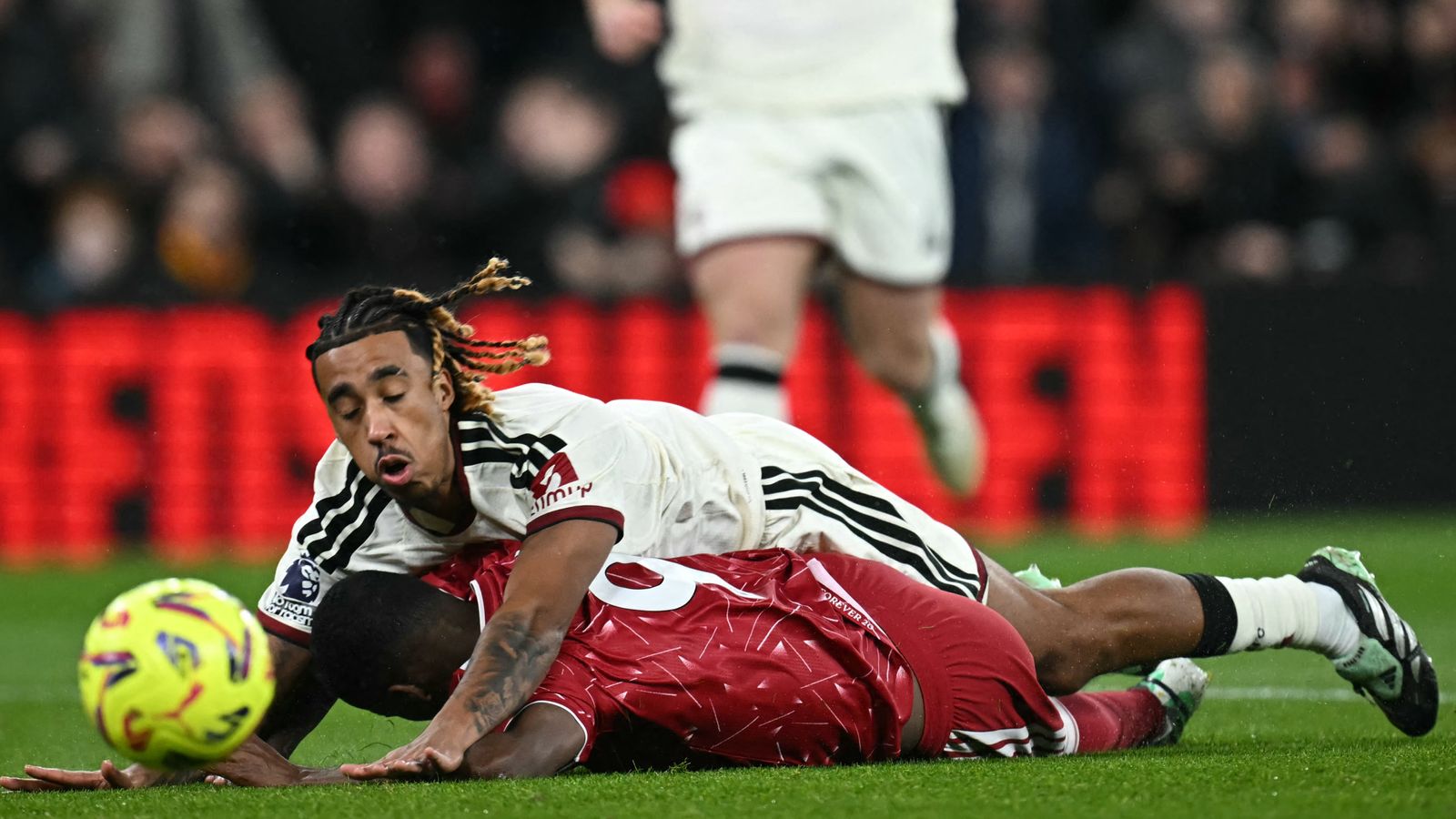
The Football Association has published its reasons for overturning Leny Yoro’s red card for Manchester United at Liverpool, ruling that the decision was an “obvious error” because Alexander Isak had lost control of the ball when he was fouled.
Referee Sam Barrott sent Yoro off for denying an obvious goalscoring opportunity (DOGSO), after he brought down Liverpool striker Isak as the last defender outside the penalty area. VAR John Brooks agreed with the decision. United went on to concede four goals in the heavy defeat.
The FA’s three-person panel, made up of former professional footballers, including one goalkeeper, said Isak’s touch was so heavy that “he had in fact lost control of the ball”. In its written reasons, the panel said the advancing United goalkeeper, Lammens, would have been able to gather or smother it before Isak could reach it and shoot.
“The Commission members were unanimous that, taking the foul committed by Yoro out of the scenario, Isak would not have had an obvious goal-scoring opportunity,” the statement read.
“Despite the fact that Isak had reached the ball initially, his touch was heavy to the extent that he had in fact lost control of the ball - that control had, in effect, passed to the advancing MUFC goalkeeper who in the view of the Commission would have been able to gather or smother the ball before AI [Alexander Isak] could get to it and shoot at goal.”
“To the mind of the Commission, the referee had made an ‘obvious error’ in deciding that AI would have had an obvious goal-scoring opportunity.”
The panel also noted that United submitted extensive evidence in support of its appeal. The club provided three angles of the incident and footage of Pascal Struijk’s red card for Brighton against Sunderland, which was later overturned. United’s analysis said Isak was “at best 1.8m short of reaching the ball”. The FA said it could not independently determine the accuracy of that analysis, so it was “viewed with caution and allocated weight accordingly”.
Pro Ref chief refereeing officer Howard Webb had indicated that no clear mistake was made. Speaking on the latest edition of Match Officials Mic'D Up, he supported the officials’ process but did not give a firm verdict on the incident.
“By and large most people would see that as a correct decision with Isak moving quickly on towards that ball,” Webb said. “The alternative view is that Lammens might get there first, but it's a little bit debatable, I guess. Certainly not clearly wrong.”
Audio from the officials showed that Brooks considered Isak “likely” to reach the ball before Lammens. Assistant VAR Paul Howard agreed.
The Struijk footage gave United a precedent to cite in its appeal. In October, two independent panels disagreed over whether the Brighton defender should have been sent off at Sunderland for a foul on striker Wilson Isidor as he tried to reach a pass that ran through to goalkeeper Bart Verbruggen.
Neither referee Thomas Bramall nor his assistant initially gave a foul. VAR Neil Davies intervened and recommended an on-field review. Bramall watched several replays, changed his decision and dismissed Struijk.
Brighton appealed, and an independent regulatory commission convened through the FA overturned the red card and the subsequent one-match ban. However, the Key Match Incidents (KMI) panel, which assesses the validity of refereeing decisions, voted 3-2 that the VAR intervention was correct.
The KMI panel said Struijk had committed a “cynical foul clearly impacting the attacker's ability to gain possession of the ball which should have been penalised by the referee”.