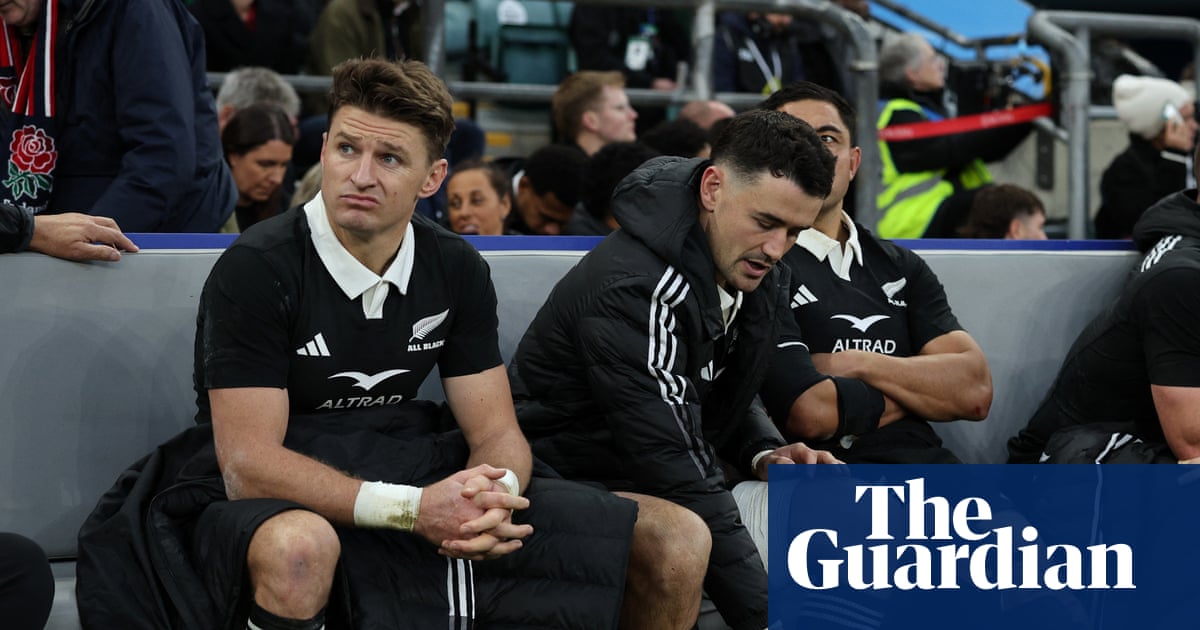
The All Blacks suffered their worst Twickenham performance of the professional era and a record defeat by England, raising fresh questions about the team’s form and confidence. The loss came after head coach Dave Rennie had told them they had let the country down, criticism that appeared to backfire.
The best All Blacks sides made their skills look effortless and played with visible enjoyment. This team, by contrast, looked short of confidence. Rugby union is no longer the religion it once was in New Zealand as the NRL grows in popularity, and Rennie’s apology was directed at an increasingly apathetic public.
New Zealand’s display was even worse than the insipid performance at Twickenham 12 months ago, which cost Scott Robertson his job. Their handling was hesitant and error-prone, with Will Jordan dropping the ball the first time they managed to pass it through the hands. The lineout struggled in the first half and fell apart in the second; Damian McKenzie’s place-kicking was dreadful, and his teammates appeared lethargic.
England, meanwhile, produced their best performance of the Steve Borthwick era. Their line speed left the All Blacks struggling to keep up, while England’s backs outclassed them. New Zealand battled at the breakdown but were physically outgunned.
There were mitigating factors. New Zealand have half a team, including talisman Ardie Savea, on the injury list. The team is nearing the end of a gruelling season, and Rugby’s Greatest Rivalry was its No 1 priority this year. A colossal series took its toll. At the time of writing, New Zealand could still win the competition, but they will need to improve markedly to bounce back next weekend.
The All Blacks’ aura has been slipping for years. New Zealand will regroup and welcome injured players back for next year’s Rugby Championship, and are expected to be a formidable force at the World Cup. But they no longer instil the fear they did a decade ago and have fallen to fifth in the world, their joint-lowest ranking.
Beauden Barrett’s 150th cap was meant to be a celebration: he became only the fourth man to reach the milestone. He was given his own entrance, then knelt to rub the turf, as is his trademark. His first touch was the restart after Henry Slade’s opening try.
Barrett was largely a bystander after that. At 35, next weekend may be his last appearance at Twickenham. It was his 12th match against England and his third defeat, by far the most comprehensive. He made his debut in a 60-0 win over Ireland in 2012 and was world player of the year in 2016 and 2017, but his powers are waning.
Barrett changed the game at his peak, and his decline mirrors that of the All Blacks. Yet his sense of timing remains: he burst on to Cam Roigard’s offload for a nostalgic glimpse of his heyday. After McKenzie converted, New Zealand were within 12 points with around 25 minutes remaining. A comeback never seemed realistic; by then, the All Blacks’ belief had been battered. It may take time to recover.