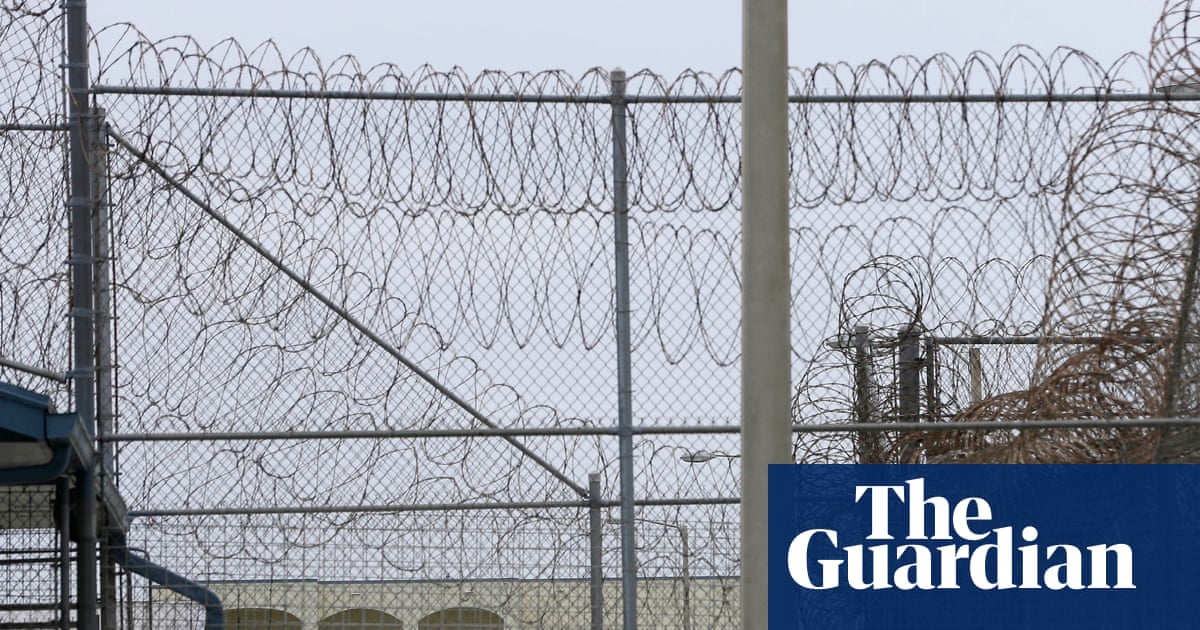
Florida prisoners testified in federal court that extreme heat inside Dade correctional institution created dangerous conditions, including heat indexes as high as 119F (48C), and alleged the heat contributed to four deaths.
Dwayne Wilson, 69, told the court Tuesday that the concrete prison south of Miami has no air conditioning. “It was so hot,” he said. “It’s so hot sometimes you have to put water on the floor just to try to keep cool.”
Wilson is housed in the H dorms, a T-shaped building with one-to-two-person cells that prisoners call “hell dorm” because its concrete walls radiate heat. Sensors temporarily installed throughout the prison in summer 2025 recorded temperature and humidity levels. Stefano Shiavon, a professor of civil and environmental engineering who specializes in thermal comfort, calculated that the heat index was above 88F (31C) 97% of the time. One reading in the H dorm dayroom reached the equivalent of 119F (48C) at 10pm on a July day. “The walls sweat,” Wilson said. “It’s miserable in the cell at night because, again, it’s so hot. No air comes to the bed we sleep at and the bed is soaked in sweat.”
Wilson is among prisoners who sued the Florida department of corrections in 2024 over conditions at the facility, alleging extreme heat contributed to four deaths and subjected prisoners to cruel and unusual punishment. The bench trial began Monday at a federal courthouse in downtown Miami, which serves the US district court for the southern district of Florida.
Gary Wheeler, 67, who was also housed in the H dorms, testified that he recently feared he was having a heart attack. A nurse at the prison’s medical clinic told him he had heat exhaustion. “I am worried about dying. I feel like sometimes when I go to sleep at night I’m not going to wake up in the morning,” he said. “My biggest fear is if I have a heatstroke and I can’t take care of myself, I have to depend on predators who could prey on you because you’re disabled.”
Wilson and Wheeler said they had filed informal complaints about heat in the H dorms, some dating back to at least 2019. They also described conditions faced by James “Jim” Beam, an 83-year-old wheelchair user with a respiratory condition. “He would breathe like he was gasping for air,” Wheeler said. “Every time he’d breathe he would throw his head back.”
Wilson testified that he woke one night to Beam calling for help from a cell across the hall. “It was like 2am to 3am in the morning. He was on the floor,” Wilson said. He helped Beam into his wheelchair and took him to the medical clinic, where Beam received a breathing treatment. Wilson said a doctor stopped the treatment after about 30 minutes, and he then pushed Beam back to his cell. “The vent wasn’t working in the dorm. Jim’s tongue was kind of hanging out of his mouth and he was having problems breathing,” Wilson said. Beam died within days.
A medical examiner’s report attributed Beam’s death to pneumonia. Dr Susi Vassallo, an emergency medicine physician and medical toxicologist who has served as an expert witness in several cases involving heat in US prisons, testified that she believed long-term exposure to extreme heat contributed to Beam’s death and those of three other prisoners at the facility. She said the prison’s summer 2025 temperature and humidity data were unusually extensive. “It’s rather shocking, honestly,” she said. “These are dangerous heat indices, putting these individuals at substantial risk of serious harm.”
Vassallo testified that age, some medical conditions and certain medicines can increase the risk of heat illness. She has also testified in a separate case that air conditioning was the only way to reduce heat and related risks of illness and death. In September, a US district court judge ruled that Texas must install air conditioning in all state prisons by the end of 2029.
During cross-examination, attorneys for the Dade correctional institution argued that more than 100 ceiling and exhaust fans helped mitigate heat and that the eighth amendment prohibition on “cruel and unusual punishments” did not apply. “In 1791, when the eighth amendment was ratified, there was no air conditioning,” said Mathew Gutierrez, defense counsel for the Florida department of corrections, FDC secretary Ricky Dixon and Dade correctional institution warden Francisco Acosta. “So the lack of air conditioning could not have been encompassed in the eighth amendment.”
Defense attorneys also said prisoners could wear shorts and had access to water jugs with ice in summer. Prisoners testified that ice in the orange water coolers quickly melted because the coolers were filled with hot shower water. Vassallo said fans can be unhelpful when temperatures reach a certain point and can increase body temperature.
Wilson said chemical burns from an incident in an Indiana jail left areas of his body unable to sweat. He testified that he often develops itchy heat rashes in the Florida prison. “When I move around, I can get scabbed up,” he said. “Then, with the rash that is on my body, it’s like it’s irritating to the point where it’s like burning.”
The trial is expected to resume next Monday, when more prisoners will testify about heat at Dade correctional institution, which can hold up to 1,500 people. The prison and Florida department of corrections will present their case later.