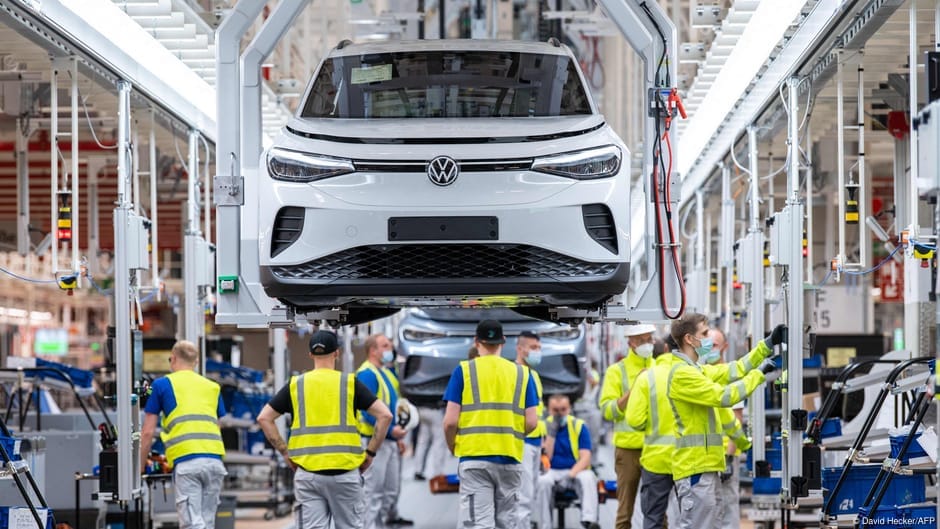
For decades, German automakers and labor representatives presented their ability to resolve disputes through cooperation as distinctive. Now, a series of industry crises and management cost-cutting moves are putting that relationship under strain.
Negotiations between union representatives and Volkswagen, Germany’s largest carmaker, began on Tuesday with the balance of power appearing increasingly tilted toward management. Volkswagen is seeking a two-year wage freeze and cuts to several allowances and bonuses. Along with Mercedes, it is also demanding longer hours for the same pay, with both companies threatening to withhold investment from German factories.
Unions have responded with warning strikes and the prospect of larger walkouts. Workers, however, are facing a difficult outlook: Germany’s auto industry lost more than 123,000 jobs between 2019 and 2025, according to the Ifo Institute.
“I think that the labor representatives are in a very difficult situation,” said Thomas Haipeter, a labor researcher at the University of Duisburg-Essen. “On the one hand, they have to make concessions in order to safeguard jobs. And despite these massive employment reductions to safeguard the rest of the jobs and locations, what is missing for them is a kind of more offensive strategy.”
Labor’s prominent role in German auto companies dates back decades. At Volkswagen, a 1945 agreement promised a hot shower a day and marked the start of “co-determination”: workers are represented within the company by employee-led workers’ councils and by outside labor unions.
In 1960, Berlin anchored labor’s strong influence at Volkswagen before the company issued public shares. Government officials retained extra votes on the supervisory board, with seats held by the Lower Saxony government, which tends to be sympathetic to workers. Workers’ councils later became established across the German auto industry, representing employees at multiple production sites within the same companies.
Auto workers’ pay and benefits rose over the years. During the industry boom from 2011 to 2019, their pay clearly outpaced the average German wage. In early 2025, auto workers earned nearly a third more per hour than the typical German worker when bonuses and allowances were included, according to Germany’s Federal Statistical Office (Destatis).
That year, Volkswagen CEO Oliver Blume praised cooperation with unions as one of the company’s “great strengths” at the 80-year anniversary of the 1945 agreement.
But cracks had been developing for years, according to case studies by Haipeter and others. As companies pursued cheaper labor abroad, workers’ representatives were increasingly focused on defending plants and jobs. Workers’ councils concentrated on saving their own production lines, and even hired business consultants in an effort to influence company strategy.
When combustion engines dominated, German workers could argue that domestic production was the most technologically advanced, Haipeter said. The shift to electric vehicles changed that. “This line of compromise is canceled now by management,” he said. “They say it doesn't matter for us where we produce. We have to produce at the locations or in countries which are best-cost countries and not in countries which have higher wages.”
Sluggish electric-vehicle sales and competition from Chinese manufacturers have exposed the cost gap. In 2024, Volkswagen abruptly canceled a series of labor agreements and threatened factory closures. After difficult negotiations, labor agreed to cuts worth €1.5 billion a year in abandoned wage increases and to the elimination of 50,000 positions through attrition, in exchange for job security for current employees through 2030.
This summer, management returned with a restructuring plan that included closing four German plants. The decision was delayed after negotiations, but another 50,000 positions were slated for attrition. Volkswagen declined to comment for this article.
For unions, one of the most sensitive issues may be the demand that employees work longer for the same pay, or receive less pay for less work. IG Metall won the 35-hour workweek in 1984 after seven weeks of strikes. It is now standard in every auto industry labor contract, although worksites sometimes depart from it by agreement with employees, according to Haipeter.
Mercedes has called for employees to accept an exception across the company. It acknowledged that the 35-hour workweek was “hard-won” and “means a great deal” to its workers. “However, the conditions under which it was agreed upon no longer exist today,” the company said in a statement to DW.
Volkswagen is seeking greater “flexibility” as negotiations begin. “They call it flexibility in both directions,” Thorsten Gröger, the union’s head of negotiations, said last week. “In the end, Volkswagen wants its employees to perform unpaid work.”
Ferdinand Dudenhöffer, a longtime analyst of the German car industry, said unions would find it difficult to give up the 35-hour workweek. “The unions are in a difficult position,” he said. “They battled for a 35-hour workweek, and that's an incredible privilege that comes with a lot of pride. The union knows that as soon as one factory, one production hall, gives up the 35-hour workweek, then they will have a conflagration.”
Dudenhöffer sees parallels with another Volkswagen crisis. After a downturn in the early 1990s, Gerhard Schröder, then head of the German state of Lower Saxony, pushed for an agreement under which workers would work less in exchange for keeping their jobs. “We need a mediator along these lines,” he said.