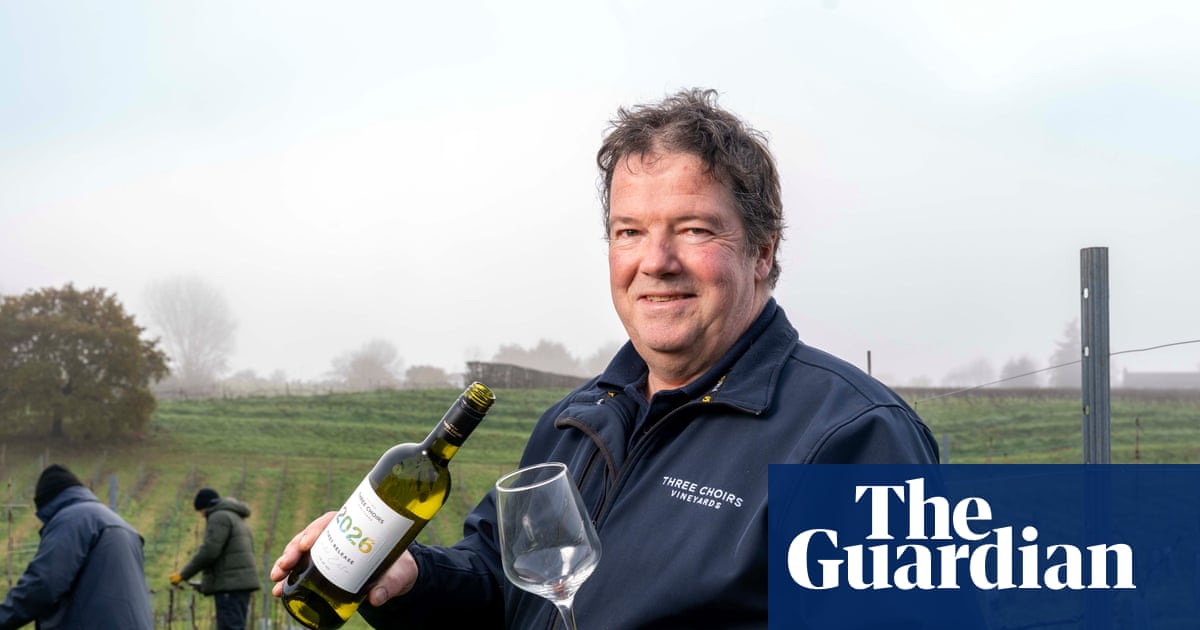
Three Choirs vineyard in Gloucestershire has released its 2026 First Release white wine after beginning its harvest on 20 August, the earliest start in its 50 years of producing wine.
The vineyard near Newent calls the young wine its “Gloucestershire nouveau”, a tongue-in-cheek reference to beaujolais nouveau, the young red wine traditionally released on the third Thursday in November. Three Choirs has bottled a young wine every November since the 1980s.
The harvest began a week earlier than the previous record, set in 2025, after a prolonged warm summer and rain at the right time. It ended on 9 October, with 200 tonnes of grapes collected across the vineyard’s 30 hectares (74 acres).
The 2026 First Release is a dry white wine made from solaris, bacchus, siegerrebe and madeleine angevine grapes. The run comprises 5,000 bottles, available from the vineyard’s shop and restaurant.
“We now have an extra month to make the wine. We had riper raw material and longer in the winery,” said Three Choirs winemaking director Martin Fowke, calling 2026 a “record-breaking year”. He said higher sugar levels and lower acidity made it possible to produce a wine that could not have been made in Britain 30 years ago.
Winemaker Jack Abbotts said the early harvest caught him by surprise while he was on his summer break. “It’s usually a safe week for me, but this year it all snowballed,” he said.
Fowke said the heat and lack of rain had made the season difficult for farmers. “We found it hard this year,” he said. “People kept saying: ‘This hot weather must be good for you’, but it was difficult because we knew the heat and lack of rain was challenging for farmers. We don’t need it to get any warmer, that’s for sure.”
More than 1,100 vineyards are registered in Britain, with vines planted as far north as Yorkshire and Scotland. Three Choirs also makes wine for about 40 other vineyards, including Llanerch, west of Cardiff.
WineGB said English and Welsh producers had their second-largest harvest in 2025, producing the equivalent of 16.5m bottles, or 124,377 hectolitres. Figures for the 2026 harvest are not expected until early next year. WineGB said in August it was “optimistic” about the harvest’s size and quality after the hot growing season.
Fowke said Three Choirs may consider growing new grape varieties if summers such as 2026’s become the norm. “We can evolve and change, but we would be planting cabernet sauvignon like they did in Bordeaux 50 years ago,” he said, noting the shift from white to red grapes. “But that is not what we set out to do.”