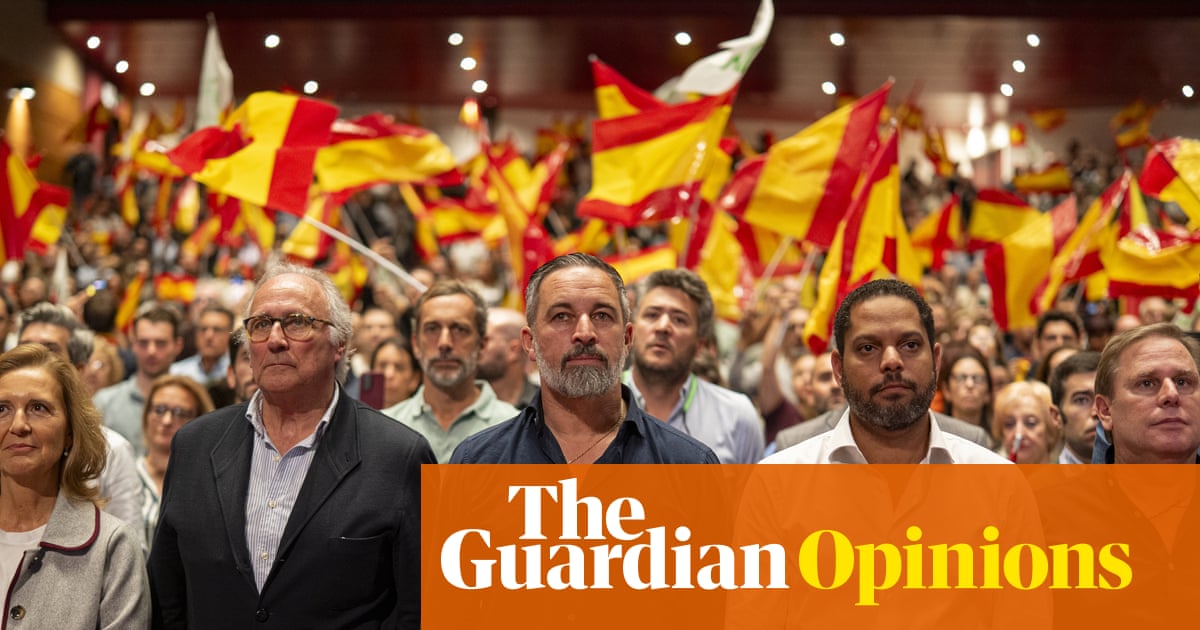
Gordon Brown argues that the far right is gaining influence in Europe, but polling suggests many voters drawn to radical-right parties do not share the parties’ core ideas. As Spain heads towards a critical election, he says, dissatisfaction with economic conditions and civic cohesion may drive protest votes, but the shift is not inevitable.
Spain votes on 29 November, beginning a 12-month period in which about 200 million people across Europe will be eligible to vote. Elections in 2027, including in France, Poland, Estonia and Italy, will test the strength and threat of extreme rightwing populist nationalism, Brown writes.
Thirty years ago, around the turn of the 21st century, the left was in government or coalition in 13 of the EU’s 15 member states. Today, Denmark is the only social democratic-led government in northern Europe and Lithuania the only one in the east. Spain, alongside Malta, is one of only two centre-left governments in southern Europe.
Of the EU’s 27 countries, 21 are governed from the centre or right. Brown says the danger is not only that Spain’s Vox could enter government, but that centre-right parties are adopting far-right policies as the firewall between them begins to fall.
Vox has proposed mass deportations of migrants under the banner of “remigration”. Spain’s Popular party (PP) has, according to an investigation published by LaSexta, been prepared to form regional coalitions with Vox to remove gender-equality initiatives and minority-language protections, and challenge abortion and LGBTQ+ protections. The PP and Vox have both explicitly endorsed the principle of prioridad nacional – national preference in social security and health benefits – although they disagree about its definition.
Brown also points to the rise of an international coalition of anti-internationalists. Reports of an early, unpublished version of Donald Trump’s national security strategy last year envisaged direct US support for Europe’s extreme populist nationalist parties. The White House denied those reports. In August, Reuters reported that the Trump administration planned to provide at least $25m (£19m) for conservative civil-society initiatives in Europe, including $4m for rightwing media.
Trump’s national strategy document said Europe was threatened with “civilisational erasure”. His vice-president, JD Vance, later met the extreme-right AfD party in Germany rather than the chancellor. The US-led Conservative Political Action Conference, which brings together conservative activists, commentators and officials, has met in Hungary and the UK this year and plans an Italian summit in 2027 as part of an “expansion into western Europe”.
Brown says one way to counter the far right is to recognise that its policies do not necessarily match what voters want. Polling for the Rockefeller Foundation, of which he is a trustee, suggests Europeans’ views are more nuanced than the political rhetoric might imply.
Under Pedro Sánchez’s government, Spain’s statutory minimum wage has risen by two-thirds and the share of workers on fixed-term contracts has fallen by more than 40%. More than half of Spain’s electricity now comes from renewables, and energy price rises have had less impact than elsewhere in Europe. Consumer confidence has also been much higher.
However, Spain’s official polling agency, the Centro de Investigaciones Sociológicas (CIS), found that only a third of people had a positive assessment of the economy. Earlier this month, concerns about housing and rents prompted the country’s first general strike in 14 years, along with mass demonstrations in major cities. Across Europe, half of those polled say they do not trust their government, while two-thirds say they are nostalgic for the past and believe their countries have lost touch with the values that built them.
Brown says people’s concerns go beyond these signs of dissatisfaction. They include economic decline: 65% say their country has got worse in the past year, nearly 50% say they are worse off than they expected to be five years ago, and 59% worry more about money each year. Half say that in a crisis, people in their community would look out only for themselves. Half also feel the government helps other groups more than theirs.
For many people, Brown writes, a sense of civic decline matters as much as economic decline. Although this may lead some to vote for populist nationalist parties that claim to speak for their concerns, most are not populist nationalists at heart. Only 15% of radical-right voters consistently take a zero-sum view of the world, in which one social group’s gains necessarily come at another’s expense. In Spain, the figure among Vox voters is 12%.
Across the European countries polled, 61% say they want their country to cooperate internationally, even when that means compromising on national interests. A further 80% reject intolerant attitudes and believe good solutions come from hearing many different viewpoints.
No more than 25% in any country say they would vote for the radical right, while about 20% see another ethnic group’s gain as their own loss. As few as 10% hold the us-v-them mindset on trade, migration and technology that characterises populist movements. Fewer than 25% put managing migration among the top issues countries should work on together, despite the attention the issue receives and concerns about illegal migration.
Brown says anti-incumbent voting is now commonplace, with millions open to voting for change when dissatisfied and potentially choosing the extreme right as a protest. Sánchez is defending a strong record at home and abroad. Despite day-to-day polling, Spain has one of the smallest us-v-them blocs and the lowest radical-right vote among the countries polled: votes for the extreme right stand at 14%, well below the PP and Sánchez’s Socialists.
Brown concludes that people in Spain and across Europe are unhappy with their economic circumstances and fear a loss of civic cohesion, but have not, for the most part, embraced far-right ideology. “The drift is not inevitable. By knowing how people really feel, we can reach them.”
Gordon Brown was UK prime minister from 2007 to 2010.