Hakeem Jeffries is on track to make House speaker history. But major challenges lay ahead
By Sarah Ferris ·
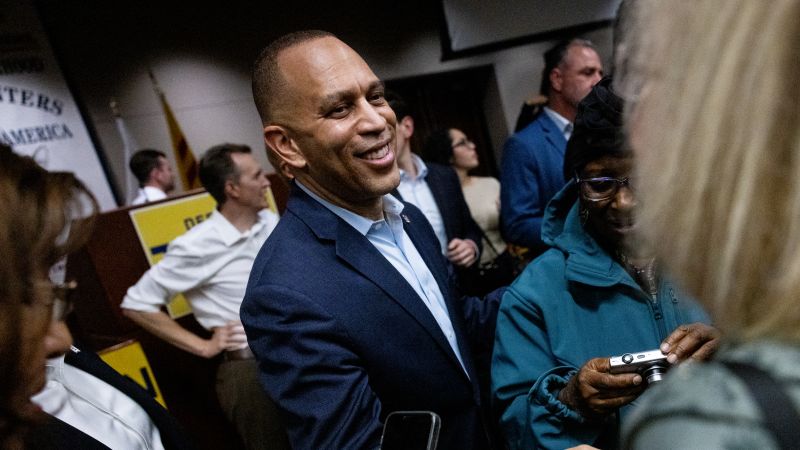
Soon after Hakeem Jeffries arrived in the House in 2013, one of his earliest mentors approached a group of senior Black Democrats with a message.
“I think he is the one,” former Rep. Eddie Bernie Johnson told lawmakers at the time, including Rep. Emanuel Cleaver, who recalled she was seated in her long-time perch on the House floor when she made the prediction.
Within months, that same bloc of Black Democrats began meeting regularly over dinner to discuss Jeffries’ future — drawing up plans to ensure that he would replace then-Speaker Nancy Pelosi when she retired and hoping to cement his place as the first Black speaker in US history, according to multiple people involved in the discussions.
A decade and a half later, Jeffries is now on a clear path to be elected House speaker in January — only second to the vice president in the line of presidential succession — in a position that effectively hands him control of a newly resurgent Democratic party in President Donald Trump’s final two years in power.
“A lot of people in this administration should not sleep well at night,” Cleaver said in an interview, predicting that Jeffries and their party would make life punishing for the Trump administration.
That gavel, though, is not yet a guarantee. Jeffries still needs to win over a crop of incoming Democratic socialists decrying current leaders for failing to meet the moment. Once considered a political insurgent himself, Jeffries now battles skepticism from the party’s activist wing over his more-establishment stance on issues like Medicare for All and Israel.
Jeffries, a deliberative former corporate lawyer, has also drawn private criticism from some in his party for being overly hesitant. But people close to him insist that he will have a decisive and aggressive approach to wielding the speaker’s gavel in the Trump era — pursuing significant confrontations with the administration and corporate America alike.
They say he plans to supercharge a new era of Democratic populism — a tax-the-rich and subpoena-the-CEOs mentality that would unravel decades of cautious party attempts to avoid controversy with big business. He wants to raise the minimum wage by much more than Democrats tried to in 2019, enact strict new ethics codes for the Supreme Court and rein in artificial intelligence.
He’ll also be leading the party as it pursues an aggressive oversight agenda into the final two years of Trump’s second term.
“The American people are rightly frustrated. They want disruption, they want dramatic change,” Jeffries said in a recent interview with CNN’s Manu Raju, previewing his agenda.
If elected, people close to Jeffries said he sees his task as two-fold: He must satisfy a restive electorate that wants Democrats to take big swings and achieve real change — while also avoiding political overreach that could cost them seats two years from now.
That means Jeffries will need to limit the whims of his insurgent left. Democrats are unlikely to vote to abolish Immigration and Customs Enforcement or enact Medicare for All, for instance. His allies say he will seek to avoid votes, wherever possible, on policy relating to Israel.
“He’s gonna do bold and smart, not bold and stupid,” one moderate Democrat told CNN. “He’s going to try to avoid massively divisive votes. … He’s going to zero in on affordability and ignore the culture wars.”
Another member, Rep. Jason Crow of Colorado, added that Jeffries has been clear that Democrats will “win this at the kitchen table and we’re going to govern at the kitchen table.” For him, that includes new ways to make life more affordable, such as expanding access to government healthcare.
“I think Americans are ready to move toward a universal healthcare system. There are a number of ways that we can get there,” Crow said, who has co-authored a bill to expand Medicare to Americans aged 60 and above.
Another challenge for Jeffries won’t be ideological, it will be generational.
Already, plans are underway inside the Democratic caucus to enact new term limits for committee chairs, according to people familiar with the discussions — a huge shift in the seniority-driven Democratic party that reflects the anti-establishment mood of this election. (Current chairs could be grandfathered in for a short time.)
But there’s skepticism about whether Democrats can pass another voter priority — a stock-trading ban — as part of the House’s rules for member conduct in January. Some members prefer to pass a standalone bill sometime next year that also includes strict stock-trading rules for Trump administration officials, not just lawmakers, though it would be unlikely to become law, according to people familiar with the discussions.
That stock-trading disagreement is a glimpse of one of Jeffries’ biggest challenges next year: Resistance from long-serving members who are used to far more gradual change.
Then there is the issue of actually working with the administration. Democrats are expecting little cooperation, if any, with a president who recently coined himself “Mr. Veto.”
And even trying to have conversations across the aisle has been a fraught endeavor for Jeffries. This summer, he faced fierce backlash from liberal Democrats after a private meeting with Trump’s son-in-law Jared Kushner. (The two worked closely on a criminal justice law in Trump’s first term.)
Jeffries later told CNN of the meeting: “We have a responsibility to solve problems and sometimes that means meeting with people on the other side of the aisle.”
Before Jeffries landed the perch of top House Democrat, his supporters occasionally pushed him to consider other positions, according to multiple people who recalled the efforts over the years.
Some Black church leaders pushed him to run against former New York City Mayor Bill de Blasio. Another group of House members encouraged him to run for the top Democrat on the House Oversight Committee after the death of Rep. Elijah Cummings in 2019. Some even privately urged him to run for president in the summer of 2024 after then-President Joe Biden was forced to leave the race.
But he turned down each one with what appeared to be a longtime goal in mind — House speaker.
“He could have been chair of the Congressional Black Caucus. He could have been the Democratic whip early on. But he’s very strategic,” Rep. Joyce Beatty of Ohio said.
Jeffries rose through the ranks of the Democratic caucus, in part, because of his skill on the House Judiciary Committee, including a high-profile stint during Trump’s first impeachment and, before that, dealmaking with Republicans on drug and sentencing reform.
“He walks in as someone who just looks like he’s just fearless,” added Beatty, who entered Congress alongside Jeffries in 2013.
The Brooklynite gained fame in the Trump-era by prosecuting the case against Trump during his 2020 Senate impeachment trial. He was handpicked for the role by Pelosi and famously quoted from the late rapper the Notorious B.I.G. on the Senate floor. (His passion for music is widely known in the party. As a teenager in Brooklyn in the 1980s, he once rap-battled under the name Kid Fresh. Cleaver refers to him as “the prime minister of hip hop.”)
In the years since the first impeachment push against Trump, Jeffries has only sharpened his attacks on the president.
He has called him “the dumbest person ever to sit at 1600 Pennsylvania Avenue” in response to Trump’s attacks on Jeffries’ intelligence. This summer, Jeffries called him a “feeble, unhinged, conspiracy-peddling 80-year-old failed president.”
“He loves to fight, he loves confrontation. He’s got that bravado and confidence,” one senior Democratic aide who’s worked closely with both Jeffries and Pelosi told CNN.
There has been some friction in Jeffries’ tenure as party leader.
Several Democrats recalled a nasty fight over a GOP resolution to honor the “life and legacy” of Charlie Kirk after his assassination last year. Jeffries and his leadership agreed to vote in favor, as a gesture of unity to condemn political violence targeting both parties.
But his decision infuriated members of the Black caucus, who said the GOP’s resolution praised Kirk while ignoring his record of what they described as hate speech against Black Americans. (Kirk had called the Civil Rights Act a “huge mistake” and has claimed Black leaders like Supreme Court Justice Ketanji Brown Jackson and Michelle Obama didn’t have enough “brain processing power” to be taken seriously in politics.)
“These are not harmless words. They carry the same spirit of division that once fueled Jim Crow—when racism and bigotry were written into law to deny people their rights and dignity,” one of the Black lawmakers who opposed the resolution, Rep. Troy Carter, wrote at the time of Kirk’s rhetoric.
In a meeting after that vote, some of those Black Caucus members confronted Jeffries about how he handled the GOP bill — and why he waited so long to tell his caucus about his decision, according to multiple people familiar with the discussions.
“I have never seen the CBC so publicly go after Jeffries,” said one person describing the meeting.
Heading into 2027, that rift between the Black caucus and Jeffries is long-healed. One person involved in the many back-and-forth conversations between Jeffries and Black Caucus members back then said the moment actually strengthened members’ trust in him: “They expressed concerns and he met them.”
And next year, the powerful bloc could see its largest-ever number of Black lawmakers — with the nation’s first Black speaker at its helm.
Shortly after Jeffries was elected party leader, Rep. Henry Cuellar of Texas approached his longtime colleague and urged him to get to the US border immediately.
It was 2022: Democrats like Cuellar believed Biden’s border policy was a mess and the only way back to power was understanding how to speak to border communities like his.
Jeffries made the trip to Cuellar’s hometown of Laredo for a nighttime border tour — where they watched smuggling attempts in real-time — in addition to more humanitarian-oriented visits with local nonprofits.
“I couldn’t get Democrats to say two words: Border security,” Cuellar said, recalling his experience with party leaders up to that point. But after Jeffries’ tour of Laredo, Cuellar said he heard a key shift in his language. “I heard him say ‘border security,’ and ‘you’ve still got to treat migrants with dignity.’”
People close to Jeffries say he has been focused for years on how to repair the Democratic party’s sagging brand — which, they add, is not just about defeating Trump.
He saw the party’s missteps in recent elections, particularly in 2024, when nearly everyone missed the flashes of anger from Americans who later voted for Trump.
Since then, he and his leadership team have been working steadily to build back that trust from voters — lighting into the Trump administration and forcing direct confrontations with Republicans whenever possible. Getting their message out was key, too.
Jeffries frequently tells his members that the average American spends about four minutes a week on politics — three-and-a-half of those minutes on Trump. “We are fighting for 30 seconds a week,” he has said, according to people familiar with the remarks.
For Jeffries, that looked like a nearly 9-hour floor speech against the GOP’s tax breaks bill, a historic 43-day shutdown over healthcare subsidies and “total war” over redistricting in the midterms.
Some of his colleagues underscored another key trait in their leader — “a spirit of American optimism,” in the words of Democratic Rep. Madeleine Dean, at a time when most other politicians of either party have been downright dismayed about the future of the country.
Dean recalled the night of the January 6 insurrection at the Capitol, where she and other members were huddled in a safe room as rioters were being removed from the building. She recalled going up to Jeffries — then, the highest-ranking Democrat in the room — and urging him to allow lawmakers to go back to the floor and resume the electoral count.
“’Hakeem, they cannot run us out of here,’” Dean recalled telling him. And he agreed — later declaring, in unison with then-Rep. Liz Cheney: “We will go back and do our job.”
Originally published by CNN