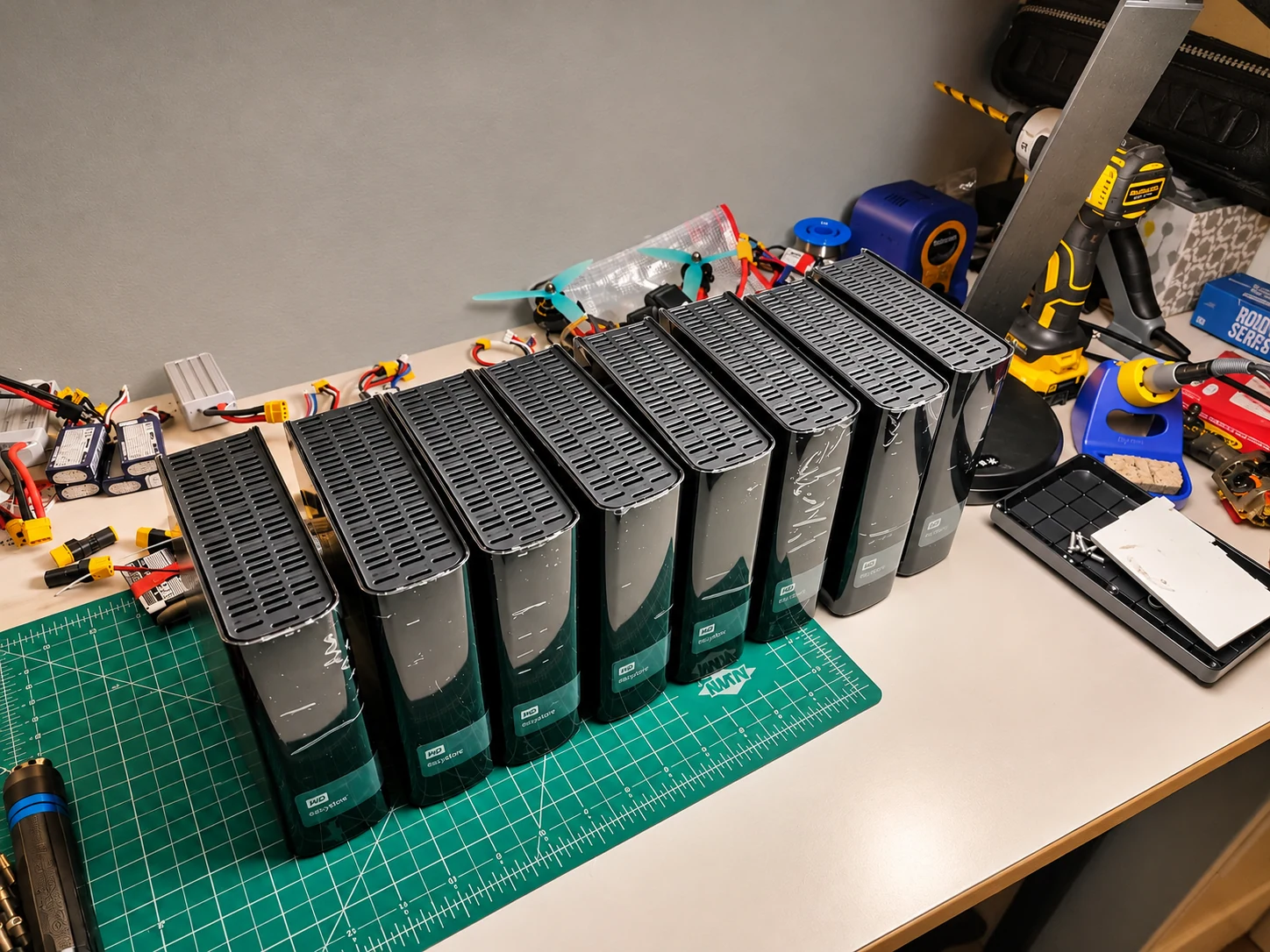
The price of hard drives has climbed sharply, making the author reconsider an annual Black Friday upgrade routine. The author typically runs around ten physical disks and replaces one or two each year to keep drives in the systems under five years old. But with current prices, consolidating from ten drives to five may be worth the work of rearranging ZFS pool layouts and moving data.
A 20TB WD EasyStore bought for $249.99 in November 2024 is listed for $549.99 this Black Friday, according to the article’s Best Buy listing. That is $300 more for the same product. The price per terabyte has risen from $12.50 to $27.50. Shucking—removing an external drive from its USB enclosure and installing the SATA drive in a server—was once a low-cost way to add storage, the author writes, but no longer looks affordable at that rate.
The author’s receipts show that five 10TB EasyStores cost $179.99 each in November 2018, or $18.00 per TB. Later purchases included two 12TB drives at $174.99 each in October 2020 ($14.58 per TB); two 14TB drives at $199.99 each in November 2021 ($14.29 per TB); and single 14TB drives at $249.99 in May 2022 ($17.86 per TB) and $239.99 in August 2022 ($17.14 per TB).
In October 2023, the author bought three 18TB drives for $199.99 each, or $11.11 per TB. The 54TB total cost $599.97, which the author calls the best deal on a per-terabyte basis. In November 2024, a 20TB drive cost $249.99 ($12.50 per TB), and in May 2025 another 20TB drive cost $279.99 ($14.00 per TB). Best Buy was still advertising the 18TB drives for $199.99 in November 2023, according to the cited deal archive.
Refurbished or recertified enterprise drives have also become more expensive, the author says. In August 2024, four recertified 14TB Ultrastars from ServerPartDeals cost $529.96 before tax, or $9.46 per TB. A comparison in the article lists November 26, 2026 prices for four drives: a recertified 14TB WD Ultrastar HC530 4Kn at $204.99 ($14.64 per TB), sold out, up 58% from $129.99; a recertified 14TB WD Ultrastar HC530 512e at $429.00 ($30.64 per TB), sold out, up 218% from $134.99; a refurbished 20TB Seagate Exos X20 at $589.00 ($29.45 per TB), in stock, up 150% from $235.94; and a recertified 20TB Seagate Exos X22 at $649.00 ($32.45 per TB), sold out, up 188% from $224.99, which was later refunded. The article says listed prices are up at least 58%, and as much as 218%, in a year or two.
The article traces today’s three major HDD makers—Seagate, Western Digital and Toshiba—to a series of acquisitions. Maxtor bought Quantum’s hard drive business in 2001, then Seagate bought Maxtor in 2006. Hitachi combined IBM’s disk business with its own to form HGST in 2003, and Toshiba bought Fujitsu’s HDD business in 2009. Seagate bought Samsung’s HDD business in December 2011, while Western Digital bought HGST in March 2012. The FTC required WD to sell desktop-drive manufacturing assets to Toshiba to preserve a third supplier in that market.
The 2011 Thailand floods occurred while the final two deals were underway. WD halted production at all its Thai plants, and its average hard drive selling price rose from $45 in fiscal 2011 to $62 in fiscal 2012. The article also notes a price-fixing case further up the supply chain: NHK Spring pleaded guilty in 2019 to fixing prices for suspension assemblies that hold read/write heads, and the court approved a $28.5 million fine. The article cites WD’s 2012 annual report and a Ninth Circuit opinion.
The author argues that the HDD market’s consolidation leaves consumers with few choices, while noting that 89% of WD’s revenue came from its cloud business in fiscal 2026. As of November 26, 2026, a 20TB drive costs 2.2 times what the author paid for the same SKU in 2024, and $270 more than a purchase in May 2025. The article also says Best Buy’s 8TB Black Friday special is $299.99, or $37.50 per TB—$50 more than the author’s 20TB drive cost two years earlier.
Four 20TB drives would have cost $999.96 at the author’s 2024 price; at the current listed price, they would cost $2,199.96, a $1,200 increase before buying a case, board or RAM. The cost per usable terabyte rises further when a drive is reserved for parity. The author hopes hardware prices return to reasonable levels in 2027, but expects people to make do with less for some time.