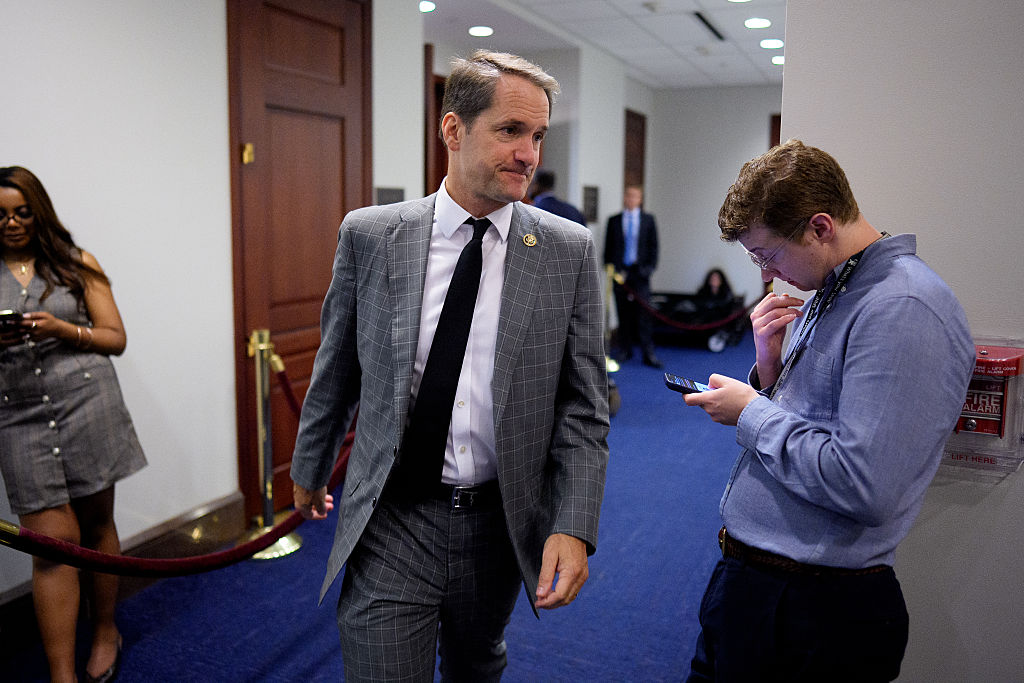
Jim Himes, the Connecticut Democrat expected to chair the House Intelligence Committee in January, has threatened to withhold support for funding government-owned systems developed by SpaceX amid an inquiry into Starshield’s use in Ukraine.
“SpaceX’s potentially unilateral modification of a U.S. Government contract, combined with its lack of responsiveness to congressional oversight, calls into question every contract the U.S. Government has with SpaceX,” Himes wrote in a letter to SpaceX founder Elon Musk on Friday.
CNN first reported the letter. The network also reported that Himes sent a classified communication to Director of National Intelligence Jay Clayton, conveying a similar message: Congress could find it difficult to authorize funding for systems for which SpaceX is the primary vendor.
SpaceX developed the consumer Starlink service over the last decade, providing high-speed Internet from low-Earth orbit to terminals on Earth. For government customers, it also developed Starshield, a suite of satellite services that includes a militarized version of Starlink communications. The US government has purchased Starshield services and extended access to Ukraine, though the terms are largely classified.
In recent weeks, interruptions to Starshield service in parts of Ukraine have cut off connectivity to drones used to defend against Russian attacks. Additional disruptions were reported a week ago.
On October 19, Ukraine President Volodymyr Zelenskyy wrote on social media: “Unfortunately, we have established that the equipment stops functioning at speeds of 130–161 kilometers per hour in various sectors of the front. This is slowing down our frontline logistics and limiting the use of various types of drones, particularly mid-strike drones and interceptors of jet-powered ‘shaheds.’”
It remains unclear who decided to curtail Starshield’s performance in Ukraine. Accounts have implicated Musk, SpaceX, the Pentagon and the White House. Musk has said US officials control Starshield access, while defending SpaceX’s right to restrict the use of commercial Starlink service in war.
“My ask to you is straightforward,” Himes wrote to Musk. “Explain the changes that were made to the Starshield service in October 2026, why those changes were made, and whether those changes were made unilaterally by SpaceX or were directed by a U.S. Government official.”
Himes’s communications suggest that Congressional Democrats, who will control the House and Senate in January following decisive victories in the Midterm elections, may pursue action that could affect SpaceX’s broader national security business as they investigate the Ukraine disruption.
“It is difficult for me to continue supporting the authorization of funding for these SpaceX-developed, government-owned systems, until I receive satisfactory answers to my questions about the Starshield service in Ukraine,” Himes wrote.
Congressional Democrats and some Republicans who have raised similar concerns could seek classified briefings and documents or restrict funding through appropriations to the US Department of Defense and other federal departments. Earlier this year, the US Space Force awarded SpaceX a $2.29 billion contract to develop the Space Data Network Backbone, intended to support the Golden Dome missile defense initiative. That program, along with SpaceX’s work building intelligence satellites for the National Reconnaissance Office, could face congressional scrutiny.
The article says it seems unlikely that the US government would sever ties with SpaceX for space-based data services or launches, because the company is currently providing capabilities that no other US company can match. It also says Democrats are serious about considering restrictions on Musk’s ability to influence geopolitical conflicts traditionally handled by governments.