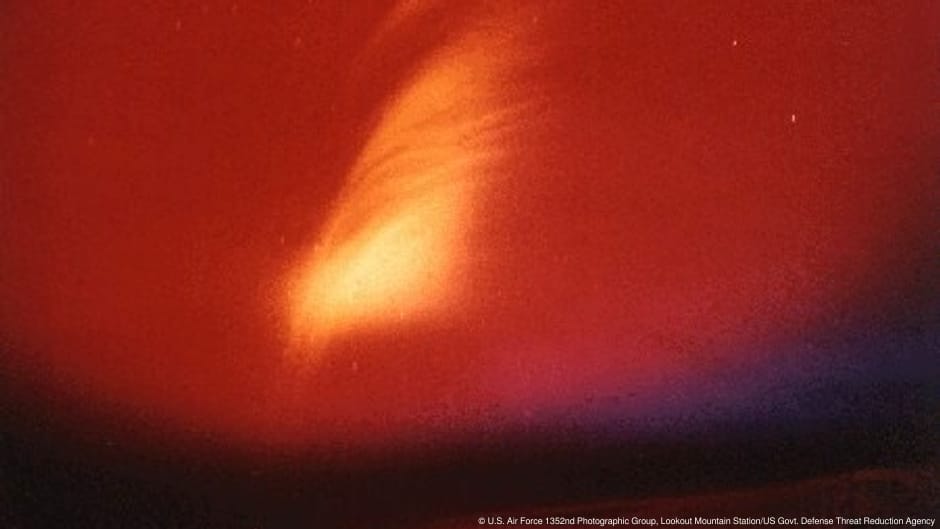
A nuclear explosion in space would be unlikely to cause widespread injuries on Earth, but it could disable satellites that support everyday services, including some that save lives.
In the United States, satellite failures could make it harder for emergency crews to communicate in remote areas. Disruption to GPS could leave drivers and pilots without navigation guidance and deprive financial networks of a source of precise time.
The effects are not entirely hypothetical. On the evening of July 8, 1962, people in Hawaii held "watch-the-bomb parties" and followed a countdown on shortwave radio. The night sky then lit up as the United States detonated a nuclear weapon about 400 kilometers (250 miles) above the Pacific. The test was called Starfish Prime.
An electromagnetic pulse knocked out some streetlights in Hawaii, and some Pacific radio links briefly went down. The glow faded within minutes, but some satellites failed months later.
The air was too thin for a conventional fireball to form or for a destructive shock wave to reach the ground. Instead, charged particles made denser air below glow, producing an artificial aurora. The atmosphere also absorbed much of the initial radiation.
Satellites are particularly vulnerable because they orbit above most of the atmosphere that shields people on the ground from the initial radiation. X-rays from the initial burst can damage spacecraft immediately. Earth's magnetic field can also trap electrons released after the blast, as it did after Starfish Prime. Satellites then receive another dose each time they cross the resulting radiation belt, potentially damaging their electronics and solar panels over time.
The impact would depend on where the explosion happened and which satellites crossed the radiation belt. GPS satellites orbit about 20,200 kilometers above Earth and send signals that help phones, planes and ships determine their locations. They could keep working even if satellites closer to Earth failed.
Satellites also support different services. A ship's emergency beacon can use GPS to determine its location, then send that information to rescuers through a separate satellite network. If part of that network failed, the alert could take longer to get through.
The 1967 Outer Space Treaty bars its parties from placing nuclear weapons in orbit. The 1963 Limited Test Ban Treaty prohibits its parties from carrying out nuclear explosions in space.
The Outer Space Treaty has no dedicated system for checking what spacecraft carry. A detonation is easier to detect because US satellite sensors are designed to pick up the signals it gives off.
Shielding could help protect satellite electronics, while backups could keep some services running. During a GPS outage, pilots over the contiguous US can use ground-based navigation aids. Operators could launch replacement satellites, but those could still face lingering radiation or debris.
Radiation could leave many satellites intact but unable to steer. If two objects collided, fragments could strike other satellites, producing more debris and further collisions. If enough debris built up for the chain reaction to continue on its own, it could persist even if no new satellites were launched. This is known as Kessler syndrome.
Whether an explosion would trigger such a cascade is uncertain. If it did, debris could endanger replacement satellites for years.
Some radioactive particles could enter the atmosphere and eventually settle on the ground. But a blast in space is too far away to sweep up the soil and water that carry fallout from a surface explosion. As the particles disperse, their radioactivity decreases over time, making the concentrated local fallout that can expose people near a ground-level blast to high doses unlikely.