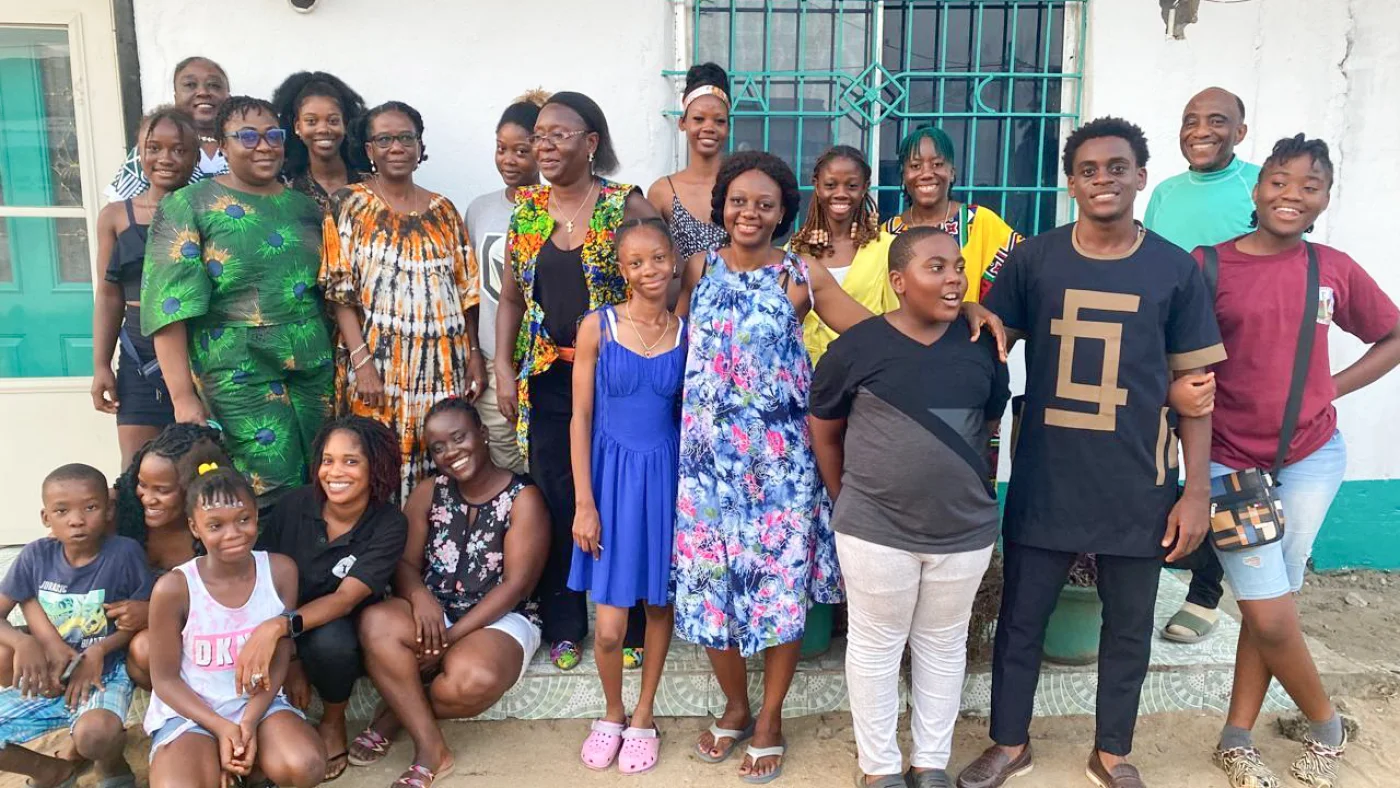
Liberian Thanksgiving, celebrated on the first Thursday in November, grew from a tradition brought by American settlers and became a national holiday in 1883. Today, families gather for church, prayer and meals that reflect local customs.
Yvonne Capehart Weah, one of 12 siblings, returns each year to Caldwell, the township where she grew up, to celebrate with her family. The gathering is so large that relatives eat outside beneath a tree rather than around a dining table. “When we meet, it's almost like we're having a party,” she says.
The holiday dates to the first half of the 19th century, when the American Colonization Society established the community that would become Liberia. Its founders were Black Americans, including people born free and enslaved people who had been emancipated; some left voluntarily and others were forced to leave. “The settlers from America brought that Thanksgiving Day tradition to Liberia,” Weah says.
Liberia became independent in 1847, but Britain continued trying to take territory. In 1883, President Alfred Francis Russell, an Episcopalian priest, called on God to help stop the incursions. Weah describes the invocation as a “prayer of protection against the intruders, preventing intrusion into our territory.” Liberia maintained its sovereignty, and that year the legislature established Thanksgiving as a national holiday, shaped by religious gratitude.
For Weah, the day is about “giving thanks to God for our freedom, for divine protection” and for “unity and for the harvest.” Her family’s celebration, like many in Liberia, begins at church, but people of all faiths observe the holiday.
“The Muslims, they go to the mosques and pray,” says Sekou Muhammad Sheriff, a YouTuber who travels around Liberia to showcase the country’s offerings and cultural heritage, including Thanksgiving. “And Muslims, Christians, and others — everybody observe this day as a holiday.”
As a boy, Sheriff looked forward to getting a new outfit for the holiday. His father bought him a “shirt-trouser suit, and then he'd buy me slipper.” His favorite was white. He has also come to enjoy different stews, including one made with sweet potato leaves and another with snails collected from the garden. “We call it king's meat,” he says. “It is very, very nice.”
The mid-afternoon meal varies from household to household. Weah says her family serves chicken rather than turkey: “We do fried chicken, smoked chicken, roasted chicken.” They also have jollof rice, watermelon, pineapple and a variety of stews, including fufu and soup, made with cassava, fish, chicken, okra, chili pepper and more. “That makes the soup very tasty,” Weah says. “It has to be [at] every Thanksgiving.”
Cooking is not Weah’s favorite task. “If you tell me, 'Go in the kitchen to cook or sit in the living room and read,'” she says, “I will sit in the living room and read.”
Sheriff did not have the resources to host Thanksgiving this year, but says he remains thankful to God for his health and for Liberia’s peace after civil conflicts from 1989 to 1997 and 1999 to 2003.
Weah is grateful, too. “When I go for Thanksgiving,” she says, “I'm thanking God for where I have come from, where I am now, and I'm also thanking Him for where He will take me because I know He holds the future.”
Weah is program manager at the We-Care Foundation, an education nonprofit that, among other things, teaches children literacy. “A reading child will become a reading elder,” she says. “And we expect informed adults to make informed decisions that affect both their social and economic life” — in ways, perhaps, that they will one day be thankful for.
NPR does not offer or accept money for coverage or interviews. Anyone who makes such an offer or request is not an NPR employee and does not represent NPR.