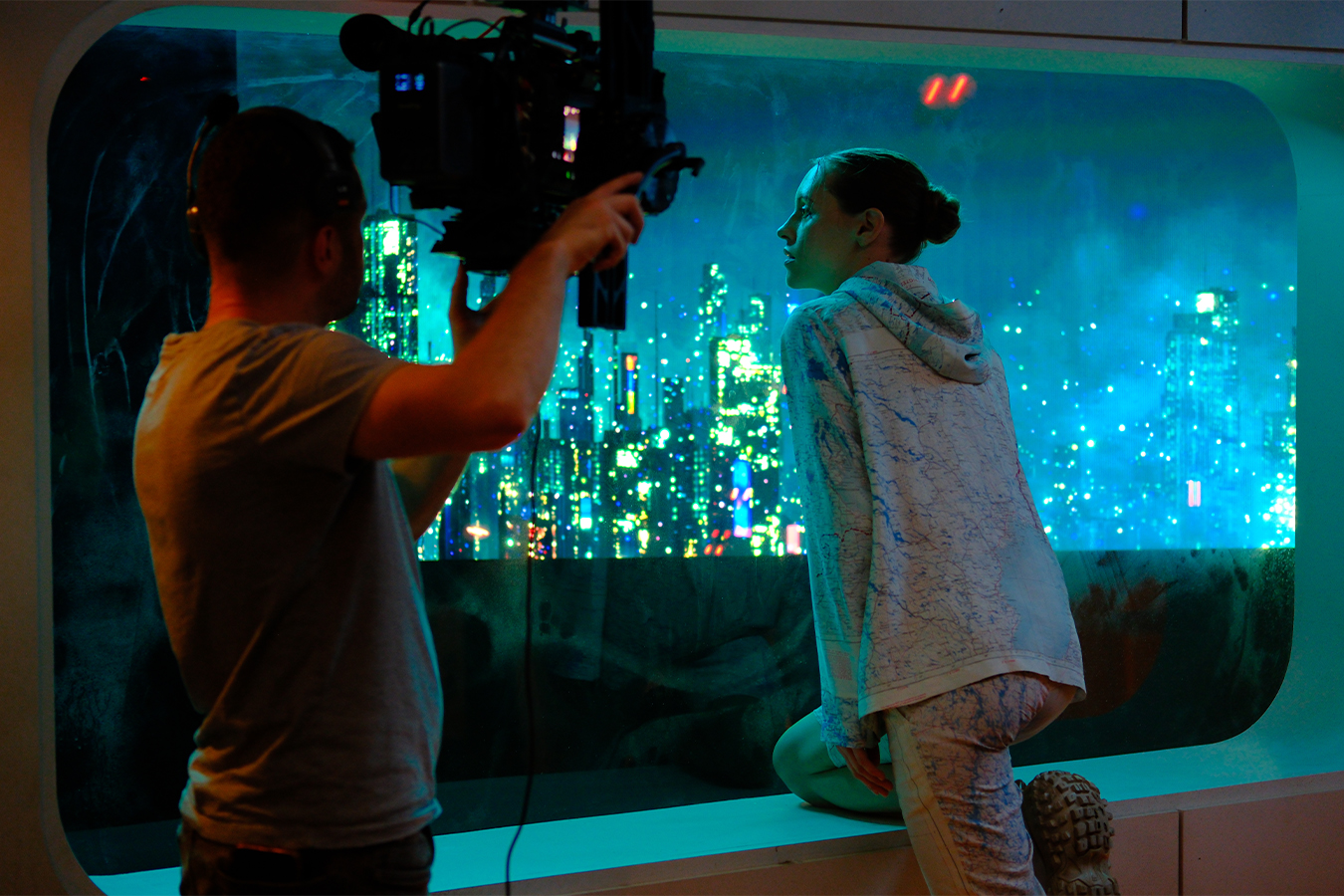
SNTIENT 2.0, a film by the Fashion Innovation Agency for London College of Fashion, used Unreal Engine to create an abandoned city visible beyond the window of a small physical set.
The dystopian story imagines a world where resources have run out, people have retreated into a simulation and the robots left to care for the physical world have begun to find beauty in it. “That gave us our visual starting point. A bleak, oppressive sci-fi environment with the potential for transformation,” says Dickon Knowles, director of content at Dandelion + Burdock. The finished film does not explore that transformation as far as originally planned, but the city set the tone.
The team chose Unreal Engine 5 for its real-time workflow, which let them adjust spaces, lighting and textures and see the results immediately. “It made the whole process much more fluid,” Knowles says. The team tried generative approaches to create the city backdrop, but encountered problems with resolution and visual fidelity. “Which is why we reverted back to our existing Unreal Engine version.”
The existing city environment was foggy and slightly desaturated, and did not look as intended through the camera. Knowles reworked the fog, replacing a general wash with more detailed VDB fog while reducing its overall presence and increasing saturation, particularly in the city windows. The team also sought richer blacks and more contrast for the LED wall.
Most of the city had been built before filming. On set, the team made visual refinements, grading and subtle adjustments, checking their appearance on the wall and through the camera without waiting for new renders.
The city appeared on an LED wall outside the character’s window, giving the performer a real backdrop to react to and illuminating the set. Cinematographer Ben Saffer, whose company Supervision VP handled the virtual production, said the setup allowed the team to control virtual and physical lighting together. “You’re doing it all in camera and capturing everything together at once, and you’re not having to guess at anything,” he says.
Knowles said cost was less of a concern than visual quality, as the city content had already been created for a previous project. “The city lights reflect on the performer’s face and on the surfaces of the props and set,” he says. “There is a level of visual immersion that is hard to capture in a studio without the LED wall to illuminate the space.” The production aimed to keep post-production to a minimum by getting footage close to the finished shot during filming.
The LED wall also served as a shutter that rose to reveal the digital city. A physical moving shutter was not realistic on the budget, while adding one in visual effects would have lost the in-camera effect. For reverse shots, a second wall on wheels acted as a fourth wall. The real-time content let the team quickly create and animate assets for the new angles. “It was nice to get that in camera,” Saffer says.
The pod was built physically to feel gritty and lived-in, while the LED wall and Unreal Engine created the distant environment. A separate AI-generated dream sequence at the start, made with generative tools, showed the character floating in water before she wakes.
The film follows a brief sequence: the character wakes, the window opens and she looks out. Saffer said the challenge was establishing the world and the character’s place in it within two minutes. The team filmed in the small set using an URSA Cine 17K 65 and prototype Atlas Lens Co. anamorphic lenses. The larger sensor helped Saffer capture more of the set without an extreme wide-angle lens that would distort perspective.
Saffer also used practical lens effects. Near the end, as the character looks towards the window, he held a plastic Polly Pocket toy in front of the lens and shone his phone torch through it from the side. He also experimented with cling film and other materials in front of the lens.