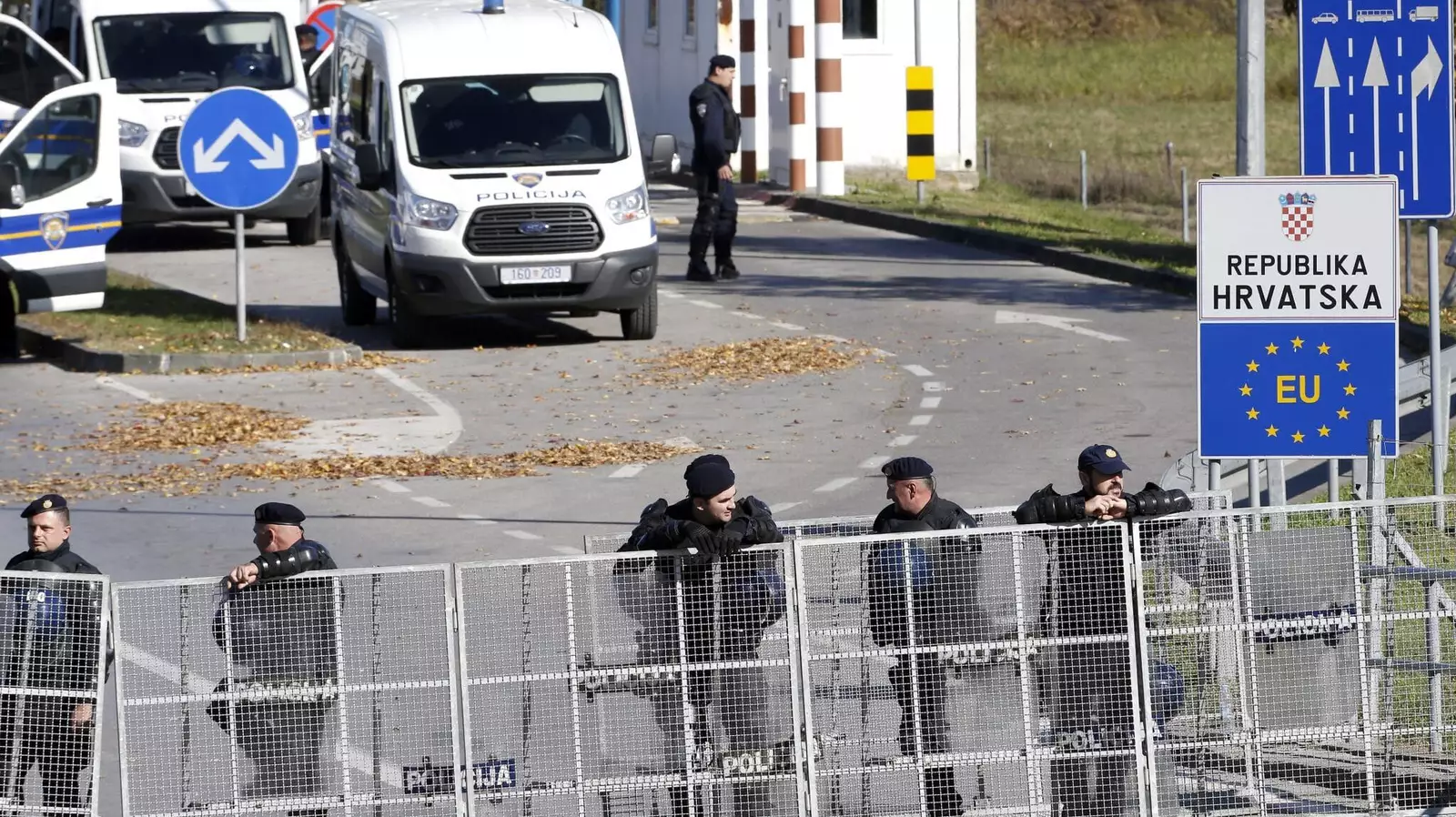
Human Rights Watch said Croatian authorities continue to push migrants back across the border to Bosnia and Herzegovina, often using violence. The practice affects unaccompanied children and families with young children, despite European Union efforts to stop it, the organisation said in a report released on Tuesday.
The report, “Doing Europe’s Dirty Work: Ongoing Violent Pushbacks of Migrants from Croatia to Bosnia and Herzegovina,” draws on interviews with more than 80 people. They included seven unaccompanied children, four children travelling with family members and six parents travelling with their children. HRW also spoke with 15 aid workers and others who provide information and support to asylum seekers and migrants.
Interviewees said Croatian police beat or kicked them, took their money and confiscated or destroyed their phones. Some said officers seized their documents and shoes, or forced them to strip to their underwear before pushing them back across the border.
“We told them that we are a family, but [the Croatian police] still took my husband away in one van and me and my daughters in another,” a woman from Ghana said. “We were separated for two days from my husband. They pushed me and my daughters to Bosnia through the woods. No phone, no food, no water. We were walking all day. We were lost and scared for many hours,” she added.
“There were maybe 12 underage boys with us, about 16 or 17 years old. The [Croatian] police hit all these underage boys, same as the adult men,” Rasul, 31, from Pakistan, told HRW.
Jamal A., a 17-year-old boy from Morocco, said in his testimony: “When the police caught me, they beat me severely and we went back to the Croatian border in a police van … We had to run to the river and swim through the cold water, and the water was sometimes over our heads. I was scared.”
“Violent pushbacks by Croatian police are a continuing issue, affecting children as well as adults, and the EU-funded systems set up to curb them aren’t working,” said Michael Garcia Bochenek, senior children’s rights counsel at Human Rights Watch. “The EU needs to act to ensure that Croatia respects EU law and protects the rights of those at its borders,” he added.
The Croatian government has not prosecuted any police officers for taking part in pushbacks, even when people suffered serious injuries or extreme forms of humiliation. The Croatian Interior Ministry told HRW that seven officers received disciplinary sanctions for mistreating migrants between 2020 and 2025.
BIRN sought a response from the ministry about the HRW report but had not received one by publication time. The government has strengthened the mandate of a border-monitoring mechanism established in 2021 with EU funding to prevent and address pushbacks and other border abuses. HRW said the programme has had little impact on police pushbacks.
A Croatian border police patrol on the Sava River. Photo: V. Tesija/BIRN.
Garcia Bochenek told BIRN the situation appeared to improve in 2023 and 2024. “There’s a readmission agreement between Bosnia and Croatia, and so we have been hearing increasing reports of this mechanism being used [in 2024],” he said.
“The reason we started to do interviews for this report is that it did seem that they then returned,” Bochenek said, adding that HRW conducted interviews in Bosnia and Herzegovina and Croatia in 2025 and 2026.
“European parliaments should really take on more of an investigatory role, which is done sporadically, but I think the fact that this issue continues is quite serious,” Garci Bochenek told BIRN, discussing steps that should be taken.
The HRW report said neither the European Commission nor the European Parliament had taken action on Croatia’s border abuses. The Commission can open infringement proceedings against an EU member state that fails to implement EU law, while the Parliament can investigate violations of EU law by member states.
The European Rule of Law Mechanism provides for an annual dialogue between the European Commission and member states. Recent rule-of-law reports have not examined weaknesses in Croatia’s border-monitoring mechanism or addressed pushbacks more directly.
HRW called on the European Commission to withhold funding for border control until Croatia investigates and ends pushbacks and other forms of mistreatment. “The EU needs to act to end the violent and abusive pushbacks at its borders and to hold Croatia to account for persistent and flagrant violations of EU law and international norms,” Garcia Bochenek said.
Migrants enter Croatia at the border with Serbia. Photo: V.Tesija/BIRN.
On the morning of November 11, a team from SOS Balkan Route, a migrant rights organisation operating along the so-called Balkan Route and founded in 2018, received information that an unusually large number of migrants needed assistance on the Bosnian side of the Croatian-Bosnian border near Bihac.
“We see people being hurt and pushed back from Croatia every day. But this was a critical episode because of the mass violence, the collective violence that these people suffered,” SOS Balkan…