Hundreds of thousands march in France’s biggest day of protests in years. Here’s what we know
By Issy Ronald ·
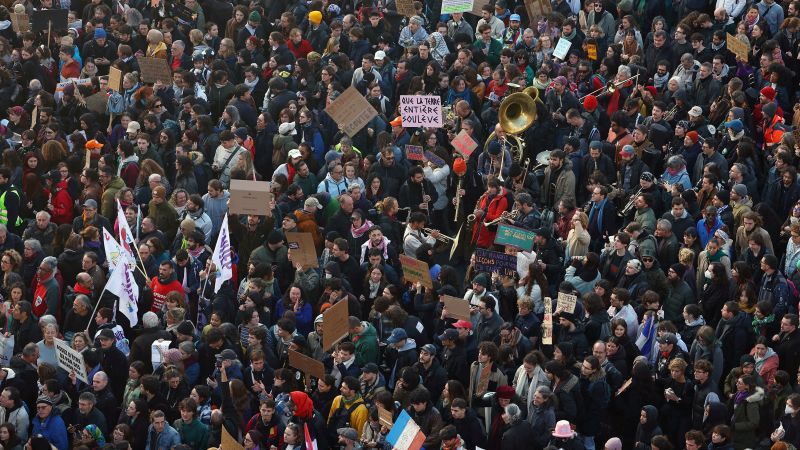
About 575,000 protesters participated in demonstrations across France on Thursday, according to government estimates, marking the biggest single day of protests since a wave of unrest began in September to coincide with a nationwide strike.
Despite the scale of these protests, and the violence which marred similar marches on October 17, the day passed relatively peacefully, albeit with some localized clashes in cities across France.
Some workers went on strike too, depleting some schools, universities, railways and, to a lesser extent, hospitals of their staff.
The diverse nature of sectors involved reflects just how many groups are now participating in these protests, which have expanded from students demanding better conditions in schools to a movement that has drawn in trade unions and Yellow Vest protesters.
Each group has its own concerns, though they are united by widespread discontent over the cost of living, perceived government inaction, a growing wealth divide and a deep desire for social and political change.
Several of France’s biggest unions, representing everyone from students, teachers and postal workers to doctors, pharmacists and transport workers had called for a nationwide strike today. About one in three of France’s higher education institutions were “disrupted” because of the demonstrations, while about 13% of all school staff went on strike, the government estimated. The unions estimated far larger numbers.
Some train services were also disrupted because of striking workers. Very few public hospital staff — only about 5% of the workforce — participated in the strike, France’s health ministry told CNN. “No significant disruption to healthcare services has been reported,” the ministry added.
Ever since protests turned violent almost three weeks ago, authorities and shopkeepers have braced for similar scenes at every one of these nationwide demonstrations. However, the day passed without major incident, aside from “clashes between police and groups of radical and far-left activists in several cities, including Rennes, Nannes, Lyon and Marseille,” France’s Interior Ministry said. Altogether, police detained 448 people.
In Lyon, police fired tear gas and charged a group of protesters, many of them masked while “several dozen” agitators were arrested in Rennes after they vandalized a hotel, threw objects at police and “violently attacked” protesting union members, authorities said.
One school near Toulouse was badly damaged by a “deliberate act of arson,” according to French education minister Édouard Geffray, and firefighters responded to 86 fires across the country, the Interior Ministry said.
Laurent Nuñez, the interior minister, said: “In a context where, once again, numerous acts of violence occurred, law enforcement officers responded with courage and determination to ensure that the right to protest could be exercised peacefully and safely, despite the controversial claims accusing them of obstructing it.”
Each group involved in these protests has slightly different demands. The labour unions which called for a strike today are demanding higher wages and pensions. In particular, the CGT, one of France’s most prominent unions, says the minimum wage must increase immediately by 10%. Another union — the CFDT — is demanding a 100 euro, about 7%, increase in the minimum monthly wage.
Student groups, meanwhile, are demanding an increase of more than $10 billion in the education budget, as well as a $1.5 billion investment in school infrastructure and 250,000 additional university places.
The Gilets Jaunes or Yellow Vests — a radical movement that first emerged eight years ago — is demanding the departure of President Emmanuel Macron and his government, and a new constitutional process.
In short, yes. None of these demands are easily attainable and protesters are indicating their intention to keep demonstrating until Christmas, and possibly even until France’s presidential elections next spring. Even just looking ahead to the next few days, the Yellow Vests are planning to protest on Friday and Saturday.
Elsewhere in Europe, where similar protest movements have emerged, strikes are planned later this month in Spain, Italy, Portugal and Belgium.
Stung by being caught unawares on October 17, authorities have remained “extremely vigilant” in their preparation for these protests, a government spokesperson said Wednesday, according to Reuters. But while security forces on the ground have largely managed to stifle any violence, Macron has been criticized for failing to adequately respond to the protesters’ demands.
“I want high schools to be able to reopen after the holiday because, when we talk about the future of our young people, they need to be able to return to class,” he told French journalist and YouTuber HugoDécrypte.
He argued that young people “have been heard,” and called for them to “return to class, for calm to be restored and for high schools to reopen under proper conditions,” even as they continue protesting.
CNN’s Saskya Vandoorne, Lucie Lepellec, Tim Lister, Billy Stockwell and Joseph Ataman contributed reporting.
Originally published by CNN