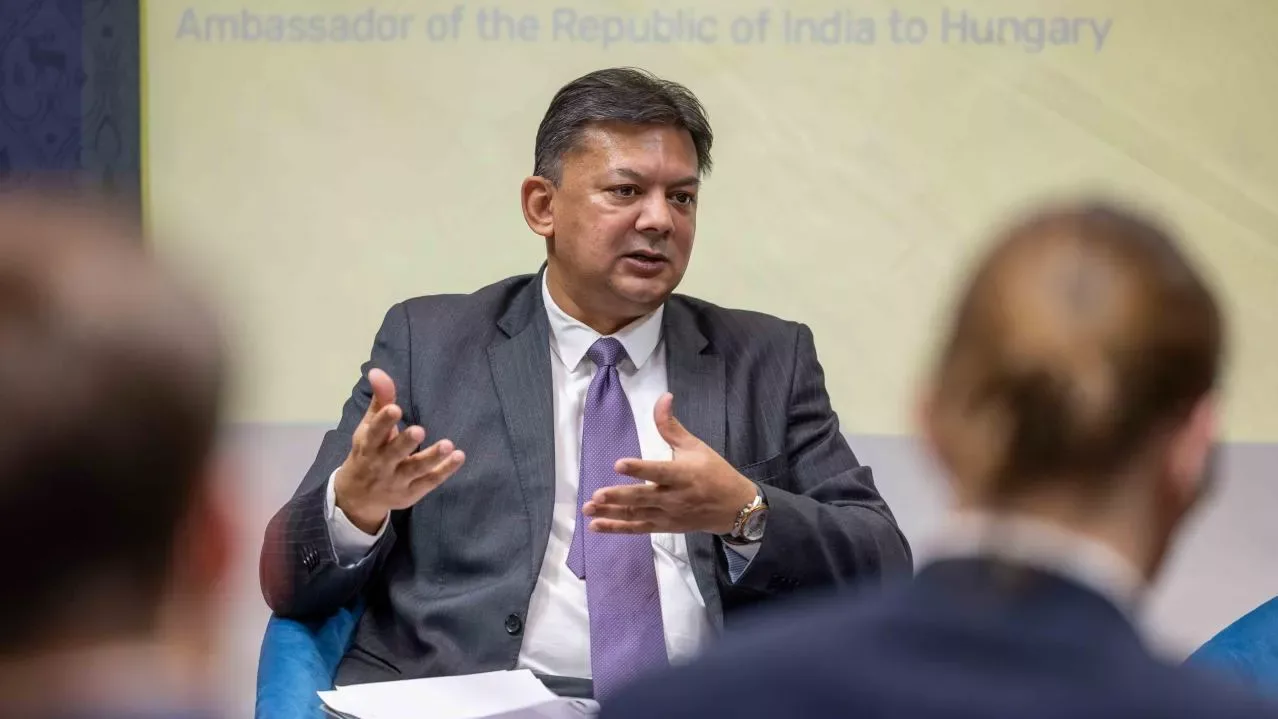
India’s poverty rate fell sharply between 2011 and 2023, according to a World Bank brief published in October, as the country’s economy grew and expanded direct support to households, writes Anshuman Gaur, India’s ambassador to Hungary.
The share of Indians living below the World Bank’s lower-middle-income poverty line of $4.20 a day dropped from 57.7 per cent to 16.1 per cent over those years — about 496 million people. Extreme poverty, measured at $3 a day, fell from 27.1 per cent to 2.6 per cent. The World Bank describes the decline as one of the fastest anywhere in the world.
The scale is difficult to picture: on average, around 41 million people moved above the poverty line each year for twelve years, more than four times Hungary’s population annually.
Writing about the report this week, American economist John Phelan compared poverty declines in 51 countries and found India’s to be the steepest. He pointed to economic growth. Among 29 countries in his comparison with incomes below $30,000 a head in 2011, none reduced poverty by more than ten percentage points without GDP per head increasing by more than 20 per cent.
For decades after independence, India’s economy was governed by licences, quotas and permits. In Economics of Shortage, Hungarian economist János Kornai explained how such systems produce queues instead of goods. In the 1980s, families in Delhi could wait years for a telephone line, as families in Budapest did.
India began dismantling its “licence raj” in earnest in 1991, cutting tariffs, opening to foreign investment and allowing private firms to compete. Hungary was breaking with central planning at almost the same time. Both countries, Gaur writes, learned that prosperity depends on people being free to produce, trade and invest.
The World Bank brief also points to changes over the past decade. Since 2014, under Prime Minister Narendra Modi’s leadership, India has sustained fast growth while working to ensure that gains reach poorer households. Employment increased by about 134 million between 2017 and 2023, nearly twice the rise in the working-age population. More people found work, particularly women in rural areas.
Rural households gained faster than urban ones, narrowing the gap between villages and cities, while social transfers, including food support, expanded.
The state’s delivery systems have also changed, the article says. Hundreds of millions of people opened bank accounts for the first time, and digital identity and payment systems now route subsidies directly into them, leaving less room for middlemen and leakage. Free food grains reach around 800 million people. Piped water serves about 82 per cent of rural homes, up from under 17 per cent in 2019.
Gaur says Hungarian water technology companies are already working in India.
Gaur calls the progress a “fantastic achievement” but says the next stage will require better jobs, higher productivity and more skills. Prime Minister Modi’s Viksit Bharat vision aims to make India a developed country by 2047, the hundredth year of its independence.
Gaur argues that people leaving poverty become customers, buying better food and medicines, building homes, paying for education and travelling. He says India’s new middle class is forming now and identifies pharmaceuticals, water management, food and agricultural science, engineering and automotive components as areas where Hungary is strong.
Merchandise trade between India and Hungary reached about $2.4 billion in 2025, almost double the 2024 figure, according to the article. Indian companies have invested around $3.3 billion in Hungary in pharmaceuticals, information technology and manufacturing. The India-EU Free Trade Agreement, concluded in New Delhi in January, is close to signature and, Gaur says, will make trade between Hungary and India easier.
Gaur says the World Bank brief describes half a billion people changing their lives in twelve years. He writes that the next stage — moving from escaping poverty to a secure and comfortable life — will be built in factories, clinics, farms and classrooms, and invites Hungarian partners to take part.