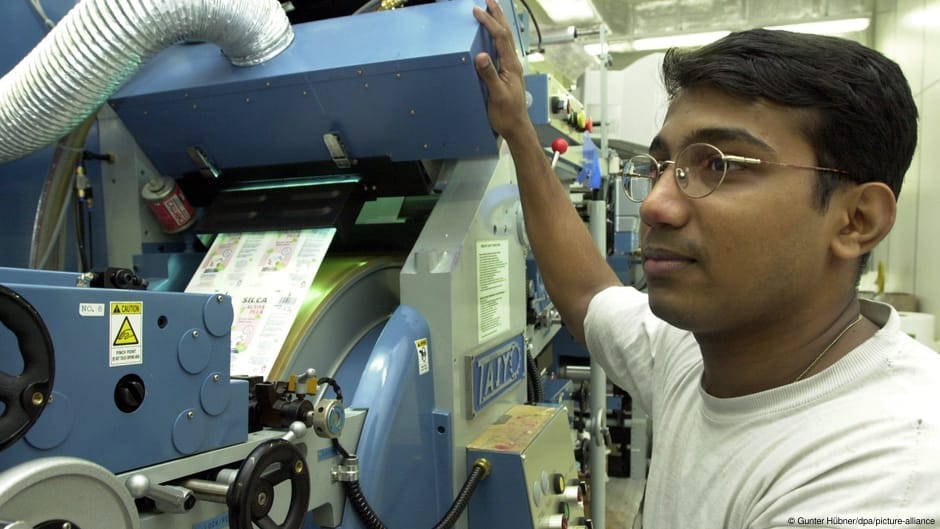
Indian workers are increasingly filling jobs in Germany, but language barriers, employer reluctance and risks of exploitation complicate their move. The number of Indian workers in Germany who pay social security contributions has risen sevenfold over the past decade to more than 140,000. Many work in IT and health care, while Germany is also seeking electricians, mechatronics technicians, solar panel installers and truck drivers.
Pratyay Saikia was studying food technology in 2022 when he saw an advertisement from Magic Billion, a recruitment agency that places skilled and semi-skilled Indian professionals in verified jobs abroad. The 25-year-old from Haryana contacted the agency to explore opportunities.
Four years later, Saikia works as a butcher at Metzgerei Lederer in southern Germany, after completing a three-year apprenticeship there. “I came to Baden-Württemberg with 180 other Indians who came here to do an Ausbildung [apprenticeship] program. Me and seven others did our Ausbildung at Lederer [butcher shop], while others went into the construction sector. I now have a full-time job here,” he told DW.
Germany’s demand for workers comes amid a shrinking and rapidly aging population. A 2024 Bertelsmann Foundation study concluded that the country needs 288,000 foreign skilled workers per year until 2040 to replace retiring workers. A report by consulting firm FMC Group said more than 369,000 skilled positions went unfilled in 2025.
Despite the need, many companies, particularly Germany’s Mittelstand of small and medium-sized enterprises, remain reluctant to recruit from countries such as India, observers say. “Hiring an electrician from India is a relatively new concept for German companies, so they are hesitant,” said Daniel Raja, managing director of Düsseldorf-based recruitment firm NM NextMittelstand GmbH, which connects German firms with skilled workers from India.
Raja said Mittelstand companies are often overlooked by young talent abroad, while many do not actively recruit internationally. The gap, combined with often high German-language requirements, leaves some skilled jobs vacant, he said.
Saikia had studied German to B1 level, considered intermediate proficiency, but found it insufficient for everyday communication at work. “Initially, I found the theory classes of my Ausbildung quite difficult. But my co-workers helped me. After one year, my German improved, and I realized integration happened automatically as my language level improved,” he said.
David Kipp, a researcher in the Global Issues Research Group at the German Institute for International and Security Affairs (SWP), said he was “skeptical” about lowering language requirements. “Language skills are an important selection criterion so people actually know where they are going. Sending people with very little language knowledge makes exploitation easier, because they have less direct contact with German institutions,” he told DW.
Language is not the only obstacle. Raja said workers’ councils also sometimes oppose hiring from abroad. “Company decisions in the Mittelstand involve the team and the shop floor,” he said. “In some cases, the workers’ council resists hiring from India because they mistakenly believe 'cheap Indian labor' will take their jobs or undercut their wages.” Raja said he uses methods including TikTok Live sessions to speak directly with industrial employers and workers and address concerns and misconceptions.
German companies have traditionally turned to workers from Central and Eastern European (CEE) countries such as Poland, Romania and Slovenia to fill labor gaps. But studies show CEE workers are increasingly reluctant to move to Germany as economic growth and career prospects improve in their home countries. Recruitment agencies in those countries have consequently begun looking beyond the European Union for workers.
Some third-country nationals (TCNs) obtain residence permits in CEE states and are then posted to German job sites under the Vander Elst visa. It allows non-EU citizens legally employed in one EU member state to be temporarily sent to work in another. “European Labour Authority's (ELA) 2025 study on the posting of third-country nationals found that the number of posted TCNs is increasing. The main sectors concerned are construction and transport,” said Pia Fallstrom, ELA spokesperson.
The number of TCNs posted across the EU is difficult to establish because data exchange between sending and receiving countries by nationality and sector is limited. “Finding out how blue-collar workers get here really requires fieldwork,” Kipp said, adding that Indian recruiters know about this mobility loophole and take advantage of the opportunities.
Although regulations are meant to protect workers posted to Germany from another EU state, ELA said the practice has often resulted in wage-dumping. “ELA's work has identified issues such as difficulties accessing information on applicable rules, complex subcontracting arrangements, letterbox companies, bogus self-employment and other cases of non-compliance,” Fallstrom said. “Posted third-country nationals can be particularly vulnerable because they may also depend on their employer for their work and residence permits.”
Raja said he had seen workers fall victim to recruitment scams and exploitation. “I know of a family that took out a loan so that their child could enroll in an institute which promised a job in Germany,” he said. “When the candidate realized it's a scam, they ended up in Bahrain doing a tough manual labor job just to pay off the loan.”
Saikia said workers should verify that recruitment agencies are legitimate. He said the agency’s detailed website and its CEO’s willingness to speak with him early in the process reassured him that it was not a scam.
Kipp said preventing exploitative hiring requires streamlining migration procedures, expanding pre-departure cultural training, improving the identification of trusted entities and tackling social media scams. “India is the most important country for experimenting with how work migration functions. If we don't pay attention, we'll just send people into the low-wage sector and into disappointment,” he said.