Originally published by Guardian World. By George Chidi in Atlanta.
‘It stings to come close’: Louisiana Democrat’s narrow failure to make it 57 Senate seatsJamie Davis falls just short as Democrats across south wonder whether blue wave could have been even bigger
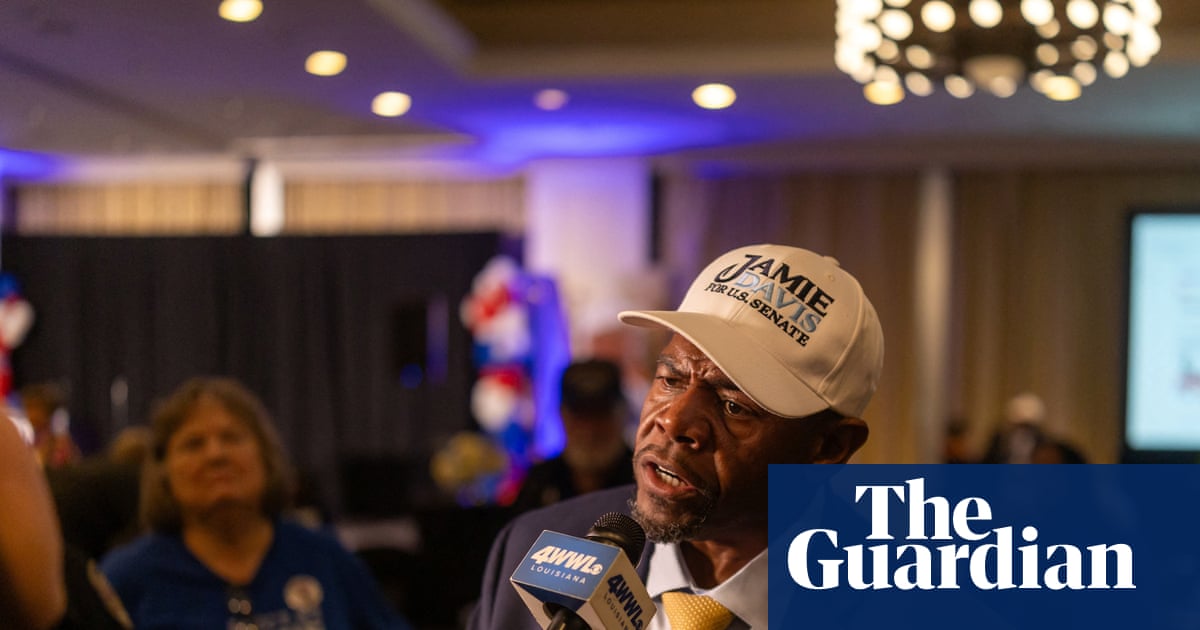
Democrats are celebrating after, with Mary Peltola’s victory in Alaska, they have officially secured 56 Senate seats after the midterm elections. But Jamie Davis, who lost an incredibly close election for a Senate seat in Louisiana and could have made it 57, told the Guardian it “stings to come close”.
In Louisiana, which has not elected a Democrat to the Senate since 2008, Davis lost to the Republican congresswoman Julia Letlow 49.1% to 50.9%. He was about 25,000 votes short in a state that cast about 1.5m votes.
“Truthfully, I mean, it kind of stings to come close, but what hurts more than anything else is the fact that, still today, people don’t realize and know what we did,” Davis said. “There are still some people out there right now today who do not realize that I only came within a point – I think it’s one point, 1.1 or 1.2 points of winning this election.”
Across the south, Democrats are now wondering what might have been, as other Senate seats were also close. Barry Moore beat Everett Wess in Alabama by nine points, which is a landslide in many states and a catastrophe compared with Donald Trump’s 30-point margin in 2024. Angie Nixon, whose progressive politics and opposition to the Israeli government looked like a mismatch with Florida’s conservative electorate, came within three points of unseating the Republican incumbent, Ashley Moody, in a special election.
In the weeks since, Democrats have questioned which of those states might have been winnable had the national party cast its light in the south. And many have zeroed in on Louisiana.
Unlike Florida, Louisiana is not an expensive media market. And Louisiana does not have the depth of partisan political identification to be overcome in a place like Alabama.
Turnout nationwide ran about three points higher in November than four years ago. In Louisiana, it ran eight points higher, in line with states facing competitive US Senate elections like Michigan and Maine.
Senator Bill Cassidy and Trump have long been at odds. Cassidy voted for his impeachment and asked him not to run in 2024. Trump targeted the Louisiana Republican in the primary, endorsing Letlow.
The Callais decision from the US supreme court originated in Louisiana and prompted the state to postpone primary elections and set off redistricting battles this year. Combined with Cassidy’s third-place finish in the primary, the motivating effect of these events on Black voters should have also set off alarm bells among Democratic fundraisers and operatives, Davis said.
“When it became open, that’s the time when Republicans and Democrats and independents all should have been on notice that there’s an open seat in the Senate,” Davis said. “And not just automatically think that the seat is going to turn to be Republican.”
Lutlow outraised and outspent Davis by almost two to one, though the total spending in the race – about $13m accounted for so far – is low by historic standards in Louisiana and nationally this cycle. Troy Jackson in Maine raised and spent about $25.2m in a state with about 1.4 million residents – or $18 for every Mainer – to unseat Susan Collins. Abdul El-Sayed spent about $5 per person in Michigan, buoyed by fierce national attention. Roy Cooper spent about $3.66 per person in a blowout race in North Carolina.
In Louisiana, Davis spent about $0.82 per person. Letlow spent $1.44.
Davis said he was hurt by a last-minute campaign ad, which used AI to depict him slowly walking toward the camera while a narrator falsely described his positions on abortion, gun rights, crime and immigration.
“I did not have enough campaign funds in my account to answer that ad,” Davis said, which he vowed regretfully never to allow that to happen again if he runs for statewide office. “I’m not saying that single-handed thing ended the election for me, but I will say not being able to answer it didn’t help me at all.
“But I also say that my dad always told me that you cannot depend on somebody to fight your fight for you. You can’t depend on somebody to plant a seed and you harvest it. If you plant the seed, you should harvest it.”
Davis was a political unknown a year ago, living on acreage between Red Gum and Ridgecrest, about 10 miles from the Mississippi River, in black dirt, row crop, river bottom country, way up north from New Orleans. Davis farms corn, soy, sorghum and cotton.
“I am that moderate Democrat that comes from real rural Louisiana,” Davis said. “That rural Louisiana part that most of the Democrats felt like, hey, they done forgot about us. We’re Democrats too. We don’t live in an urban area, but we still get up and go to work in the morning, we still farm, we still raise chickens, we still do country things like old-school Democrats used to do.”
Explore more on these topics- Louisiana
- US politics
- US midterm elections 2026
- Democrats
- features