Judges appear open to Trump’s push to overturn hush money conviction
By Kara Scannell, Lauren del Valle ·
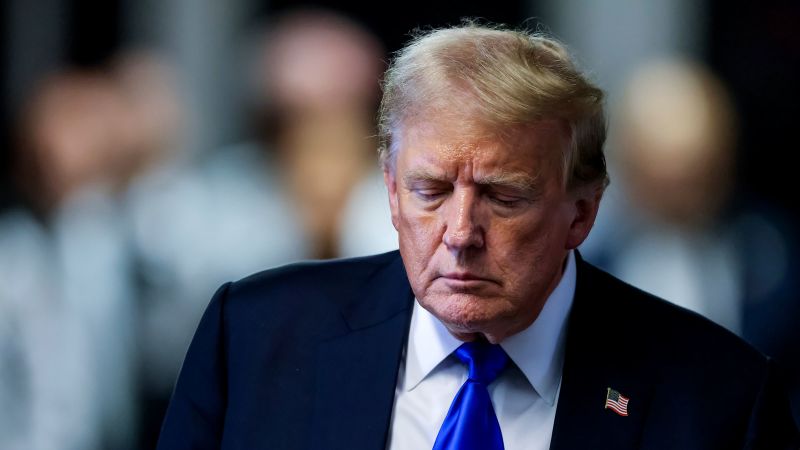
Two years into his second term, President Donald Trump is still trying to wipe his 2024 felony conviction from the books. A panel of New York appellate justices on Thursday heard Trump’s legal challenges to his conviction on falsifying business records to cover up hush money payments to influence the 2016 presidential election.
The five justices – who were all appointed by Democratic governors – at times appeared open to Trump’s arguments that federal election law and presidential immunity could affect the conviction.
His lawyers argued the conviction tied to the reimbursement of hush money payments to Stormy Daniels should be overturned based in part on the argument that federal election law preempts state law.
Trump’s legal team also says the trial judge ran afoul of the Supreme Court’s 2024 decision on presidential immunity by allowing testimony of White House officials and Trump’s tweets – official conduct – to be used as evidence in a criminal case involving unofficial acts.
Trump was convicted on 34 counts of falsifying business records with the intent to commit or conceal another crime.
At trial, prosecutors with the Manhattan District Attorney’s Office said that crime was to promote or prevent an election through unlawful means, which could include violations of the Federal Election Campaign Act (FECA), falsifying bank records, or tax crimes.
“For purposes of the underlying election law conspiracy, the point is that (Trump) and his co-conspirators were really indifferent to the legality of what they were doing. They wanted to hide what they were doing, and to make these hush money payments without anybody finding out,” Steven Wu, Chief of Appeals for the DA’s office, said Thursday.
The FECA violations were the most obvious ground for conviction, prosecutors said at trial, but Trump’s attorney Robert Giuffra told the appellate panel it’s actually “the most obvious ground for reversal.”
“And the law is quite clear,” he said. “The Department of Justice and the Federal Election Campaign Commission have exclusive jurisdiction to regulate and enforce contribution and expenditure violations.”
A jury of 12 New Yorkers found Trump guilty on all counts, making him a felon. Trump was reelected president, and days before his inauguration the judge sentenced him to an unconditional release.
The panel Thursday challenged the state’s attorney on how heavily the trial team relied on the FECA violations to prove the 34 counts of falsifying business records against Trump.
“Only partially,” Wu said, adding that evidence of Trump’s FECA violations were facts for jurors to consider rather than elements of the charged crimes.
“What preemption does is prevent the state from directly enforcing a federal statute. That’s not what the prosecution was doing here,” Wu said.
Associate Justice Bahaati Pitt-Burke pressed Wu further, noting the case dealt with campaign contributions. “That’s clearly within FECA purview. What are you using to get around that?”
Wu said, “FECA is limited to direct limitations on contributions and expenditures. That comes from the cases, that comes from the regulation. But this prosecution and the statutes under which defendant were convicted are not about expenditures or contributions at all.”
“If you think about the focus of this prosecution – the fraud that was committed in the records of a New York enterprise. That is not what FECA regulates at all,” the judge added.
Giuffra leaned heavily on the federal preemption argument, but still said the appellate interpretation of the SCOTUS 2024 immunity decision could be precedent-setting.
“It could be some other president down the road,” Giuffra said. “It’s not just about President Trump – it’s about future presidents.”
Conversations with White House staffers and Trump’s tweets were both about unofficial acts and so not covered by immunity, Wu argued adding that even if the judge erroneously allowed the evidence there was plenty more to convict Trump.
They were a “drop in the bucket” in terms of evidence of Trump’s guilt, Wu argued, so any presumed error would be harmless in light of the overwhelming evidence of Trump’s guilt.
“Can there be such a thing as harmless error with regard to presidential immunity?” Justice Shlomo Hagler challenged.
The Supreme Court’s immunity ruling determined presidential tweets can be official actions because that’s how he communicates with the American people, Giuffra said.
Justice Troy Webber read from the Supreme Court decision and asked Guiffra how Trump’s discussions with former White House communications director Hope Hicks to respond to media inquiries about the payment go toward enriching Americans’ lives.
Giuifrra said the tweets relate to Trump’s fitness for office. Other presidents have had to similarly defend themselves against allegations in public statements while in office, Trump’s lawyer added.
Longtime Trump adviser Boris Epshteyn attended the proceedings. Court officers admonished him three times for using his cell phone and threatened to remove him.
Originally published by CNN