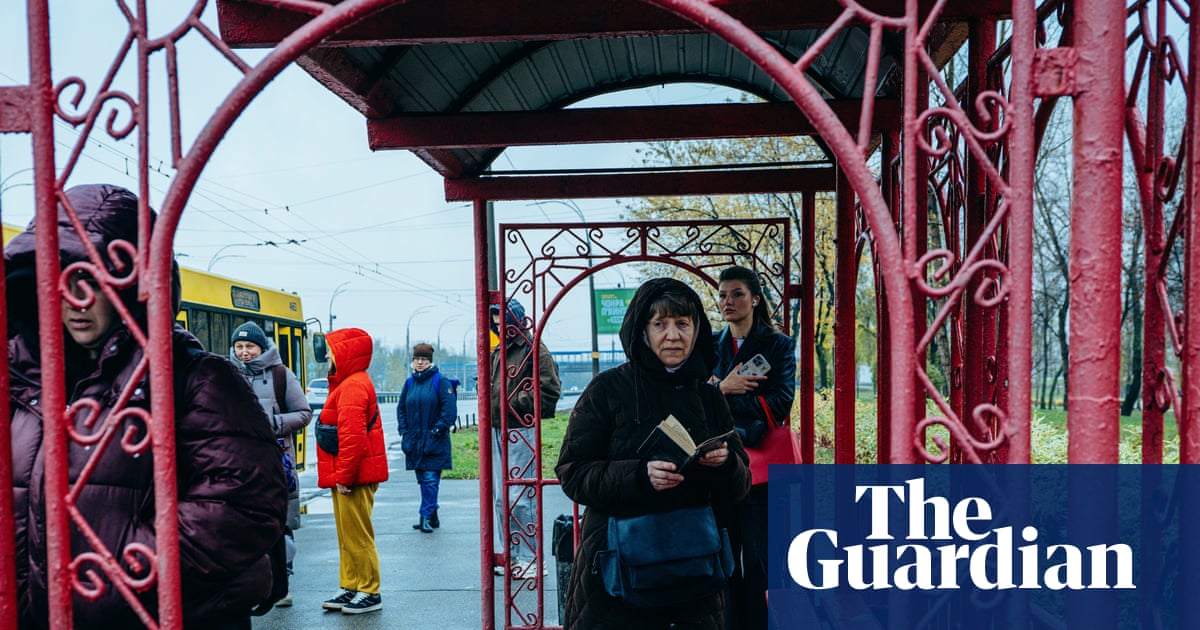
Kyiv residents say they are not overly worried about Russian attacks on the city’s bridges, even as damage has restricted road traffic and officials prepare alternatives. People interviewed said they would deal with further problems if they arise.
On Tuesday, a Russian ballistic missile attack damaged the Northern Bridge, leaving holes in its roadway. Buses are now the only motor vehicles allowed across the normally busy crossing, and must use its only functioning lane to pass the damage. By lunchtime, the holes had been covered.
Mykola, 65, a marshrutka driver who expects to cross the bridge 20 to 24 times a day, said: “So what if there’s a hole? The bridge hasn’t collapsed. You need to know a bit about bridge construction,” He added: “It would be very difficult to destroy the bridge. It would take a huge number of missiles, and if one or two hit it, it wouldn’t be the end of the world,”
Russia has been attacking Kyiv’s bridges since early October, alongside strikes on the capital’s electricity, heating and water systems. The attacks have targeted routes connecting the city centre in the west with the newer, largely residential east, home to about a third of Kyiv’s population.
The Southern Bridge was allowing motor traffic only from east to west as of Friday, while the recently damaged Podilskyi Bridge was also restricted. Mayor Vitali Klitschko urged people to avoid car travel after a night in which six were killed. The Northern Bridge remained open to public transport, cyclists, scooter riders and pedestrians.
Dmytro Bespalov, a transport planning expert at Kyiv’s National University of Construction and Architecture, said the Northern Bridge’s supporting structures were so far unscathed and that damage to its roadway could usually be repaired. Suspension bridges have “a strong construction, with a lot of repairability”, he said.
Bespalov warned that Kyiv would be strategically vulnerable if Russia attacked its bridges with “dozens or hundreds” of missiles, saying the city had too few bridges even before the war. He also said pontoon bridges would have less capacity and be more exposed to attack. “I don’t think it would be possible to use pontoons during a red [missile] or yellow [drone] alarm,” he said.
Earthworks have begun beneath the Northern Bridge to prepare for a floating pontoon bridge, one of eight planned in case of the worst. Bespalov said: “It would take 20 pontoon bridges to have half the current capacity.”
Nataliya, 40, and Iryna, 39, said they were willing to continue crossing the Northern Bridge. “The main thing is to get through the first 24 hours at home after the initial discomfort, and then we’ll adapt,” said Nataliya, a customer service specialist.
Iryna said: “If we start to despair, that’s exactly what they want. A bridge can be built. The main thing is that when the attack comes, there are no civilians or military personnel around. It’s just concrete, that’s all. They’ll either repair it or come up with something new.”
Oleksandr, 42, a construction worker, said he and his wife would leave if the bridges were destroyed, moving to her parents’ home across the river. He said they had a generator and water well there and had converted the home’s gas heating to wood-burning.
The article was written by Dan Sabbagh in Kyiv, with photographs by Julia Kochetova and additional reporting by Galya Rudyk.