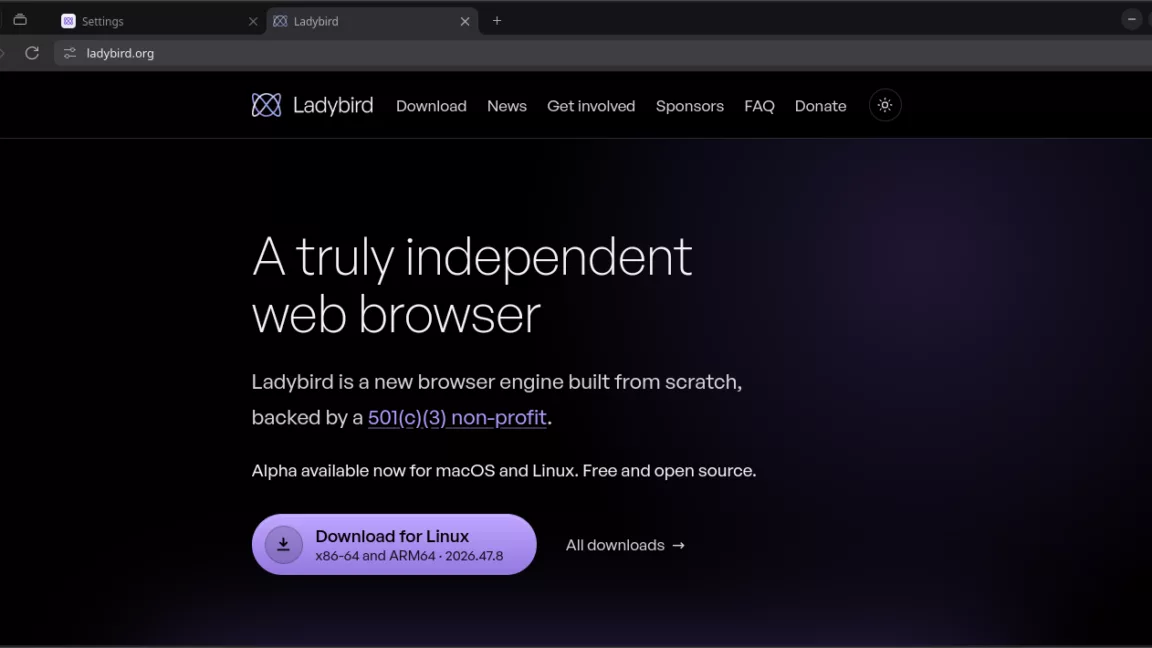
Ladybird, a browser built around a rendering engine and JavaScript engine written from scratch, released its first downloadable alpha on November 23. The package is available for macOS and Linux, installs without requiring users to compile the source code and updates automatically.
The project’s release follows four years of work. Ladybird is not a fork of an existing browser engine: Chrome, Edge, Brave and Opera use Google’s Blink, while Firefox uses Gecko. “The engine is our own, built from the ground up, and not a fork,” project lead Andreas Kling wrote in Monday’s announcement. “The browser around it is modest, but functional.”
Most of the modern web runs on three engines: WebKit, used by Safari; Gecko, used by Firefox; and Blink, used by Chromium. Because most traffic goes through Chromium, developers often optimize sites for it, the article says, with the web platform tending to follow what the dominant engine supports.
An independent engine offers another implementation against which web standards can be tested. It can also expose cases where sites rely on Chromium behavior rather than published specifications. Ladybird is unlikely to shift the market soon, the article says, but adding another engine can help reveal those assumptions and encourage adherence to standards.
Ladybird grew out of Kling’s SerenityOS project, an effort to build an independent operating system from scratch, before becoming a separate project. Kling formed the Ladybird Browser Initiative, a 501(c)(3) nonprofit funded by sponsorships and donations. The project’s website says it has no sponsored search-engine deals, unlike many popular browsers, and that sponsors have no say in its roadmap.
The alpha is a rolling release that updates automatically. “Ladybird improves quickly, and until now you had to build it from source to see that,” Kling wrote. The browser began in C++, in keeping with SerenityOS’s ethos, but the project has started moving toward Rust, beginning with its JavaScript engine.
The project describes the release as very early and includes a built-in tool for reporting websites that fail to render or crash the browser. Kling wrote: “We want security nerds to hack it! A new browser gets hacked, over and over, and that’s part of the process, so we make no promises about security today.” Windows support is planned, but the alpha is currently available only for macOS and Linux.
In a test of Ladybird alpha version 2026.47.8, the reviewer used an AceMagic W1 mini PC with an AMD Ryzen 7 8745HS and 16GB DDR5, running Fedora Linux 44 and KDE Plasma 6.8.3. The reviewer said the browser felt less like alpha software than expected, with responsive tab switching, smooth downloads and menus that seemed well developed for an early build.
Google Maps loaded, located the reviewer and handled map layers, zooming and Street View in Alberta, Canada, in around three seconds. GitHub, YouTube and the news sites tested also worked without a hitch. The reviewer said the mini PC’s fan spun up noticeably while pages rendered.
The browser eventually stalled while the reviewer had about 10 tabs open and was streaming a 4K test video from a personal Jellyfin server. Repeatedly skipping through the file preceded the freeze. The reviewer described this as an attempt to trip up an alpha build, not evidence that the browser is inherently broken.
The reviewer said Ladybird would not replace Firefox for them soon, but was impressed by the performance of an early browser built with a scratch-made engine. The article concludes that the alpha is worth exploring on a Mac or Linux PC, while cautioning that it is not ready to be a daily driver.