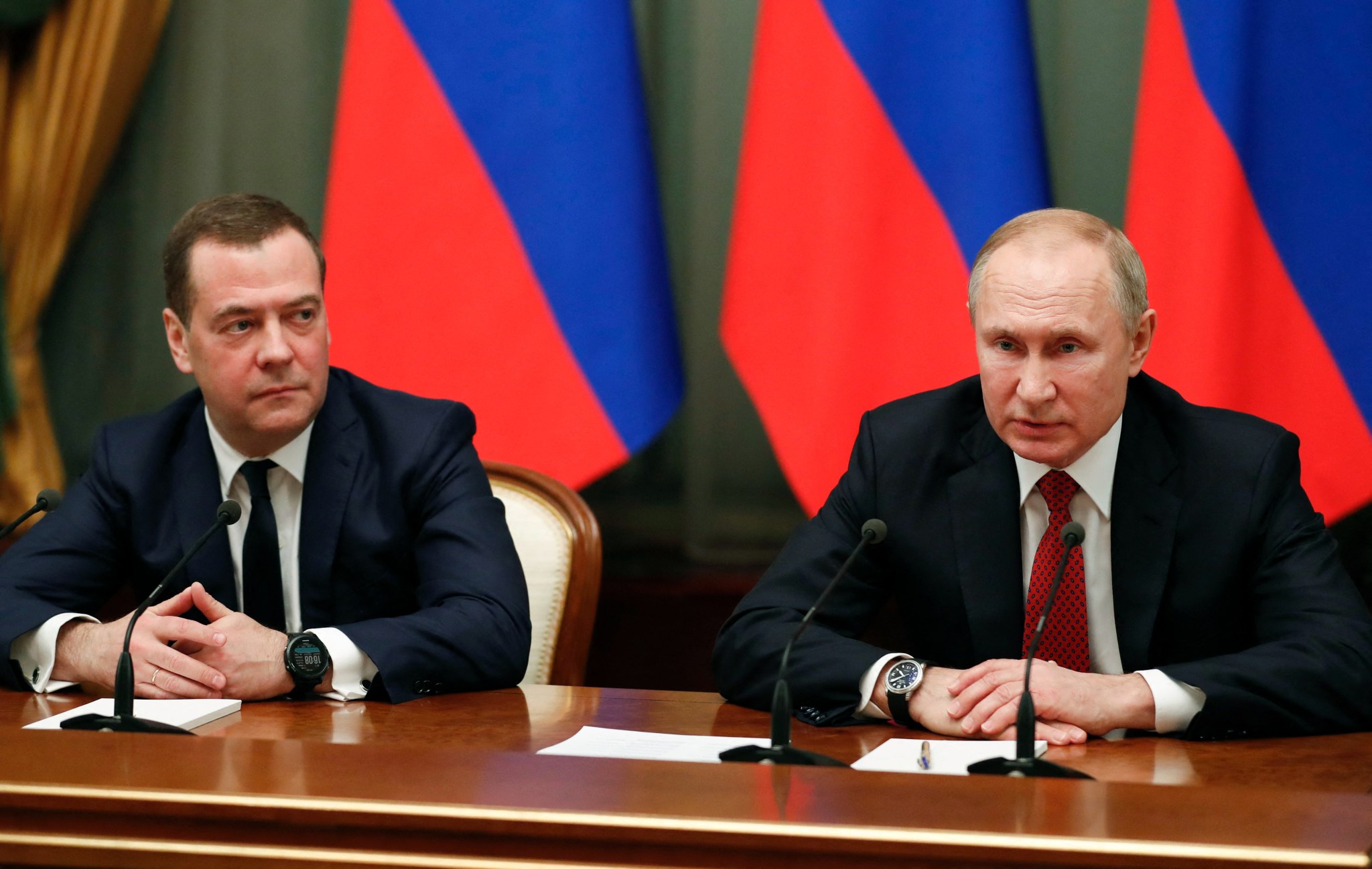
Dmitri Medvedev, a close ally of Vladimir Putin, says NATO has created circumstances in which Russia could consider launching a nuclear strike. His remarks were reported by Kremlin-run news agency Tass.
Medvedev, a former Russian president and now deputy chairman of Russia’s Security Council, also said moving nuclear weapons into Ukraine would justify a pre-emptive strike against Kyiv.
In an article published in the Moscow Journal of International Law, Medvedev wrote that Russia could use nuclear weapons if the state’s existence were threatened. He said NATO had passed that threshold, adding that it had “already created situations in which Russia considers the possibility of launching a nuclear strike.” He also said Russia would consider “analysis of all factors and the proportionality between the actual damage inflicted and the retaliatory measures.”
The comments follow Russia’s agreement last week with the U.S. and China to help reduce the risk of nuclear warfare. Trump, Putin and Xi Jinping signed a “declaration toward peace” that reaffirmed nuclear war cannot be won and should never be fought. Medvedev’s remarks also come amid months of Ukrainian attacks on Russian infrastructure during the nearly five-year full scale war launched by Putin.
Throughout 2026, Ukraine has targeted Russian oil refineries, logistics hubs and retail warehouses, causing massive damage to the Russian economy, the article says. Last week, coordinated drone and missile attacks destroyed a large portion of the Kerch Bridge, which connects Russia to occupied Crimea. At the weekend, Ukraine destroyed a $200 million Russian warship from 1,000 miles away.
Medvedev has repeatedly raised the possibility of a nuclear strike against Kyiv since Russia’s 2022 invasion of Ukraine. He is described as holding limited direct power but being one of Putin’s most influential advisers and one of Russia’s most outspoken and hawkish mouthpieces.
Nuclear threats have also come from other senior Russian figures. In 2022, after Ukrainian counteroffensives, Medvedev said Russia had the right to defend itself with nuclear weapons if pushed beyond its limits, adding that this was “certainly not a bluff.” He also said NATO would likely not intervene: “The demagogues across the ocean and in Europe are not going to die in a nuclear apocalypse,” he said.
Russian Foreign Minister Sergey Lavrov has said Moscow would not rule out nuclear weapons to defend its annexed territories in Ukraine, which the Kremlin considers formally part of Russia. Ramzan Kadyrov, head of the Chechen Republic, called on Putin to launch a nuclear strike after Ukrainian forces recaptured a strategically important town in Kharkiv. Putin’s press secretary, Dmitry Peskov, rebuked him.
In 2023, Sergey Karaganov, head of Russia’s Council for Foreign Defense and Policy, argued for breaking the ‘nuclear taboo’ and lowering the threshold for a pre-emptive strike. He said Russia should “hit a bunch of targets in a number of countries in order to bring those who have lost their mind to reason.”
In September 2024, Putin warned the West that he would consider nuclear retaliation if NATO attacked Russia with conventional weapons. He said other nuclear-armed states supporting an attack on Russia would also be considered viable targets. Two days later, Belarusian President Alexander Lukashenko, a close Putin ally, said he would use nuclear weapons if Belarus were attacked by the West.
Last year, Donald Trump and Medvedev exchanged hostile posts on social media, with Medvedev again threatening nuclear escalation. After Trump threatened tariffs on Russian oil exports, Medvedev suggested the move would bring the U.S. and Russia closer to all-out war.
Trump responded on Truth Social: “Tell Medvedev, the failed former President of Russia, who thinks he’s still President, to watch his words. He’s entering very dangerous territory!” Medvedev warned Trump not to underestimate “how dangerous the fabled ‘Dead Hand’ can be,” referring to a Russian command system designed to initiate a nuclear strike if Moscow’s leadership were wiped out in a decapitation strike. Trump then dispatched two nuclear submarines close to Russian territory.
Dmitry Muratov, a Russian journalist awarded the Nobel Peace Prize in 2021, said in 2023 that Russia’s frequent nuclear threats were an attempt by the Kremlin to normalize the idea of a nuclear strike among the public and justify a pre-emptive strike.
“We see how state propaganda is preparing people to think that nuclear war isn’t a bad thing,” he told the BBC. “On TV channels here, nuclear war and nuclear weapons are promoted as if they’re advertising pet food.”
“They announce: ‘We’ve got this missile, that missile, another kind of missile.’ They talk about targeting Britain and France; about sparking a nuclear tsunami that washes away America. Why do they say this? So that people here are ready.”
The article says Russia has often been accused of using ‘nuclear blackmail’ to project force and normalize the threat of nuclear war at home and abroad. It says the Kremlin’s warnings about pre-emptive strikes can deter attacks on Russian territory or leadership by raising fears of retaliation.
Keir Giles, associate fellow at Chatham House, says the Kremlin’s language on nuclear strikes is often deliberately vague. He cited Putin’s statements that Russia’s nuclear forces were on ‘high alert’ and had been placed on a ‘special mode of combat duty’.
“Reports that Russia’s military leadership had discussed use of nuclear weapons in Ukraine have been widely cited as being highly concerning,” Giles says. “In fact, they should cause no additional concern, and should even provide a measure of reassurance; the option has indeed been discussed and, as expected, rejected—as evidenced by the fact that nuclear weapons have not been used.”
Contact Newsweek editors on this story: Henry Holloway and Trevor Davies.