‘On autopilot’: Experts blast Congress’ lack of action for looming Social Security crisis
Andrew Biggs, a senior fellow at American Enterprise Institute, and Romina Boccia, Cato Institute’s director of budget and entitlement policy, warned that Congress’ 50 years of action have led Social Security to the cliff of insolvency.
NEWYou can now listen to Fox News articles!A panel filled with top economists, including a Nobel Peace Prize winner, warned Congress decades ago that their reforms to Social Security could spell disaster.
Now, experts tell Fox News Digital that group from a bygone era was right, as the safety-net program hurtles toward a crisis that could affect millions.
"Social Security benefits were put on autopilot back in 1977," Andrew Biggs, a senior fellow of the American Enterprise Institute, told Fox News Digital. "Since then, Congress has done as little as it possibly could."
Senate Budget Committee Chair Ron Johnson, R-Wis., unveiled a report on the decades-old program that blasted it as a "Ponzi scheme," and warned that Social Security’s slide into insolvency began in the 1970s, when, despite warnings, lawmakers opted to tie benefit growth to wages rather than inflation.
AMERICANS MISLED ON SOCIAL SECURITY FOR DECADES AS CLOCK COUNTS DOWN ON BENEFITS, EXPLOSIVE REPORT REVEALS
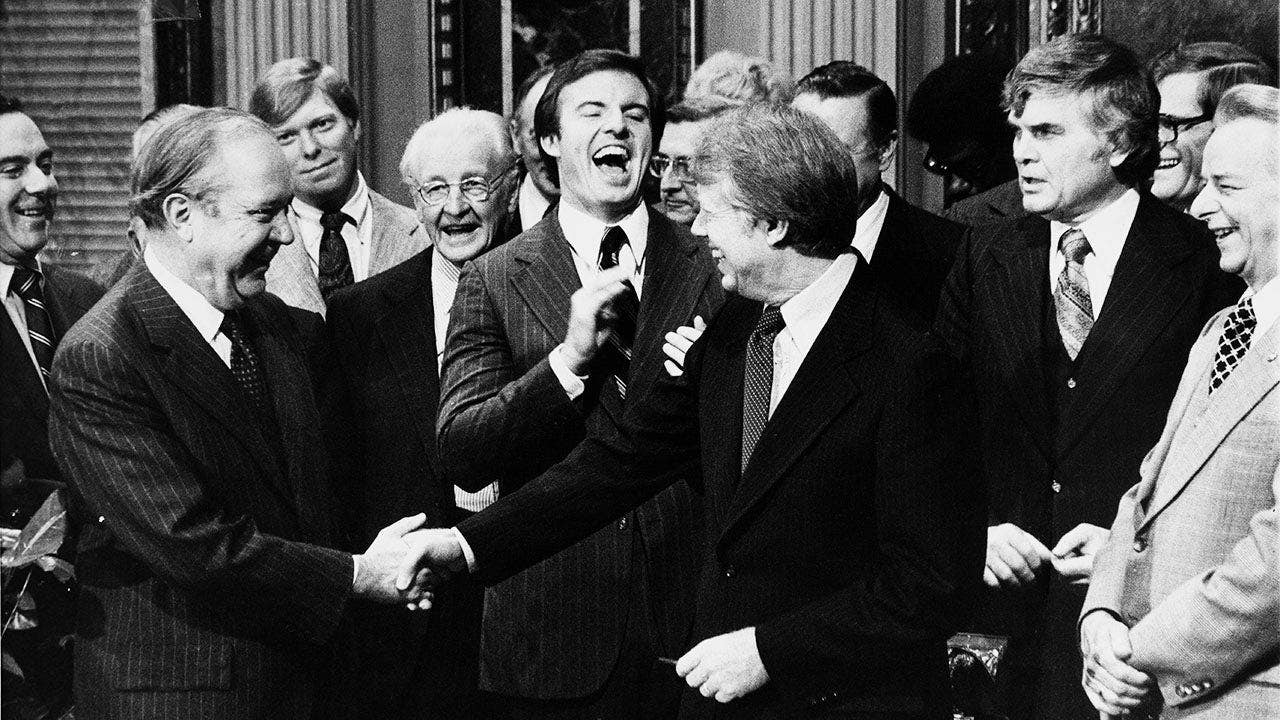
President Jimmy Carter shakes hands with Louisiana Sen. Russell Long after signing the Social Security bill at the White House in Washington on Dec. 20, 1977. (Getty Archive)
Johnson wrote in his report that at the time, an expert panel was formed that warned lawmakers that if they were to tie benefits to inflation, "Social Security would likely be sustainable today."
Still, lawmakers at the time ran with their own amendments to the program, which were signed into law by former President Jimmy Carter in December 1977.
"What they said in 1977 was if you index benefit growth to wages, you're effectively building a solvency crisis into the program," Biggs said. "You are over-promising, you're going to build in benefits that the current system can't afford to pay, and you're committing future taxpayers to pay rates of taxes that the taxpayers in 1977 weren't willing to pay."
In the decades since, Congress has done little to change the program.
SENATE REPUBLICANS BREAK THROUGH WASHINGTON GRIDLOCK WITH MASSIVE AMERICAN ENERGY, DATA CENTER OVERHAUL
VideoRomina Boccia, the Cato Institute’s director of budget and entitlement policy, told Fox News Digital that’s largely because lawmakers have not had the political will to do it.
She agreed with Johnson that Social Security was effectively a "Ponzi scheme," and said "there's this misconception that a lot of Americans think that Social Security is a retirement savings program."
"But for that, you would actually need to have savings occur in the system, and there would need to be assets that would be invested in earning returns," Boccia said. "That's not the case. We're talking about a pay-as-you-go program."
One of the side effects of Congress’ lack of action to rein in the program is that the wage growth formula relies on workers in the economy contributing with their paychecks.
Boccia noted that as the decades have gone on, "We've seen a severe decline in the number of workers compared to the number of retirees collecting benefits as a result of a decline in fertility."
DEMOCRATS COULD ENTER CONGRESSIONAL MAJORITY IN A GOVERNMENT SHUTDOWN
Sen. Ron Johnson, R-Wis., makes his way to votes in the U.S. Capitol on Sept. 30, 2026. (CQ-Roll Call, Inc. via Getty Images)
Congress’ last real successful effort to reform Social Security came in the early 1980s, Biggs noted, when lawmakers were forced to step in to deal with the "funding crisis" hitting the program.
"They raised taxes. They increased the retirement age. So they did this with months to spare to fix Social Security," Biggs said. "It's not something they wanted to do, but they were forced to do."
"Now in 2032, we're going to face the same situation, where Congress will be forced to take action sometime before the trust fund runs out in 2032, not because they want to, but because they're forced to do it," he continued.
If Social Security’s trust fund runs dry by 2032, Americans’ benefits would be slashed and the onus of paying for the shortfall would add trillions more to the nation’s debt.
But Johnson, in his report, declared that the Social Security problem could not be fixed between now and then because of Congress’ inaction for the last several decades, and he suggested that the solution would be to repeal a possible benefits reduction as the program’s trust fund heads toward insolvency in just under seven years.
Biggs, who was part of former President George W. Bush’s effort to reform Social Security over two decades ago, said that had Congress taken action "25 years ago, you could fix Social Security in barely noticeable ways."
"There is no easy fix to Social Security today, and that stems entirely from the fact that every year, when Congress has had the opportunity to fix Social Security, they chose to duck the issue for political reasons and kick the can down the road," Biggs said.
CLICK HERE TO DOWNLOAD THE FOX NEWS APP
Boccia disagreed with Johnson’s solution and contended that the real answer was one that lawmakers of yesterday and today would be hesitant to approach — raising taxes.
"The real way to think about this is that there's almost no way to imagine Congress would let those benefit cuts take effect," Boccia said. "It will be so politically toxic. So most likely they're going to try to find a different solution."
"The last time the trust fund was running out of money in 1982, Congress put together a commission and then voted on a bill that increased taxes and reduced benefits, including raising the social security retirement age," she continued. "The problem is that the funding gap now is much larger, more than two times bigger than it was in the ‘80s."
Alex Miller is a writer for Fox News Digital covering the U.S. Senate.