Millions of bogong moths are blanketing our cities and they are still endangered
By Kate Umbers, Associate Professor, Zoology, Western Sydney University ·
This article was originally published by The Conversation. Author: Kate Umbers, Associate Professor, Zoology, Western Sydney University.
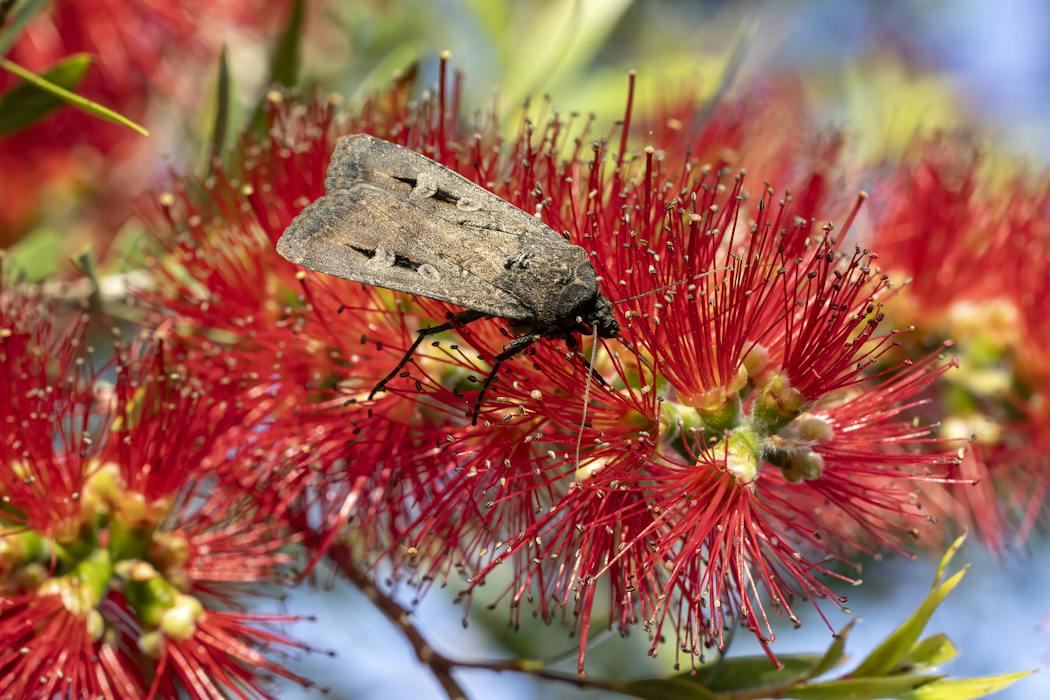
In recent weeks, people across Australia have found fluttering bogong moths (Agrotis infusa) in their homes, cars and even bedrooms. These insects have embarked on their annual migration from breeding grounds across southern Australia to the cool caves of the Australian alps.
For entomologists, or insect scientists, like myself who have studied these moths for years, it’s been a hopeful sight. But it hasn’t changed the fact bogong moths remain endangered on the International Union for Conservation of Nature’s Red List of Species. Bogong moths are at risk of extinction due to climate change heating up their mountain boulderfields.
Why so many moths?
Scientists are keen to understand why bogong moth numbers have surged in cities this year.
More food, favourable breeding conditions and strong winds carrying moths towards the coast could all have contributed. It’s unclear whether the bogong population is rebuilding after years of decline or if we are just seeing them more in cities this year.
In many places, scientists can model and predict bird migrations. But we can’t do that for bogong moths until we learn more about their biology and movement patterns. Dedicated citizen scientists are helping fill these knowledge gaps.
When researchers like myself discover something new, we usually publish a scientific paper about it and then spend years trying to tell everyone what we’ve learnt. But this spring, it’s felt like we’ve gained millions of colleagues, with Australians recording hundreds of bogong moth sightings in a matter of months. These observations provide crucial information, such as how much bogong moths seem to prefer Callistemons (bottlebrushes) and Grevilleas (spider flowers), something unknown a month or so ago.
In 2000, when a vast cloud of moths famously engulfed the stadium where the Sydney Olympics closing ceremony was unfolding, we didn’t have many online platforms to document insect sightings. Today, this is as easy as taking a photo and sharing it on biodiversity platforms like iNaturalist and social media.
An endangered species
Because bogong moths can be almost everywhere, the species may appear to be thriving. But it’s not that simple. A species’ extinction risk depends on access to high-quality habitat, which in this case is cool mountains.
On the Red List, which classifies species’ risk of extinction, a species only needs to meet one of five criteria to be considered endangered.
These include Criteria A and C, which refer to whether a species has a small and declining population, with few individuals left. This is simple to answer for animals that can be easily counted, such as rhinos or quolls, but not insects like bogong moths.
Criterion B, the criterion under which bogong moths are listed as endangered, is concerned with the amount and quality of habitat available to a species. Current research suggests bogong moths migrate because they don’t cope well with heat, seeking refuge in cool alpine caves. But the Australian Alps are rapidly warming due to climate change. Without this vital habitat, bogong moths may be less able to escape the summer heat and might not continue to complete their migration.
Where to from here
There’s so much left to learn about bogong moths, including how far they actually travel.
Bogongs are found as far west as Perth and as far north as southern Queensland. While visiting Uluṟu recently, my family and I spotted a bogong moth at our hotel, more than 2,000 kilometres from the alps. Where they fly from and to, and the routes they take to get there, are all still open questions.
Researchers are currently exploring whether weather radar could help us understand and track the travel patterns of bogong moths. People can also get involved in the Bogong Watch tagging program.
It’s been 26 years since bogong moths last blanketed Sydney and Canberra. That means many young and new Australians may have never experienced their mammoth migration. It’s my hope that after this year’s experience, the next generation will not only marvel at these migrating moths, but join us in protecting them.
Read more: From bogong moths to Christmas beetles – how to slow down and spot more insects

Kate Umbers works for Invertebrates Australia and the Biodiversity Council. She receives funding from the Australian Research Council.
Originally published by The Conversation Global