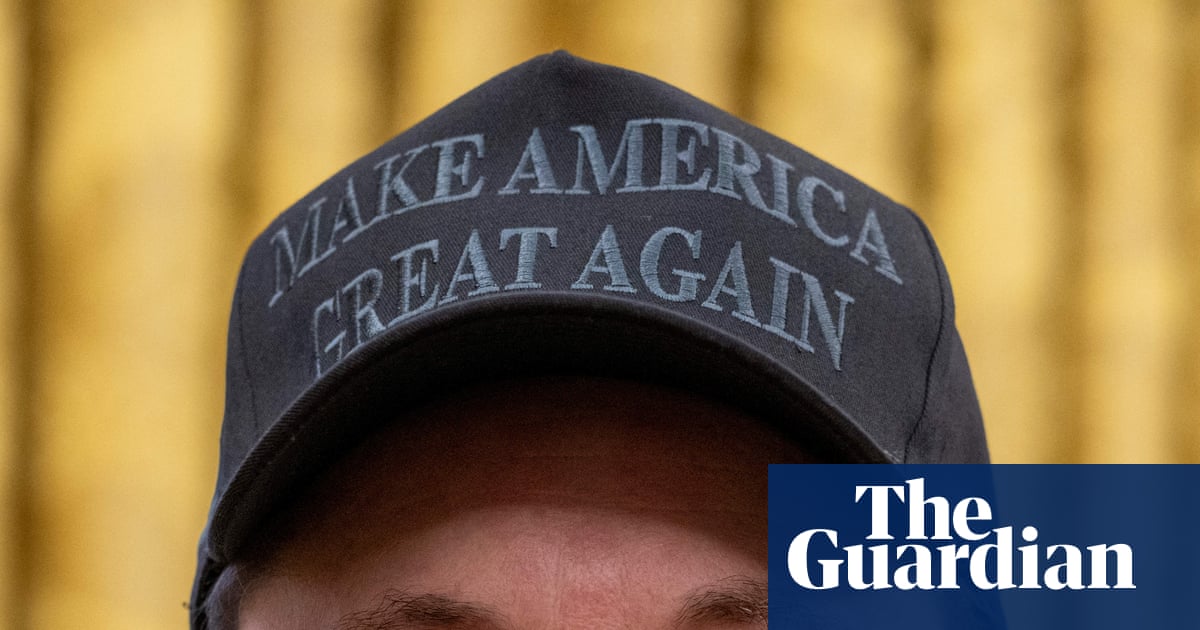
After Democrats’ decisive triumph in the US midterm elections, several Silicon Valley leaders have softened their public political positions, including Elon Musk and Palantir chief executive Alex Karp.
Two years ago, Musk told a New York City audience: “I’m not just Maga. I’m dark, gothic Maga.” On Wednesday, he said: “I’m not Maga,” adding: “Well, at least I’m not sure what Maga means.” At the New York Times’ DealBook conference, Musk said he felt “foolish” about spending some $500m to elect Republicans in the midterms. “If I could rewind the clock, I would have spent less money,” he said, adding that he did not have “some sort of blind adherence to a set of policies by the Republican party”.
Silicon Valley’s tycoons moved sharply to the right during Donald Trump’s second term, donating millions to his inauguration and later to the White House ballroom project. Musk spent more than $200m through his political action committee, America Pac, to help elect Trump in 2024. When Trump took office in January 2025, some technology executives who had banned him from their platforms in 2021 were among those flanking him. Musk was installed as head of the temporary federal initiative known as the “department of government efficiency”.
Karp began to soften his public position on immigration in an interview with Politico a week before Musk’s remarks. The Palantir chief executive said Trump had mishandled immigration enforcement.
“I was really happy to hear the president be honest that – you know, his words, I believe, were something like: ‘Yeah, we kinda went too far,’” Karp told Politico. “And I’m glad he’s saying in public now what I’ve been saying in private.”
Karp, who once described Palantir as “anti-woke”, also presented the company and himself as progressive. “I’ve been a Democrat my whole life. I grew up in a far-left environment. I know more about being a progressive than almost anybody on the planet, and I absolutely believe Palantir – all of our products are essentially progressive,” he said.
Those remarks contrast with Palantir’s work for US Immigration and Customs Enforcement (ICE). Lesley Nash, a staff attorney at immigration defense organization Just Futures Law, described the company as the “corporate and data analytics backbone of ICE”.
“Look, we power ICE,” Karp said on an earnings call in November 2025. “We power efforts to defend America and Ukraine. And with allies. We’re on the frontline of all adversaries, including vis-a-vis China. And we support ICE, and we’ve supported Israel. I don’t know why this is all controversial, but many people find that controversial.” He added: “Our ability to win while sticking by what we believe is important for the world.”
Meta chief executive Mark Zuckerberg has also reportedly shown signs of shifting left after the midterms. According to Axios, following the departure of Joel Kaplan, Meta’s president of global affairs and a former adviser to George Bush, the company recruited and promoted a more bipartisan slate of executives. Kaplan had been at Meta for 15 years and was promoted at the start of the Trump administration; he was known for his ties to the Republican party.
The article describes Silicon Valley executives as having repeatedly adjusted their public positions as American politics changed. Musk, a self-described moderate, previously donated to the Democratic national committee and Barack Obama’s 2012 re-election campaign. In 2018, he celebrated Tesla receiving a perfect score on an LGBTQ+ workplace equality index for the fourth year in a row.
“Don’t buy our car if that’s a problem. People should be free to live their lives where their heart takes them ❤️🧡💛💚💙💜🖤💖🌈,” Musk wrote. After moving from California to Texas and donating hundreds of millions of dollars to Republican candidates, he later attacked Texas’s Democratic Senate candidate, tweeting that James Talarico “will trans your kids”.
Following the midterms, Musk spoke positively about Texas’s Democratic governor-elect, Gina Hinojosa. Asked about her on Wednesday, he said: “I don’t think she’s sort of a far-left governor, and based on everything I’ve heard about her, I think everything will be fine in Texas with Gina [Hinojosa] as governor.” He called her “quite moderate” and described his own politics the same way.
Kaplan had helped Zuckerberg build ties with the Trump administration over the previous two years, as Meta moved away from its former left-leaning image. He replaced Nick Clegg, a former UK deputy prime minister who had taken a more global approach. Facebook had championed diversity and set a goal of ensuring half its workforce came from underrepresented backgrounds; Zuckerberg and other leaders also started a group to help immigrants. Meta temporarily banned Trump’s Facebook account after the January 6 insurrection.
Palantir has a long history of working with the US Department of Homeland Security. It first won a contract with ICE’s investigative arm in 2011, under Barack Obama. During the first Trump administration, the company developed software for ICE that helped the agency investigate and arrest people using a searchable network of government and private databases.
In September 2020, as the first Trump administration neared its end, Palantir called Trump’s zero-tolerance immigration policy, which led to family separations, “abhorrent” and said it violated “basic human decency and human rights standards”. Five years later, under Trump’s second administration, the company received a $30m contract to develop Immigration OS, a software platform for the Department of Homeland Security intended to “streamline” the identification and deportation of immigrants. Nash said Palantir’s products were “integral to ICE’s draconian immigration enforcement and deportation abuses”.
Juan Sebastián Pinto, a former Palantir content strategist who worked on marketing the company to government and commercial customers, now criticizes its defense and immigration enforcement work. He said Karp and the company had historically used public statements to appeal to whoever controlled government contracts. Pinto said Palantir would have to work overtime to obscure its involvement with the second Trump administration, and that its tools had been used by ICE and in the Iran war, and “really challenged our democracy, our fourth amendment, our perception of safety”.
“Palantir’s priority right now is to shape the narrative as much as it can to avoid responsibility because it’s going to be facing a lot of questions from the incoming Democratic administration,” Pinto said.
Palantir presents its technology as politically neutral, saying its tools serve the purposes of the organizations that use them. In 2020, as the company criticized Trump’s family separation policy, its then director of privacy and civil liberties, Courtney Bowman, said Palantir accepted the “moral implications” of working with ICE, but that its technology was politically agnostic and “serves the core institutional missions of our partners, not any political or ideological agenda or individual elected official”.
Nash said Karp’s stated concerns about Trump’s immigration enforcement tactics were unconvincing. “Palantir’s CEO may now express that he had doubts about the very immigration system his company enabled, but private expressions of concern will not mitigate or alleviate the harm that this system has and continues to cause,” she said. “Companies like Palantir must take a hard look at corporate accountability and complicity with the worst abuses of the Trump administration.”