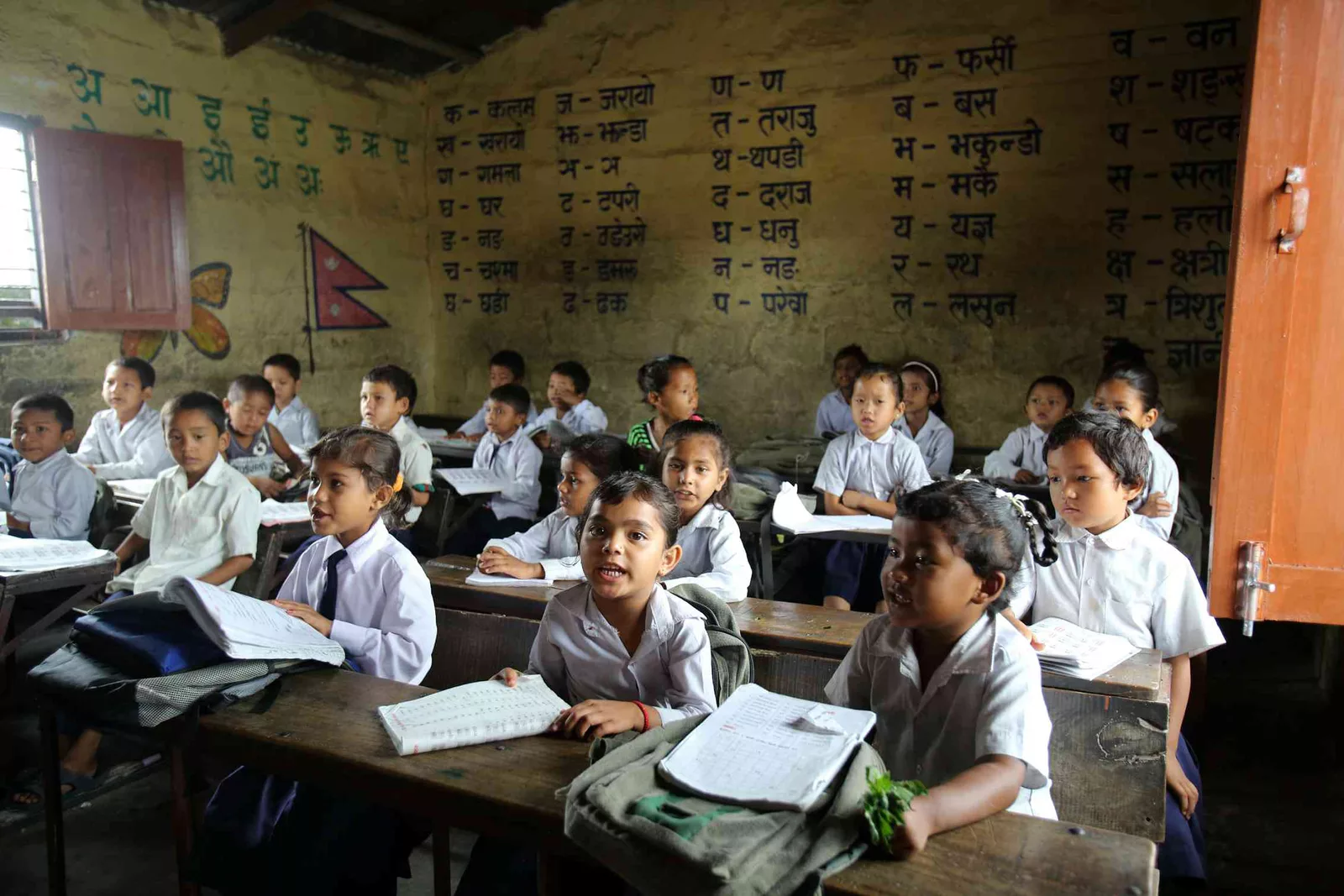
In a Grade 2 classroom in Rautahat, in Nepal’s southern plains, teacher Renuka Dahal shows students a picture of a mango. She says its name in Nepali, then asks what they call it at home. The children answer in Tharu and Maithili, languages many speak with their families.
“I ask my students to teach me words in their language,” Dahal told UNICEF in 2025. “It makes them feel that I care about who they are.”
For generations, many children in Nepal began school in a language they did not understand. Research shows that starting in a familiar language can strengthen learning and help children acquire additional languages, including Nepali and English. Nepal’s 2015 Constitution guarantees communities the right to education in their mother tongue, but putting that right into practice has been slow and uneven.
Nepal’s experience may interest Canadians working on Indigenous language revitalization and teachers welcoming newcomer students. It shows the challenges of moving language rights from policy into classrooms.
The 2021 census recorded 124 mother tongues in Nepal. In 1971, when the Panchayat regime promoted Nepali above all other languages, the census counted just 17. Today, just under 45 per cent of the population speaks Nepali as a first language.
In 2021, the census asked people for the first time about both their ancestral language and their mother tongue. Nearly three million more people named Nepali as their mother tongue than as their ancestral language, indicating that many families have shifted to Nepali. The reverse was true for Nepal Bhasa, the language of the Newar community: about 300,000 more people named it as their ancestral language than as their mother tongue.
Nepali is also increasingly spoken as a second language. The share of the population doing so rose to 46 per cent, from 33 per cent in 2011. Nepali is not a language at risk.
Mark Turin, who has worked in Nepal since 1991 as a volunteer schoolteacher and later as a linguist and anthropologist, says the census figures reflect changes he has witnessed in communities.
The government’s School Education Sector Plan 2022-32 commits to expanding early-grade teaching in children’s mother tongues. But, as comparative education scholar Uma Pradhan has shown, policy has long treated those languages as a bridge to Nepali—a stepping stone to be left behind—with little state support.
A 2026 study in Tanahun recorded a grandparent’s account of a granddaughter in Grade 2 taught only in Nepali and English: “She [does not have the] opportunity to study in [her ancestral] language; so, there is a gap.”
A 2024 study commissioned by UNICEF Nepal examined language use in 30 schools across all seven provinces. It found that children learning in their mother tongue or another familiar language took a more active part in lessons and performed better in assessments and exams.
Many schools have switched to English-language teaching, often for financial reasons and with little teacher training. The study’s analysis of school assessment results, which was limited in scale, found that students taught in Nepali outscored their English-taught peers in Nepali, science and even English.
In Dailekh, in western Nepal, principal Sher Bahadur Rana told UNICEF that teachers once corrected children for using their own “language or dialect.” After training in multilingual teaching, he said, “we learned that children learn faster and feel more confident when we teach them in the language they speak and understand best.”
A review by education researchers Pariksha Onta and Amado Padilla, covering 111 studies and policy documents, describes a “persistent disconnect between constitutional commitments, classroom practice and targeted funding.”
Where mother tongues are taught, they are usually offered as a subject rather than used as the language of instruction. Textbooks in those languages are scarce; most that exist are translations of Nepali materials with little locally relevant content. Too few teachers who speak local languages are recruited or trained.
Many parents see English-language schools as a marker of quality and employability. Funding is also limited: in 2026–27, education and sports together received around 10.3 per cent of Nepal’s national budget, well below the international benchmark of allocating at least 15 per cent to education.
Onta and Padilla’s review also identifies approaches that work. In some Kathmandu Valley schools, children learn in Nepal Bhasa for their first three grades before Nepali and English are phased in. A strong mother-tongue foundation supports learning in other languages, so families do not have to choose between them.
As Turin previously argued with colleagues Lava Deo Awasthi and Yogendra Prasad Yadava, rights “do not implement themselves.” Children should start school in the language they understand best, with Nepali and English introduced gradually. That requires sustained funding, teachers trained to teach in children’s languages, and materials reflecting their lives and communities.
Some municipalities have introduced local-language education programs, and Nepal’s Curriculum Development Centre has developed elementary curricula in more than 20 mother tongues.
Language policy can sound technical, but it shapes whether a child’s first experience of school is welcoming. In Dahal’s classroom in Rautahat, where children teach their teacher, the message is that their languages belong in school, and so do they.
Mark Turin receives funding from the Social Sciences and Humanities Research Council (SSHRC).
Source: The Conversation — Mark Turin, Associate professor, Institute for Critical Indigenous Studies, University of British Columbia.