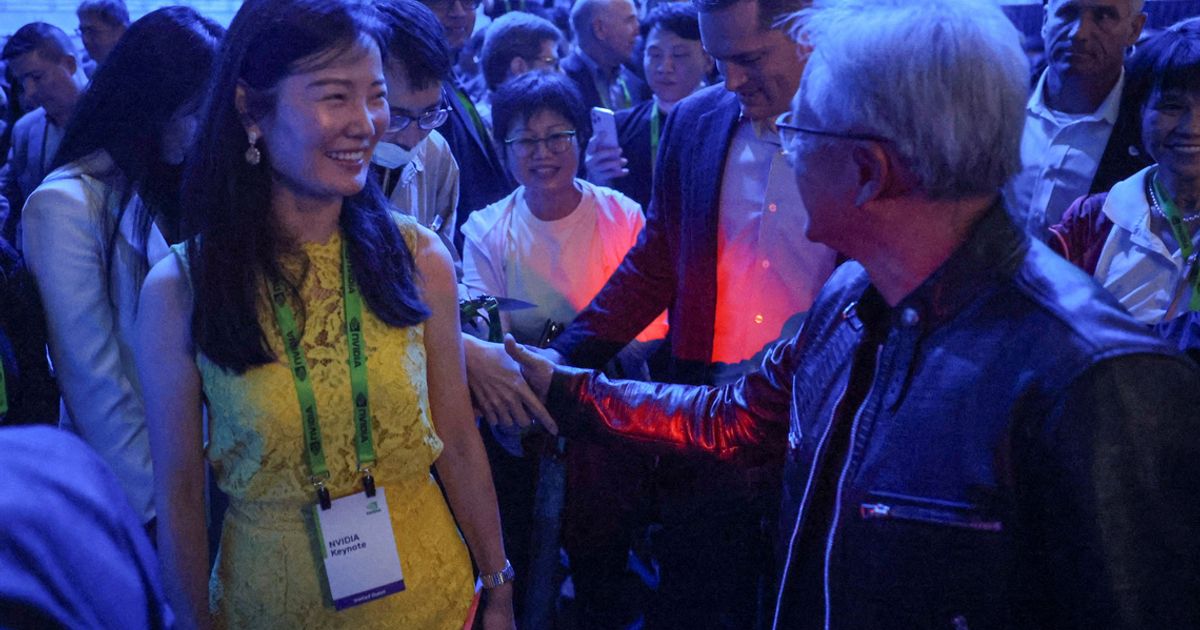
The scandal involving former Nvidia chief executive Jensen Huang and allegations that Chinese businesswoman Alice Huang may have been a spy has revived harmful stereotypes about Asian American women, who say they fear worse treatment at work.
The revelation in early November that Jensen Huang had extramarital affairs sent shock waves through the tech world. But Asian American women say the discussion of Alice Huang, who is not related to Jensen Huang, has also revived stereotypes portraying Asian women as foreign, untrustworthy and unfit for leadership.
The US Justice Department has not found sufficient evidence that Alice Huang was a spy. “I don’t know if that’s been determined yet,” US President Donald Trump told reporters this week.
Videos and memes invoking stereotypes about Asian women spread on social media. “So few Asian women in general make it to the news for positive things. This is just going to continue to perpetuate negative stereotypes or biases for Asian women,” said Misa Chien, founder of The Authentic Asian, a network for Asian American women leaders.
Chien said that regardless of whether the allegation is true, “just the news will definitely influence people’s opinions of women who have broken the ceiling or are trying to.” Asian American women in technology, civil rights advocacy and academia say they worry the episode will affect how colleagues see and treat them.
Author May-lee Chai called a social media collage of CEOs with Asian female partners “disgusting”. Portraying the women as trophy wives “implicates these spouses like they’re somehow similar to this suspected spy,” said Chai, a creative writing professor at San Francisco State University.
April Moh, a financial technology company’s chief marketing officer and a board member of Stand with Asian Americans, said she was shocked by how quickly the Asian female spy narrative spread. She said women had shared accounts of uncomfortable interactions at work.
“I have women in technology who tell me that they get really weird looks and they get questioned about laptop security by their colleagues when they’re visiting China,” Moh said. “I have another person telling me that she has been jokingly asked, ‘So, are you a spy?’ by people who think that’s a joke now. It’s not funny to her or me.”
Rachel Lee, president and general counsel of Stand with Asian Americans, said many of the organisation’s clients are Asian women whose competence is questioned and who are accused of fraud or deceit. “It is deeply disturbing to see this not just unique to the Nvidia Jensen Huang case, but as a part of a long-standing dangerous narrative that Asians are perpetual foreigners, untrustworthy, disloyal,” Lee said.
Asian workers also face misconceptions that they cannot lead. The Asian American Foundation’s annual Social Tracking of Asian Americans in the United States Index found at least half of US adults described Asian Americans in the workplace as “respectful” or “reliable”, while only 1 in 10 viewed them as “assertive”.
“The No. 1 theme in onboarding interviews all last week were ‘I’m mistaken for the secretary, I don’t look like the typical face of leadership,’” Chien said, referring to new members of her Asian leaders network.
Chai said suspicion toward Asian women has deep historical roots. In 1875, Congress passed the Page Act to control immigration from “any Oriental country”, including a specific prohibition on women coming for prostitution. The Chinese Exclusion Act followed in 1882.
“Chinese women were deemed – and East Asian women in general – as being untrustworthy,” Chai said. “It was presumed that they would be coming for illicit means as prostitutes to the United States and that would cause harm to white men.” She said the Asian woman as a seductress, spy or “dragon lady” became a Hollywood archetype by the early 20th century.
Chien recalled playing a spy in a building security advertisement in Hong Kong 20 years ago. She said she was instructed to wear three bras to resemble Angelina Jolie’s figure. In an Instagram post, she highlighted “how the media enjoys putting Asian women in that kind of role” and urged women not to let assumptions stop them from succeeding.
The article also cited wider effects of suspicion toward Chinese people in the US, including proposals or enactments by over two dozen states in recent years of “alien land laws” restricting Chinese nationals from buying property, and a decline in international student enrolment at American universities. The first Trump administration’s “China Initiative” targeted espionage by profiling Chinese professors.
Critics say the initiative contributed to the 2024 suicide of Jane Ying Wu, a 60-year-old neuroscientist at Northwestern University who had lived in the US for 40 years. Wu came under federal investigation in 2019 and was never charged with anything.
“This type of pernicious stereotype can actually destroy lives,” Chai said. “It’s not in any way an accurate portrait of an entire race and ethnicity.” Lee said jokes based on stereotypes do not help Asian women workers: “Whether it’s a compliment or not, a trope is a trope,” she said. “I don’t care if it comes out of the mouth of the US president.”
Lee said companies should provide education and training on the history and harm of stereotypes. She encouraged women who experience uncomfortable interactions to contact advocacy groups such as Stand with Asian Americans. The organisation offers assistance, including education on rights and mental health support, without requiring a legal discrimination or harassment case. Lee said individuals can also set boundaries and tell others what is not acceptable to say.
Lee said it is in employers’ best interest to ensure federal laws against discrimination and harassment are not violated. “It’s a win-win to have that conversation,” she said.